|
 |
NASA'S Phonesat Wins 2012 Popular Science Best of What's New Award |
This story was retrieved from the NASA website. Neither
NASA nor any other entity represented in the article endorses this website.
Nov. 14, 2012
RELEASE : 12-396
NASA'S Phonesat Wins 2012 Popular Science Best of What's New Award
WASHINGTON
-- NASA's PhoneSat project has won Popular Science's 2012 Best of What's New
Award for innovation in aerospace. PhoneSat will demonstrate the ability to
launch one of the lowest-cost, easiest-to-build satellites ever flown in space
-- capabilities enabled by using off-the-shelf consumer smartphones.
Each year, Popular Science reviews thousands of new products and innovations,
and chooses the top 100 winners across 12 categories for its annual Best of
What's New issue. To win, a product or technology must represent a significant
step forward in its category. All of the winners will be featured in the December
special issue of the magazine.
"NASA's PhoneSat mission will demonstrate
use of small satellites for space commerce, educational activities and citizen-exploration
are well within the reach of ordinary Americans because of lower cost, commercially
available components," said Michael Gazarik, director of NASA's Space Technology
Program at NASA Headquarters in Washington. "Thanks to America's continuing
investment in space technology to enable NASA missions, we've seen space tech
brought down and into our lives here on Earth. With PhoneSat, we're doubling
up, and taking those same great technologies back to space."
NASA's
PhoneSat 1.0 satellite has a basic mission goal -- to function in space for
a short period of time, sending back digital imagery of Earth and space via
its camera, while also sending back information about the satellite's health.
NASA engineers kept the total cost of the components to build each
of the three prototype satellites in the PhoneSat project to $3,500 by using
only commercial-off-the-shelf hardware and establishing minimum design and
mission objectives for the first flight.
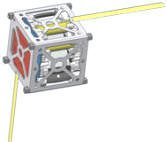
Each NASA PhoneSat 'nanosatellite'
is a 4-inch cube and weighs three pounds. NASA's PhoneSat design makes extensive
use of an unmodified, consumer-grade smartphone. Out-of-the-box smartphones
offer capabilities needed for satellites, including fast processors, versatile
operating systems, multiple miniature sensors, high-resolution cameras, GPS
receivers, and several radios.
"NASA PhoneSat engineers are changing
the way missions are designed by rapidly prototyping and incorporating existing
commercial technologies and hardware," said S. Pete Worden, director of NASA's
Ames Research Center at Moffett Field, Calif., where a small team of engineers
developed and built PhoneSat. "This approach allows engineers to see what
capabilities commercial technologies can provide, rather than trying to custom-design
technology solutions to meet set requirements."
NASA's prototype smartphone
satellite, known as PhoneSat 1.0, is built around the Nexus One smartphone
made by HTC Corp., which runs Google's Android operating system. The Nexus
One acts as the spacecraft's onboard computer. Commercial-off-the-shelf parts
include an open-source, micro controller adapted as a watchdog circuit that
monitors the systems and reboots the phone if it stops sending radio signals.
NASA's PhoneSat 2.0 will lay the foundation for new capabilities for
small-sized satellites, while advancing breakthrough technologies and decreasing
costs of future small spacecraft. PhoneSat 2.0 will be equipped with an updated
Nexus S smartphone made by Samsung Electronics which runs Google's Android
operating system to provide a faster core processor, avionics and gyroscopes.
PhoneSat 2.0 will supplement the capabilities of PhoneSat 1.0 by adding
solar panels to enable longer-duration missions and a GPS receiver. In addition,
PhoneSat 2.0 also will add magnetorquer coils -- electro-magnets that interact
with Earth's magnetic field -- as well as reaction wheels to actively control
the satellite's orientation in space.
A beta version of PhoneSat 2.0
will accompany two PhoneSat 1.0 spacecraft aboard the maiden flight of Orbital
Sciences Corporation's Antares rocket from NASA's Wallops Flight Facility
at Wallops Island, Va., in the coming months.
The PhoneSat project
is a technology demonstration mission funded by NASA's Small Spacecraft Technology
Program, which is managed by NASA's Space Technology Program. NASA's Space
Technology Program is innovating, developing, testing, and flying technology
for use in NASA's future missions and by the greater aerospace community.
For more information about PhoneSat, visit:
https://go.nasa.gov/ZoNxpg
Posted 11/19/2012
|
|
|
|
|