|
|||||||||||||
 |
|||||||||||||
Transistor Growth
|
|||||||||||||
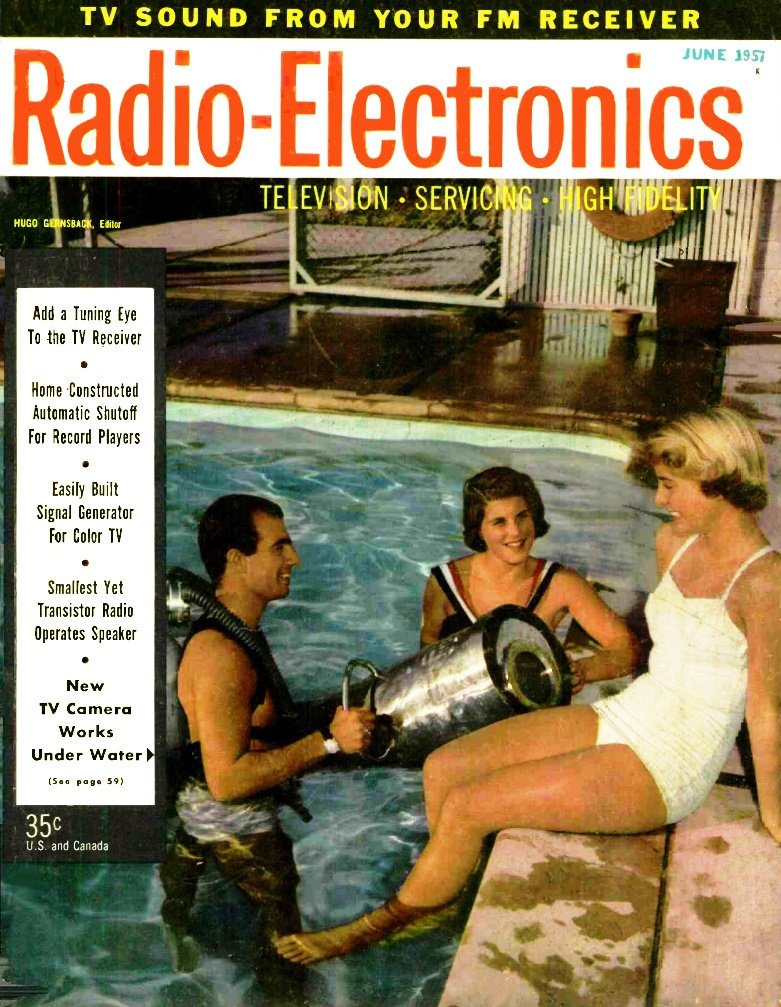
As Radio-Electronics magazine publisher Hugo Gernsback stated in his "Transistor Growth" article (perhaps an intentional innuendo to the process of "growing" silicon crystals), the transistor had been invented by Bell Laboratories' Drs. Bardeen, Brattain, and Shockley less than a decade prior to his 1957 writing. Being the visionary that he is, Mr. Gernsback foresaw many of the implications of wonderful new products that would be enabled by semiconductors. Not only would transistors and semiconductor diodes totally replace all current uses where vacuum tubes were employed, but untold new applications would ensue as well. Relatively high cost of production (due partly to rejects), low power, low frequency, and lack of ruggedness were barriers that would soon be overcome. One of the biggest barriers to adoption of transistors was hesitancy on the part of designers to integrate them into new products; the public had not yet been convinced of their superiority over familiar tubes. By the end of the next decade (1960s), semiconductors had made an unstoppable advance into electronic products for defense, aerospace, commercial, and domestic use. The rest, as they say, is history. Transistor Growth - What Is the Future of the Transistor?
The transistor, less than 10 years old, has now emerged from its swaddling clothes. Marvelous instrument that it is, much work still remains to be done in research laboratories before it will be near perfection and can be fully mass produced. Many transistor manufacturing problems are still in flux. They are chiefly chemical, metallurgical and mechanical - and, more important, they hinge on process control. Yet constant progress is being made in every direction of transistor manufacture and it appears that within a few years the main difficulties that now delay mass production and full automation will have been overcome.
While a number of transistor pocket radios are now manufactured, these are still expensive and may be termed a quasi-luxury article. As for transistor television sets. about which readers frequently ask, there certainly is no need for them now. Transistors are chiefly in demand where space saving and weight are big factors - as in hearing aids, pocket radios, etc. But for the present, space saving in TV sets is pointless because of the comparatively huge size of our picture tubes. Once flat picture-on-the-wall television is a commercial reality, then transistors in TV sets will be a must, but probably not before. Generally speaking, transistors are following a cycle parallel to our early tube trend. Old -timers well remember such first tubes as the VT1, VT2, 201, WD11, WD12, 201A, 199 and others. These tubes - produced some before and most during the early Twenties - were in vogue about 10 years before they were replaced with more efficient models. The early tubes, too, were not fully mass-produced immediately, not for lack of machinery but for lack of multimillion-unit demand, and chiefly for lack of know-how. In other words, humans had to be trained in the complexities of vacuum-tube manufacture - always a most difficult and usually slow process. So with transistors which, due to their minuteness. are in a way more difficult to construct than vacuum tubes. Their manufacture may be compared to that of ladies' precision, dime-size watches. The micro-fine parts today are usually assembled by women, mainly because they are more nimble-fingered and more adaptable for this tedious type of work. We recently had an interesting talk with Dr. Alan Glover, general manager of the RCA transistor plant. We learned, among other things, that at present there is no longer a bottleneck in transistor production. The industry, he feels, can keep in step with any transistor demand. Mechanization and automation, as far as transistor manufacture is concerned, are no longer serious problems. The chief problem is teaching and breaking in new operatives, the learning cycle - process control, as it is called. While the industry as a whole does not give out figures on rejects (defective units), we were told that the percentage today is becoming more and more moderate. This is particularly true of those types which have been manufactured for a few years. As for high-frequency transistors, every year sees at least a several-fold increase in maximum frequency. Here it is where invention and research are most intense. It was thus in high- frequency vacuum tubes, too. The RCA drift transistor and the Philco surface-barrier transistor are high-frequency types that prove the point in the evolution toward ever-higher maximums. To understand better the present trends in transistor manufacture, a few statistics regarding their sales may be of interest. Sales of transistors in the United States during 1956 were around 13 million. Spoke-men for the industry cite the following forecasts: 1957 - 26 million, 1958 - 59 million, 1959 - 125 million. How does this compare with vacuum -tube sales? In 1956, the industry sold over 464 million tubes. This brings up once more the inevitable question so often asked and answered by us on this page a number of times. We for one do not believe for a moment that the transistor will ever supplant the vacuum tube, any more than television will ever supplant radio. Both the vacuum tube and the transistor are here to stay. Both have their own uses and their own fields in which they are indispensable. This is true despite the fact that the future day may arrive when some types of transistors will sell for 10 cents apiece. What about the more distant future? What comes after the present-day transistor? To us it appears that it will be a radioactive transistor, i.e., an atomic transistor. The reason? A radioactive type of transistor will supply its own electric energy and needs no outside current supply or battery. Atomic batteries are already on the market -the atomic transistor consequently is a logical combination which is bound to follow. |
|||||||||||||
 |
|||||||||||||
|
|||||||||||||
 By Hugo Gernsback

|
||||||||||||||||||||||||||||||||||||