|
|||||||||||||
 |
|||||||||||||
Millimeter Waves
|
|||||||||||||
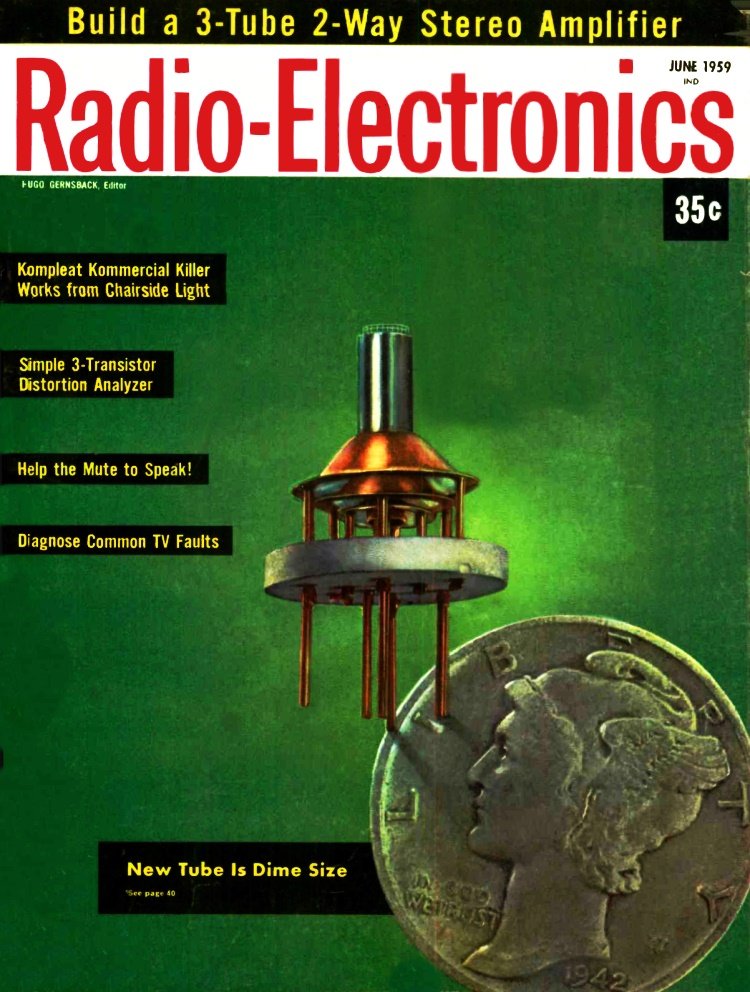
In his 1959 Radio-Electronics magazine editorial, noted futurist Hugo Gernsback identified millimeter waves (30,000-100,000 megacycles) as an undeveloped frontier with immense potential. He accurately stated the technical hurdles: inefficient generation, atmospheric absorption by oxygen and water vapor, and the need for waveguides and horn antennas instead of conventional cables. Gernsback predicted these waves would solve spectrum congestion by enabling hundreds of thousands of telephone and television channels on a single line. He foresaw space applications, suggesting millimeter-wave transmitters could communicate across interstellar distances and provide radar for meteorite detection. Modern technology validates his vision. Millimeter waves now enable 5G networks, high-capacity satellite links, and automotive radar. While solid-state devices he hoped for are reality, atmospheric limitations remain challenging. His space communication predictions proved prescient - NASA uses similar frequencies for deep-space networks. However, medical applications haven't materialized as significantly as anticipated. Gernsback's forecast demonstrated remarkable foresight about a technology that would take decades to mature. Millimeter Waves - Microwaves Are Opening a New Electronic World
As we ascend the scale of radio frequencies beyond the ultra-high range, we emerge into the millimeter waves. This band lies between 30,000 and 100,000 megacycles (10 and 3 millimeters). These have been under intense study for a number of years, yet they are still largely in the unutilized realm of electromagnetic radiation. The new waves can be generated by crystal-diode harmonic producers, klystrons, backward-wave oscillators and high-voltage beams. The difficulty thus far has been that these generators are not very efficient transmitters at such high frequencies. As the transmitting power at present is microscopic - a few watts at most - the signal is weak, too. The range so far has been limited to between 10 and 20 miles. So far, transistors can be used up to less than 2,000 megacycles, while millimeter waves start at 30,000 mc. It is possible, however, that some solid-state device for generating millimeter waves will evolve. Millimeter radio waves approach light waves, and in many ways act like them. They are often called quasi-optical waves.* When these waves are transmitted through the air, water moisture or vapor and oxygen, particularly, interfere with the transmission, making for poor reception. In this way, millimeter waves act very much like light waves in a dense fog - signaling for both becomes unreliable. So far, at the lower limits of these frequencies, waveguides (hollow metal pipes) seem to work out best in transmitting these extremely short waves. Such guides are most efficient, at the present state of the art, causing comparatively little loss of power. The waves are so short that they can be sent through what are essentially hollow wires. The opening in that case would have to be greater than 1/2 a wavelength, say 1/8 inch, for 5-millimeter waves having a frequency of 60,000 megacycles. The difficulty here is that transmission through such small holes creates losses, while very straight pipes 2 inches in diameter appear much more useful. Unfortunately, ordinary solid wires cannot be used in transmitting millimeter waves because wires radiate too much power at the ultra-high frequencies. Ordinary antennas cannot be used. For best transmission, "horn" antennas and parabolic reflectors seem to give best results. At a recent session in New York early in April, several hundred scientists and engineers discussed millimeter waves at great length. All admitted the great future of these waves if only a more satisfactory means could be found for their generation, transmission and, particularly, their control. It will probably take a number of years before new instrumentalities have been invented to make millimeter waves as common as longer radio waves. In this respect, we have to go back to Heinrich Hertz and Marconi, who also had to grope along unknown paths to make wireless practical. Yet we already know that millimeter waves are not only here to stay, but that they are the forerunner of vast changes in radio, electronics, television and other communication. Whether we use waveguides or an entirely new means of transmission, millimeter waves are certain to be u3ed intensively in the foreseeable future. The chief reason is that, at these quasi-light frequencies, we will eventually be able to handle with ease several hundred thousand millimeter-wave telephone channels, with hundreds of television channels, simultaneously along a single transcontinental or transoceanic line. As a matter of fact, far more channels are available in the millimeter range than in the entire radio television radar frequency spectrum combined. And, as every technician knows, our present radio channels are practically exhausted now. Hence the urgency for opening the millimeter band. In the space age now dawning, the new ultra-high waves will be especially useful. It is quite certain that millimeter transmitters can also be miniature in size, possibly as small as a matchbox, yet powerful enough to cover vast distances in space. According to Dr. John R. Pierce, physicist of Bell Telephone Laboratories, who kindly gave us considerable factual data used in this article - if one used parabolic antennas hundreds of feet in diameter, a few watts at millimeter frequencies could easily reach our nearest star, Alpha Centauri, 4 light years distant! What is more, these microwaves are not affected in their transmission in free space, as they are in our dense oxygen- and water-soaked atmosphere. There is little doubt that spacemen of the future, as well as all spaceships, will be equipped with millimeter radio equipment. Millimeter radar gear in space is quite feasible and will surely be used in the foreseeable future on the moon and spaceships. It should be particularly effective in detecting even small meteorites. This, as all future spacemen are well aware, is vital in "sidestepping" these lethal bodies, which travel at the rate of 5 to 10 miles a second. If they can be detected and intercepted early enough, the spaceship can easily change course and evade the celestial missiles. There is also the possibility that millimeter waves may prove highly important in biology and in the treatment of diseases. Just as high-frequency radio waves have been used very effectively in radiothermy, so the new waves are certain to find other health uses, perhaps even more important ones.
*See Radio-Electronics March 1952; January 1957; April 1957 |
|||||||||||||
 |
|||||||||||||
|
|||||||||||||


|
||||||||||||||||||||||||||||||||||||