|
|||||||||||||
 |
|||||||||||||
How Linemen Handle Hot Wires and Stay Alive
|
|||||||||||||
Back in my days of doing electrical work, prior to entering the USAF, I seriously considered training as a lineman. At some point I decided I rather pursue electronics rather than high voltage electrical networks. This 1949 Popular Electronics magazine article does a great job of presenting the kinds of skills and risks that go along with being a lineman. Today's high-tension linemen benefit from advanced equipment like two-way radios, mechanical augers, and specialized tools that streamline repairs and improve safety. Rubber gloves, sleeves, and protective gear are rigorously tested, while "line hoses" and insulator hoods shield workers from live wires. Despite these advancements, the job remains perilous, demanding unwavering adherence to safety protocols, especially during inclement weather and emergency repair jobs. Training is now more structured - apprentices spend years mastering skills under seasoned professionals before handling high-voltage lines. Speed is no longer prized; meticulous caution is. Even "dead" wires are treated as hazardous, and linemen must remain vigilant against static electricity or accidental contact. Modern technology may make the work faster and safer, but the core principle remains unchanged: a single lapse can be fatal. Linemen must still combine mechanical skill, electrical expertise, and unshakable discipline to keep the power flowing... safely. How Linemen Handle Hot Wires and Stay Alive
Held only by his safety belt, a veteran lineman hangs far out in space to repair a power line. But he had to go to school to learn how. It takes years to train a high-tension man to work with death only an elbow away - and keep it there. By George H. Waltz, Jr. PS photos by Hubert Luckett The summer's first big electrical storm had hit. Lightning, wind, and falling trees knocked out a power line. A third of the town was plunged into darkness - including the hospital. When its superintendent frantically called the power company, he was told: "You'll have electricity within half an hour." Just 22 minutes late; the lights flashed on. Emergencies like this break suddenly upon thousands of communities every year. But in spite of hurricanes, ice storms, blizzards, floods, and direct hits by thunderbolts, vital electricity is kept flowing across the country with a minimum of interruption. How do our power companies perform these high-speed repair miracles? Part of the answer is two-way radio, special equipment, and trucks that are complete mobile workshops for the line crews. But a bigger part is the skill and versatility of the pole-climbing linemen themselves.
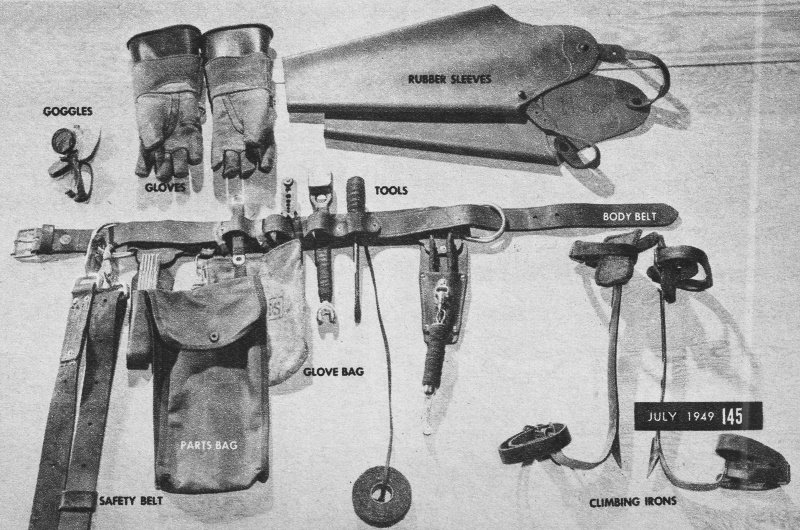
What well-dressed lineman wears is shown above and below. Hands and arms are completely covered by heavy rubber gloves and sleeves.
Rest of outfit includes climbing irons, goggles, and body belt that holds tools and safety belt. Peaked cap shield head, shades eyes against sun glare.
Linemen test rubber gloves before each climb by filling them with air, closing the wrists, and squeezing. Any air leaks then show up tiny, pin-point holes that would be extremely dangerous.
As lineman climbs up pole, he covers all wires he must pass with long, tubular, slip-on insulators called "line hoses." Where voltage is high, all wires are covered with rubber protectors.
Two-way radios in line trucks speed emergency repairs by keeping field crews constantly in touch with central dispatcher who directs trucks, issues orders, and co-ordinates activities of crews.
New pole holes are quickly dug to right depth by a mechanical auger mounted on the rear of a special truck. A derrick, also mounted on the truck, then lifts the pole and lowers it in place.
Picking up small nails would be difficult trick for lineman wearing heavy gloves, so nails are hoisted up to him stuck through rope. When he needs one, he simply pulls it out of the rope.
To cut high-tension wires, linemen use special wood-handled hack saw, never ordinary wire cutters. Note how surrounding lines and insulators have been covered with "hoses" and "hoods."
Linemen must learn to be fire fighters, too. Here one battles a hard-to-reach, pole-top fire with an extinguisher containing a special mixture of carbon dioxide and carbon tetrachloride.
In case of accidents, linemen must be able to apply artificial respiration - even at pole top. Mastery of prone method is aided by scales and timer to show the proper pressure and timing. Each lineman who has won his climbing spurs is a mechanic, electrician, woodsman, aerialist, carpenter, gadgeteer, and first-aider all in one. I saw all these skills in action when I recently spent a week with an emergency crew of the Public Service Electric and Gas Company of New Jersey. There was a time years ago when linemen were rugged rovers who went wherever there was work. They prided themselves on how fast they could climb a pole and come down in two or three jumps. They learned to be linemen by experience-and often suffered, sometimes fatally, from lack of experience. Not so today. In most cases it now takes a lineman longer to win his Grade I spurs than it does a college student to get his degree. After spending three years as a line helper, or "groundhog," he then divides his time for the next two years between the linemen's school and actual work in the field under old-timers. Speed in getting up and down a pole no longer is the lineman's goal. One of the first lessons he learns is that haste not only makes waste but also danger. Let's follow the typical career of a young man we'll call John Clure. When John graduated from his New Jersey high school, he heard that Public Service was looking for line-men trainees. John had always been handy with tools; but, being an athlete and liking the outdoors, he couldn't quite reconcile himself to a stuffy bench job indoors. Line work seemed like a good way of combining his abilities. That summer John began as a helper on a line crew. For the next 36 months, he toted, shoveled, wielded an axe, and learned to use a pike - the long, steel-pointed poles used to maneuver a line pole into place. When it carne time for John to go to line school, he had a good ground's-eye picture of the job he hoped to fill.
Broken power lines are reconnected by a mechanical splice called a compression connector. Hand splices are seldom used, although all linemen know how to make them. Heavy cable clipped on wire to right of lineman is mechanical jumper that shunts current around break until it is repaired. This permits linemen to work directly on live wires without shutting off power. Lineman Stakes Life on "Gaffs" At school, the first thing he learned was that his climbers were his most important pieces of personal equipment. From then on his life would depend on them. He was shown how the metal spurs or gaffs must be kept sharp by filing them to a special three-sided point to match a gauge. His instructor showed him how a poorly sharpened gaff can cut out of a pole and possibly cost him his life. For the first time, he strapped on his "waistline workshop," the body belt that holds a lineman's pliers, skinning knife, wrenches, parts bag, screw driver, folding rule, connectors, a bag for his all-important rubber gloves, and safety belt. By the end of his first school day, John had taken his first timid step up a practice pole in the school's pole yard. During this early stage, John was a "termite," the name often jokingly given new linemen because of the mounds of chips that pile up around the practice poles. The tenth day in school found John perched at the top of a 40-foot pole for the first time. He had worked himself there by easy stages, climbing a little higher each day. John admits now that he felt a little scared that first time at pole top, but he wasn't half as upset as one boy who two-thirds of the way up literally froze to the pole with fright. He could move neither up nor down, and his instructor finally had to climb up and bring him down. An instructor likes to pick a slightly overcast day for this important pole-top test, the kind of day when clouds are scudding across the sky. He then orders each beginner to climb his pole with his back to the oncoming clouds. If a student has the slightest tendency toward dizziness or height fright, one look at the sky will make it blossom out like measles. The clouds, passing over him from back to front, make him feel that he is falling backwards. If he can't shake off the illusion, he is likely to freeze, grabbing the pole with both hands and hanging on. This is the student lineman's first big hurdle. John Learns on a "Stub" Pole For six weeks, John learned his pole work literally from the ground up. Each new problem of construction and wire work he first solved at the top of a "stub" pole just a few feet off the ground. As he became more confident, he proceeded higher and higher to pole top. A lineman not only has to become apt in each of the many jobs he has to perform, but he has to feel at home resting on his climbers and safety belt. As one veteran lineman put it: "You've got to be relaxed up there. Handling hot wires, you've got to concentrate on the job -not on your legs and spurs. The first couple of months are tough. You're dog-tired before the day is half over. Going up, you dig your spurs in too deep and then have to use extra effort to pull them out. Topside, you stiffen up. You haven't learned yet to relax and lean back on your belt. But you'll get it, and then it'll be easy." At the end of seven weeks of basic training, John left the line school as a Grade II lineman and reported to a line crew for his first real field work. But here again he progressed by easy stages. His pole work was limited either to working alone on low-voltage lines that were dead, or working with another qualified Grade II lineman on low-voltage lines that were alive. For the next year and a half, John shuttled back and forth between the school and the field, learning more at each stage. At the end, handling high-tension wires was relatively safe and easy at just about any height. He was a Grade I lineman. Safety becomes second nature to a well-trained lineman. From the time he was a groundman he has worked with a hat on and his shirt sleeves rolled down even in the hottest weather. Rolled-up sleeves may be more comfortable on a sizzling summer day, but unabsorbed perspiration on bare arms can cause deadly current leakages around a lineman's gloves and rubber sleeves.
Linemen steady new pole with long, steel-pointed "pikes" while hole is filled in. Wires from old pole, removed but still standing, will be transferred to new one when it is firmly in place.
No termite could do a more thorough job of chewing up this practice pole than spurs of student linemen. The pile of chips at base of pole shows why trainees are aptly dubbed "termites." Learning from the ground up - literally.
Students practice on stub poles that are exactly like real ones - except closer to terra firma. Here they perfect their skills and gain confidence.
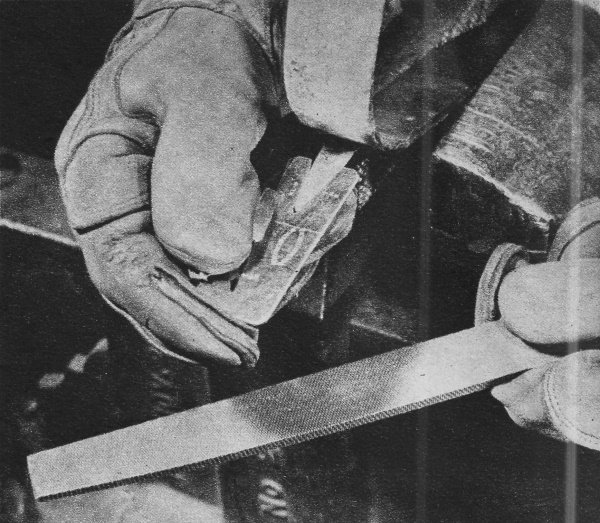
Lineman's life depends on his climbing irons. To prevent them from cutting out, they must be kept filed to special three-sided point. Here metal gauge is used to check accuracy of shape. He knows the danger of finger rings, watches, fasteners, and key rings. Any piece of metal, even a metal button on his cap, can help to form an accidental spot contact for high-voltage current. Before he climbs a pole, he tests his rubber gloves for dangerous leaks. He fills them with air and holds them closed by folding and rolling down the wrists to make sure they hold the air and have no pin-point holes. Then he pulls leather protecting gloves over the rubber gloves. If he is going to work around high-voltage wires, he puts on his rubber sleeves. As he climbs toward pole top, he covers all nearby wires with rubber blankets and slip-on insulators called "line hoses" and "insulator hoods." "Covering up," as the linemen call it, is the first step on every job. Often a lineman will spend half an hour "covering up" to make a repair that takes less than five minutes! Even "Dead" Wires Can Kill He has learned to regard any wire, "dead" or "alive," with the utmost respect. He knows that under certain conditions even a "dead" wire can give him a fatal jolt. A long, unconnected wire stretching for many miles, particularly at the high altitudes encountered when stringing power lines over mountains, can develop a charge of static electricity heavy enough to kill a man. Ask the average lineman what he does with his spare time and you'll probably find that his yen for using his hands and building things doesn't stop when he puts away his climbers at the end of a day. The chances are he'll tell you he spends a good many of his evenings either in his home workshop or doing odd jobs around the house - something different like rewiring a living-room lamp or fixing the vacuum cleaner. He'll tell you, too, that he handles no volts with as much respect as any high-tension line. |
|||||||||||||
 |
|||||||||||||
|
|||||||||||||





|
||||||||||||||||||||||||||||||||||||