|
|||||||||||||
 |
|||||||||||||
An Unusual TV Antenna
|
|||||||||||||
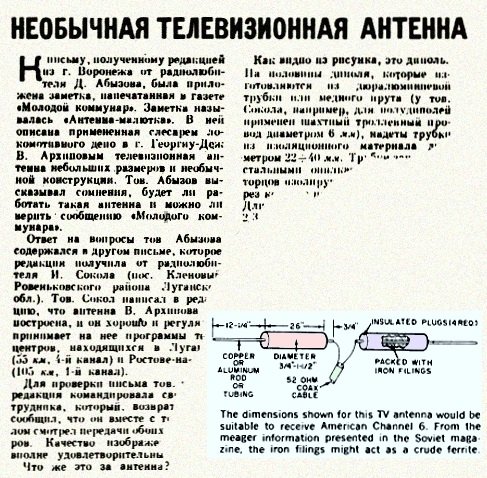
This being an April issue of Popular Electronics magazine, I am not sure whether this is an April Fools gag article of the real McCoy. The Iron Curtain was in full force, the Cuban Missile Crisis was a mere five years earlier and the Gary Powers U-2 incident just seven years hence, so anything related to the USSR (aka Soviet Union) was considered mysterious and possibly nefarious. Seeing Ruskie text was a real attention-getter. The article titled "НЕОБЫЧНАЯ ТЕЛЕВИДЕНИЕ АНТЕННА" reportedly appeared in the April 1966 issue of the Soviet Union's "Radio" magazine (still in print). I did a search for it and could find the March and June 1966 issues, but not April. BTW, if you plug the Russian text into the Duck Duck Go translator, it does indeed come back with "Unusual TV Antenna," just as author Joseph Zelle claimed in 1966. Now, as to whether the article's claim is legit or not, I can't say. An Unusual TV Antenna
If you are an inveterate experimenter and if you read Russian - especially the Soviet electronics hobbyist journal, Radio - the title of this article may stir a memory. The antenna described here was originally presented in the October, 1966, issue of Radio on page 56. The Editor of Radio stated that he had received a letter describing a "tiny antenna" constructed by a railroad worker which was reported to be faithfully capturing TV signals 35 and 65 miles from the worker's home. The dimensions shown for this TV antenna would be suitable to receive American Channel 6. From the meager information presented in the Soviet magazine, the iron filings might act as a crude ferrite. At first glance, the strange antenna in the drawing above appears to be a simple dipole in shunt with a crude ferrite antenna. The dimensions given are for Soviet Channel 4 (84-92 MHz), and according to Radio, the dipole section may be ordinary copper or aluminum tubing. The large tube of insulated material can be 3/4" to 1 1/2" in diameter. This larger tubing is filled with iron filings and plugged at each end with insulating washers. The length of the insulated tubing appears to be approximately two-thirds of the length of each dipole element. No dimensions were published in Radio for any other TV channels. The impedance would appear to be between 50 and 70 ohms, since a coaxial cable is connected to the antenna. Further improvements could probably be made by introducing a balanced feed line and matching the antenna input to the feed line. Despite its exotic structure and the obvious skepticism of the Soviets, there are reports that this TV antenna works remarkably well. - Joseph Zelle
Posted |
|||||||||||||
 |
|||||||||||||
|
|||||||||||||


|
||||||||||||||||||||||||||||||||||||