|
|||||||||||||
 |
|||||||||||||
Can You Trust a Drug Store Tube Tester?
|
|||||||||||||
I am sure there is some kind of old adage about one of the best ways of teaching somebody is to present it in a way that is entertain, and maybe does not even seem like a lesson. John Frye exploited that method over many decades of writing Mac's Service Shop, Carl and Jerry, and other pieces for various electronics magazine. He wasn't alone in that method of wile. Art Margolis employed the craft as well. This "Can You Trust a Drug Store Tube Tester?" from a 1964 issue of Popular Electronics magazine is a fine example of which I speak. Of course the material is out-dated, but the schooling in troubleshooting through a process of observation and elimination is timeless. Being old enough to remember going with my father - who had absolutely zero knowledge of electronics, but could not afford to pay a repairman - with a paper bag filled with tube from our black and white TV set or tabletop AM radio. His modus operandi (MO) was to take and test every tube in the corner convenience store tube tester - no sense in making more than one trip. He was not averse to uttering a swear word or two (which always elicited a reprimand from my mother - while we kids giggled) when burning his fingertips on a hot tube. I don't know if he labeled the tubes and corresponding sockets, as recommended in this article. I do know we very seldom had to actually call a TV repairman. Can You Trust a Drug Store Tube Tester?
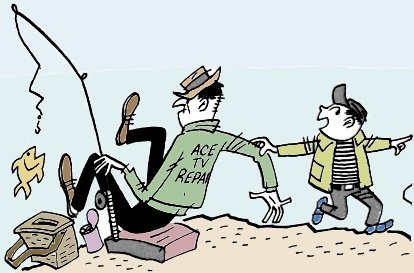
By Art Margolis I was mumbling to myself as I walked across the highway with my eleven-year-old, Denny, and a bag of tubes in my hand, heading for a do-it-yourself tube tester in the drug store. "Fine state of affairs," I thought to myself. "After months of hard work, I end up doing on a vacation what I do for a living: fixing TV sets." As any TV technician will tell you, the best way to test tubes is by direct replacement. In the shop at home, I pull out the suspect tube and put in a new one and see what happens. If the trouble clears, I know the tube is bad no matter what the tester might say. The only difference now was that I was stuck without my stock of replacement tubes; hence, the trip to the drug store. I had been ignoring the typical motel TV picture till Denny, proud of his powers of observation, said, "I guess you didn't notice it, Dad, but there's a 60-cycle hum in the video." "Glad you spotted it for me," I said as I settled back on the pillow. It had been a long day, and it was ending on a pleasant note. Denny was not to be discouraged. "Let's fix it for Uncle Albert as a surprise." Denny and I were the guests of my bachelor Uncle Albert at his luxury highway motel in North Carolina, right in the heart of some real good fishing country. "Let's not, buddy," I told him. "First of all, I would like to watch this science fiction movie. Second, I don't have any tubes here." "You can fix it anyway, Dad! Besides, there's a drug store with a tester that sells tubes right across the road."
Hum bars in the video, like those on our motel room set, are often caused by a heater-to-cathode short or leakage in one or more of the tubes that process the video signal from the tuner input to the picture tube. The two elements are close together, separated by a coating of aluminum oxide that passes heat but insulates electrically. When the coating deteriorates, it loses some of its insulating properties and the 60-cycle heater current leaks through into the cathode circuit. When this happens along the video pathway, hum bars appear on the screen. Denny had the back of the set off. "Which tubes shall I take out, Dad?" he asked. Following the layout pasted on the back cover, I told him to yank the video pathway tubes - a 2CY5 r.f. amplifier, a 5BR8 mixer-oscillator, all the 3CF6 i.f.'s, and the video output, an 8AW8. Then I found myself walking across the road trying to figure out how this could happen to me. The typical drug store tube tester has an excellent test to reveal heater-to-cathode shorts. It connects the various tube elements to an a.c. voltage source and a neon bulb. If any of the elements are touching, the a.c. finds a path and the bulb lights. Sometimes the elements short intermittently, or flakes of metallic substances lodge between them, so it's best to tap the tube gently with your finger to see if the neon indicator flickers. Denny began testing the tubes for shorts. There were two neons on the tester, one labeled "short" and the other "gas." The "gas" test is really a grid current test. The plate is the only element in a tube that's supposed to draw appreciable current, and if the "gas" neon lights, it shows there's a grid defect, or the tube is gassy, causing grid current to flow. All the tubes Denny tested read "good," till he got to the second i.f. It made both neons light brightly. The third i.f. produced a dull glow in the "gas" neon. I hauled out my wallet, bought two new tubes, and installed them. The picture was perfect, but when I looked around to show Denny the results of his persistence, he was gone. Shaking my head over the vagaries of youth, I reinstalled the back on the TV set with my nail clippers and settled down to watch. The science fiction story was well along, and I was just starting to piece together the part I had missed when the junior TV repairman burst into the room followed couple from next door.
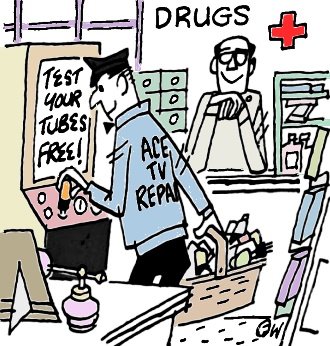
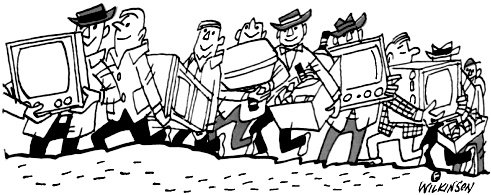
Steeling myself and resuming control, I went next door to find a cold TV set with the exception of the pilot light in the channel selector. The light exonerated the wall socket and the line cord - the set was getting juice. A quick look revealed the lack of a power transformer - a sure sign that the tube heaters were wired in series. When one of the heaters in a series-wired set opens up, none of the tubes light. Every one of the fifteen tubes in the TV would have to be tested to find the dead one simple but tedious. However, our drug store "service shop" was ideal for this it would easily show up a dead tube; a weak tube might be another matter. One thing to remember when removing all of the tubes from a set is to make sure they are replaced in the same socket - and this holds even for tubes of the same type. As I pulled out each tube, I marked the socket with a number; the same number was marked on a bit of adhesive stuck on the bottom of the tube. Then Denny and I returned to the tester. "I got it, Dad," Denny called excitedly. "It's this 12DQ6." I looked at the tube carefully. It was a 17DQ6. Denny had tested it incorrectly - the reason for the "bad" read - by the younging. It's always a good idea to double-check any tubes that read "bad," and as a further check, test the new tube you purchase before taking it home. If the new tube performs like the suspect, chances are you have performed the test incorrectly, the new tube is bad, or the tube tester is out of whack. "This one is it," Denny yelled again. I retested the tube for him, a 12BY7. He was right. We bought a new tube and threw the old one in a litter can on the way out so there wouldn't be any possibility of reinstalling the same trouble in a TV set. By the time we fixed the second set and got profuse "thank-you's" from the couple next door, the science fiction movie was nearly over. A space battle was in progress, and the hero was about to make a U-turn at 250,000 miles an hour. I quickly became at peace with the world. The hero and heroine were winging their way to one of the moons of Jupiter where they would live happily ever after and I was dropping off to sleep when little Mr. Energy burst into the room again. "Dad, Dad," he shouted in my ear, "wait till you see Uncle Albert's TV. It's a mess. Let's fix it while he's out - he'll sure be pleased." I sighed, but I knew there would be no letup until I at least looked at the third TV set, so we stumbled down to Albert's quarters. When Denny flicked it on, a narrow pictured appeared which took its time in filling out to less than full-screen width. There were black spaces on the sides, top, and bottom. As an extra added attraction, the bottom had a whitish vertical fold-over. To top it all off, there was more than the usual amount of interference and snow. Denny pulled out the tubes as I read them off. Because the picture was slow in spreading out, we removed the horizontal output, a 6BQ6, and the damper, a 6AX4. Since there was a four-sided shrink, the 5U4 low-voltage rectifier was next on the list. We decided to test the vertical output, a 12BH7, in an effort to clear the vertical fold-over, and the 6BQ7 r.f. amplifier because of the snow in the TV picture. We placed the five suspects in a paper bag and crossed the road for the third time. Denny inserted the 5U4 into the tester. Drug store-type tube testers provide an excellent test for 5U4's and other rectifiers since they are basically diodes. As a matter of fact, these testers test all tubes-triodes, pentodes, etc. - as if they were diodes. This is called an emission test. Control grids, screen grids, and other elements are tied together and attached to the plate. The right voltage is applied to the heater which warms the cathode, causing the emission of electrons. A meter in series with the plate indicates the current flow, and if it approximates the amount of current an average tube of that type draws, the meter needle will rise into the "good" region. The idea behind emission tube testers is that if cathode emission is satisfactory, it follows in most cases that all the rest of the complex characteristics of the tube are up to par. Since this may or may not be true, the accuracy of the tester is limited. There are plenty of ways for a tube to be bad and still read "good." The rule to follow is that if a tester says a tube is "bad," you can be fairly certain it is bad. If the tester says a tube is good, it might be true, but it ain't necessarily so. The 5U4 from Albert's TV set was getting a fine test since it was a diode. The needle rose very slowly, stopping short of the question mark. It needed replacing. Denny plugged in the 6AX4 damper, also a diode. The needle rose smartly into the "good" region. Denny tapped it gently with his finger. The neon lamp labeled "short" flickered. "Uh-oh, another bad one," I told him. The next tube was the 6BQ6 horizontal output. It lit brightly, in fact too brightly. Instead of burning with a reddish light, the heaters had a yellowish glow like a candle - a sure sign of burning carbon rather than glowing metal. It took about the same time for the meter needle to rise into the "good" region as it took the TV picture to spread out. This tube was the reason for the slow spread. Denny turned the tester off quickly. "You've really got it down to a 'T'," I congratulated him. For most tubes, prolonged emission testing is bad. This is because, with all the elements tied together, there is no valve action on the tube like that normally exercised by the control grid, and the tube runs wide open. Sensitive elements can become hot, swell, and get loose. A good tube can end up bad if tested too long. It didn't matter in this case, however. The 6BQ6 was on its last legs. Next to be tried was the 12BH7. The meter needle rose swiftly through red, yellow, and green, and hit the pin on the meter. Denny turned off the tester. The tube was running too hard. Too much uncontrolled emission, probably because of gas in the tube. This defect was causing excessive vertical sweep which was, in turn, responsible for the fold-over in the TV picture. The last tube Denny tried was the 6BQ7, a dual triode. The first triode section tested perfectly. He tried the second section. The needle rose jerkily and vibrated in such a way that the pointer tip looked blurred. It never made the green, and the neon flickered on and off. The one good triode would have to be discarded, and the tube replaced. This is often the case with multiple section tubes the important thing is not to forget to test each section. Armed with five new tubes, we returned to Albert's TV set. When we were done the picture was full and bright, and the snow was gone. I was really bushed now. I trudged back to our room and dozed off, leaving Denny to watch TV. The last thought I had was wondering whether or not the hero and heroine in the science fiction movie ever made it to Jupiter. The next morning Denny was up bright and early. "Gee, Dad, you missed a nifty science fiction picture last night," he greeted me. "Sure, you dragged us around fixing everybody's TV sets." "No, Dad," he answered. "This was after you fixed them. That movie ran continuously all night!" |
|||||||||||||
 |
|||||||||||||
|
|||||||||||||
 What could I do when he had so much faith in
me? Also, Albert wouldn't take any room rent, and TV repairmen are a scarce commodity
in this part of the woods, so I knew he would appreciate it. Denny gleefully began
removing the back of the set with a scout knife, as I dragged myself off the bed.
What could I do when he had so much faith in
me? Also, Albert wouldn't take any room rent, and TV repairmen are a scarce commodity
in this part of the woods, so I knew he would appreciate it. Denny gleefully began
removing the back of the set with a scout knife, as I dragged myself off the bed.

|
||||||||||||||||||||||||||||||||||||