|
|||||||||||||
 |
|||||||||||||
A Frank Statement About the Future in Field Engineering
|
|||||||||||||
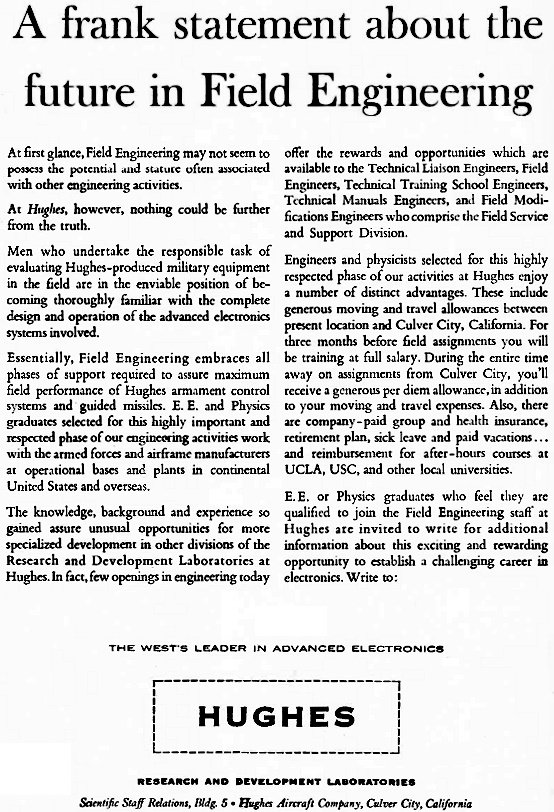
A lot of the guys I knew from my time in the U.S. Air Force as an Air Traffic Control Radar Repairman (AFCS 303x1) went to work for the government or defense contractors after separation. Many were retirees, so they were (are) collecting military retirement pay on top of really good pay doing field service work. At this point, probably most of those guys are now doubly-retired, and collecting Social Security. They're living pretty well these days, probably with nice homes paid off long ago. 1957, the year this solicitation for field engineers appeared in Popular Electronics magazine, was right at the end of the Korean War, and only a decade after World War II. A lot of new equipment was designed and delivered into action during those times, and especially with no ongoing conflicts, the size of the military had been reduced significantly, while the equipment still needed to be maintained, modified, and replaced. A Frank Statement About the Future in Field Engineering
At Hughes, however, nothing could be further from the truth. Men who undertake the responsible task of evaluating Hughes-produced military equipment in the field are in the enviable position of becoming thoroughly familiar with the complete design and operation of the advanced electronics systems involved. Essentially, Field Engineering embraces all phases of support required to assure maximum field performance of Hughes armament control systems and guided missiles. E. E. and Physics graduates selected for this highly important and respected phase of our engineering activities work with the armed forces and airframe manufacturers at operational bases and plants in continental United States and overseas. The knowledge, background and experience so gained assure unusual opportunities for more specialized development in other divisions of the Research and Development Laboratories at Hughes. In fact, few openings in engineering today offer the rewards and opportunities which are available to the Technical Liaison Engineers, Field Engineers, Technical Training School Engineers, Technical. Manuals Engineers, and Field Modifications Engineers who comprise the Field Service and Support Division. Engineers and physicists selected for this highly respected phase of our activities at Hughes enjoy a number of distinct advantages. These include generous moving and travel allowances between present location and Culver City, California. For three months before field assignments you will be training at full salary. During the entire time away on assignments from Culver City, you'll receive a generous per diem allowance, in addition to your moving and travel expenses. Also, there are company-paid group and health insurance, retirement plan, sick leave and paid vacations ... and reimbursement for after-hours courses at UCLA, USC, and other local universities. E.E. or Physics graduates who feel they are qualified to join the Field Engineering staff at Hughes are invited to write for additional information about this exciting and rewarding opportunity to establish a challenging career in electronics. Write to: The West's Leader in Advanced Electronics Hughes Research and Development Laboratories Scientific Staff Relations, Bldg. 5 Hughes Aircraft Company Culver City, California |
|||||||||||||
 |
|||||||||||||
|
|||||||||||||


|
||||||||||||||||||||||||||||||||||||