|
|||||||||||||
 |
|||||||||||||
New Incentive Regulations for Hams - What Happens Now?
|
|||||||||||||
This 1967 Electronics World magazine article detailed the FCC's at-the-time incentive licensing program that established a strict hierarchy where exclusive frequency blocks were reserved solely for Advanced and Extra Class operators, creating clear privileges based on examination proficiency. This system mandated Morse code testing at 13 wpm for General class and beyond, with the explicit goal of pushing hams toward technical excellence by restricting prime DX and phone segments. Today's licensing structure retains a modified version of class-based frequency assignments, but the distinctions are far less restrictive. While some band segments remain allocated to specific license classes like Technician, General, and Extra, the partitions are more permissive and designed for operational convenience rather than as exclusive rewards. The most significant change is the complete elimination of Morse code proficiency requirements for all license classes, which the FCC removed in 2007. Modern licensing emphasizes universal broadband access, digital modes, and emergency communications preparedness over the technical gatekeeping of the 1967 system, reflecting amateur radio’s evolution from a predominantly technical hobby to one focused more on operational flexibility and public service. New Incentive Regulations for Hams - What Happens Now?
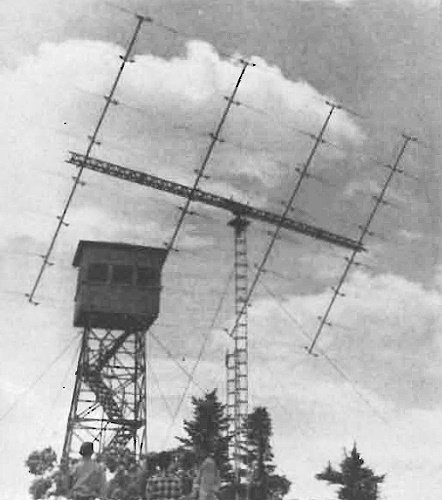
Incentive licensing may stimulate experimental work by American hams, like this antenna and moon-bounce communications installation operating on 144 MHz. By Robert M. Brown Sweeping changes provide incentives for amateurs to develop their technical skills and increase their prestige. Exclusive frequencies will be available for all Advanced rind Extra Class License holders. Climaxing nearly five years of heated argument and internal controversy in the Amateur Radio Service, the Federal Communications Commission has adopted new regulations. On November 22, 1967 the first part of a three-phase incentive licensing program goes into effect, a plan which is said to provide "for the remodeling and revitalization of the Amateur Radio Service without changing its basic character and spirit and without depriving any amateur licensee of the major portion of his present operating privileges." The new rules re-establish the Advanced Class ham license, which has not been available since 1951. (Extra Class exams are still available to General Class operators "or higher" who have at least 2 years status as such.) Novice tickets issued after this elate are for two years. Radio amateurs with at least 25 years of amateur standing may apply (S20 fee) for two-letter calls. In its new form, the Advanced Class ticket will be at a difficulty level between the current General Class (50 multiple-choice questions) and the Extra Class (100 harder multiple-choice questions) licenses. Code speed requirements are the same 13 wpm required for the General ticket. Actual Advanced Class questions and answers were not available as this was written, but the Commission has stated that these will be made public along with availability of the actual FCC-administered exams as soon as possible. To provide motivation for upgrading the approximately 100,000 General Class ticket holders, the Commission is introducing "reserved frequencies,", which will be phone and c.w. frequency blocks available only to Advanced and Extra Class licensees. These new reserved bands represent the "incentive" behind the entire program and will be implemented on the installment plan: approximately half made available in 1968 and the remainder in 1969. There will be no frequency cuts or changes during the rest of 1967.
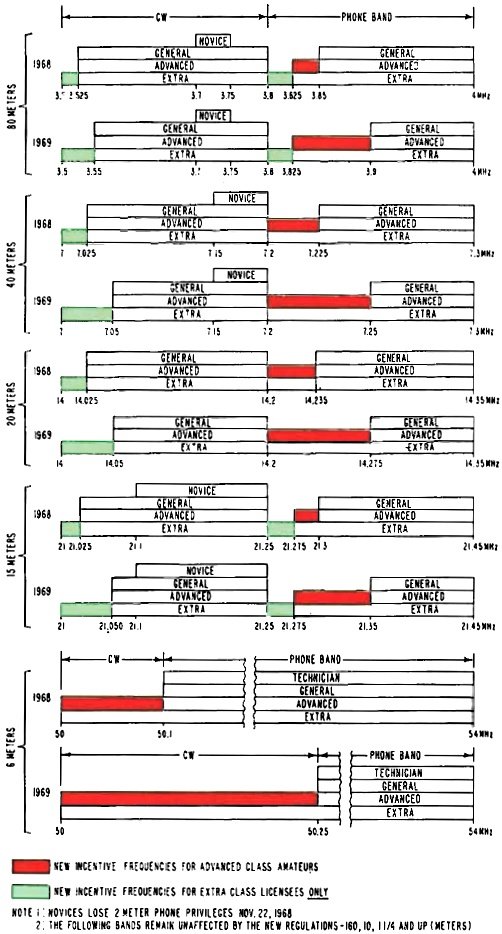
The new FCC rulings provide that certain amateur frequency bands will be open exclusively to advanced license holders. Chart shows status effective as of November 22, 1968 and 1969. All General Class amateurs will immediately qualify for the new Advanced examination. Since code proficiency requirements are identical, the prospective Advanced ticket-holder can proceed directly into the written portion of his test - providing he brings proof of his General amateur status. On November 22, 1967, all the new Novice licensees receive two-year operating privileges. According to Washington, "Extension of the 1-year Novice Class term is intended to afford licensees an additional period for the development of their proficiency and knowledge before attempting to advance to higher classes of licenses." Many persons have felt that the present one-year non-renewable restriction inhibits growth of the hobby from the standpoint of youngsters who are unable to master so much in such a short period of time. Proposal RM-775, a formal petition submitted by Joseph L. Kofron of Las Vegas, requested that the "Novice Class license be made renewable by licensees 12 years of age or younger" to facilitate their gaining the required operating experience. The Commission pointed out this request in explaining why it is extending the term of the beginner's license. Next in line of things happening in 1967 comes the availability of 2-letter (W2AA-type) call signs for Extra Class amateurs who have been active in the hobby for 25 years or more. Although no choice of call letters will be possible, a check for 820 and a suitable request is all that will be required of these "old timers." This highest grade of license holder will be the only one with any kind of distinctive call-sign. An earlier proposal to issue calls according to license status has been abandoned. In a statement released on August 24, 1967, the FCC said that means of identification now in use are satisfactory. Automatic data processing now makes available listings of amateur licensees with their classes of operator licenses which can be utilized by monitoring personnel for reasonably prompt identification purposes " Additionally, it has been reported that the publishers of "The Radio Amateur's Callbook" will begin immediately to print the class of license held by every ham listed in the directory. Enforcement of the new regulations, however, still rests upon the hams themselves who must be counted upon not to bootleg higher-license-class call signs.
1968-1969 Incentive Program Timetable.
The New Advanced Class Exam. For the 40,000-odd hams who still hold the pre-1951 Advanced Class tickets, the Commission has good news. These amateurs will be grouped with the new incentive program - Advanced Classers. This "grandfather clause" was adopted after floods of mail called the Commissioners' attention to the fact that at one time these people had passed a far more difficult examination than is now required of most hams. "Rather than have amateurs think we are losing faith with these licensees ", the FCC added, "no further demands will be made upon them." New Rules in 1968 On November 22, 1968, holders of the Extra Class ham ticket will get "reserved" frequencies on the h.f. bands. On this date the Commission is opening a 25-kHz c.w. section at the lower edges of the 80 -, 40 -, 20 -, and 15-meter bands for Extras only. A special phone band will be reserved in the first 25 kHz of the 75- and 15 -meter bands; this is felt to be the choicest allocation of them all and one which may ultimately spur other licensees to graduate to Extra Class. With Extra licensees truly the rarest of all those now in the hobby, these sub -bands should be relatively free from interference - at least for a while. The Extra Class is the only license that stands to lose nothing under the incentive licensing provisions. Extra Class operators will continue to be able to operate anywhere they choose within the U.S. Amateur bands. Novice licensees will lose their 2-meter phone privileges permanently on November 22, 1968, although they may operate c.w. in the 145-147-MHz range if they desire. In explaining this move, the Commission mentioned certain petitions by amateurs in addition to reiterating that "one of the prime purposes of the Novice license is to prepare for the higher classes of licenses which require increased code proficiency." Those individuals, however, who feel that the code barrier is too much to handle can still elect to pass the Technician Class examination and operate on all modes in the 6 -meter band and up. While the original proposal called for setting aside re- served frequencies in much the same manner as will soon be implemented on the h.f. bands up on 144 MHz, in the final version this concept was dropped entirely. With the exception of the deletion of phone privileges for Novices, 2-meter privileges will be unchanged. Opponents of the original proposal petitioned Washington that "since this band is very useful for experimental operations, it should continue to be available to all licensees ". In an order released in late August the following remark was made: "The Commission agrees and will delete reservations of the proposed 144- 145-MHz segment." What is left, then, is only the loss of the first 100 kHz of 6 meters in the v.h.f. spectrum, a segment now allocated exclusively for c.w. and one which will revert to the Extra Class and Advanced amateurs on November 22 of next year. Final Implementation: 1969 The third phase of the three-part program also concerns frequency assignments and goes into effect on November 22, 1969. No new reserved blocks will be created but, with the exception of the 75- and 15-meter Extra phone segments, all "incentive attraction frequencies" will undergo final expansion. Nearly all reserved blocks will become twice as large, cutting down the size of the remaining General frequencies proportionally. For the most part, this will mark the date when the General Class hams will have only half the usable phone privileges they had prior to 1968. And with just over 100,000 licensees so affected, it isn't difficult to understand, at this point, where the "incentive" lies. Interestingly, the 160- and 10-meter low-frequency bands have come out of this unscathed, as have all bands above 2 meters. These frequencies represent bands not utilized by the majority of the country's radio amateurs. And frequency demands from emerging nations (largely African) have increased in recent years to a point where the next Geneva Frequency Allocation Conference is expected to review all sparsely populated amateur bands carefully. According to many sources, 160 and 10 meters may be lost at this time for these reasons. However, with the results of the incentive program still undetermined, it is entirely possible that many amateurs not desiring to compete with others for the remaining DX band space (and not electing to upgrade themselves out of it) may begin to fill these two h.f. bands. Should the overall program not pan out, it is conceivable that 160 and 10 meters might wind up as extremely active frequency blocks - thereby redeeming themselves perhaps just in time for Geneva. However, this opinion is the author's and is not official thinking now. This same concern for Geneva apparently has motivated a great deal of what is illustrated on the accompanying chart. With the exception of a final 250 kHz reserved block at the bottom of the 6-meter band, the u.h.f.-v.h.f. spectrum has come out largely unaffected by the new program. It should be noted that these frequencies are not "mutual interference" bands normally of concern to other countries, primarily because of their range limitations. Further, it appears the Commission has concentrated on the most occupied bands where congestion was a serious problem from the very beginning - dating back to 1963. How It All Began While this has been the subject of the most intense internal controversy that has hit the U.S. Amateur Radio Service, the idea of an "incentive" program did not originate with the FCC. It was introduced in an early 1963 issue of QST, the official journal of the American Radio Relay League: "Should we return to an incentive system of licensing whereby an amateur must demonstrate increased technical proficiency in order to increase his operating privileges?" This gave rise to confused reactions in ham circles, with the number of proponents and opponents, in itself, the subject of a great deal of mystery. Thousands of ARRL members resigned when the organization formally petitioned the FCC for such a program. Other amateurs fervently supported the move as a much -needed "clean-up" procedure, and one that was long overdue. CQ, an independent ham magazine, appeared to support the effort and published a controversial article "The Swans of Abbotsbury" by a British observer who noted that a swan population can only survive when limited to a given number of birds. Reason: the available food was the same from year to year; a corollary to the international problem of just so many available frequencies for purposes of amateur radio operation. And 73 Magazine, vehemently denouncing both ARRL and CQ for "selling the hobby down the river," organized its own national club known as the Institute of Amateur Radio (IoAR). For a while it appeared that IoAR was getting most of its members from the disgruntled ex -ARRL block, but eventually the Institute was dissolved. According to 73's editor-publisher and IoAR founder, Wayne Green, his organization lacked required "support from the concerned amateurs." The ham world was split right down the middle over the original FCC proposal as announced in QST in May, 1965. One of the most controversial segments of that version of the incentive program called for the establishment of "distinctive call signs" and the down-grading of present old-timer Advanced Classers to General status. These provisions and some others were omitted from the final rule-making - a move which may act to reunite forces in the hobby and strengthen its primary spokesman - the ARRL. Reports continue to circulate that the ARRL was pressured into suggesting the program in the first place by the FCC - which is normally hard put to do much more than react to formal petitions. This Timor has at last been officially denied by all concerned. AV}nether the story (now about five years old) contained any element of truth may never be known. But it appears that credit for the idea now being turned into Amateur Radio Service law rests primarily with the League. After the League petitioned the Commission for sonic kind of incentive program, the FCC issued the Notice of Proposed Rulemaking (in 1965) incorporating concepts from a wide number of sources. In reply, the ARRL and many individual hams undertook to issue formal (petitioned) comments calling for modifications and rule clarifications. In the words of the Commission, the rule proposal had "generated ... formal comments by some 4000 licensers" and that "two thirds of the continents supported an incentive licensing program." The Disadvantages Although the primary portions of the original plan which seemed to alienate many hams from the ARRL have been deleted in the new rule-making, there still remains substantial numbers of U.S. amateurs who sense impending doom for the hobby. Many of their arguments are worth examining. The big question seems to be: "Where will the new hams come from?" Since the inception of the Citizens Radio Service on 27 MHz in 1958, amateur radio has been less and less attractive to the aspiring enthusiast. Applications for new Novice licenses have dwindled and from a purely economic standpoint the news is bad. Since word first came that hamdom might undergo severe changes, annual equipment sales have tended to settle around 816 million. It is expected that year-end analysis for 1967 will reveal actual sales of equipment and accessories near $13-$14 million, reflecting the uncertainty over the future. (These figures compare with roughly $60 million for CB in 1966- excluding the unlicensed Part 15 walkie-talkies.) The Novice Class license, which slid much to revitalize the hobby by bringing in hordes of newcomers, has become unappealing to many because of its 5-wpm code requirement. Even with the new 2-year license for Novices, as provided in the incentive program, the 5-wpm requirement remains. But worse still, all phone privileges have been withdrawn. Hence, a youngster trying to decide between ham radio and CB will be faced with the hard fact that he'll need much more than a Novice ticket to enjoy phone operation via the amateur route. Opponents of the new program point out that without "young blood," any group or organization can only fade off into oblivion. They ask how the pro-incentive people propose to draw newcomers (especially teenagers) into the hobby. One New Jersey amateur, upon being told the news. wanted to know "if ARRL is planning a program of mass-brainwashing so as to prevent an enthusiast from ever hearing that CB exists Along these same lines, opponents see amateur radio in the U.S. slowly fading away. Mane feel that the number of harts will chop from 200,000 to just over 100,000 after the rules go into effect. They think the Commission will never he able to get the majority of General ticketholders to FCC examination offices for Advanced tests. The equipment industry, however, seem s somewhat cheered by the over-all prospects, although they foresee dark days ahead for several months. There is some feeling that the Advanced exam may prove a major stumbling block and be primarily responsible for the almost-predestined disappearance of ham radio in this country. If the number of licensees begins to dwindle, what will happen to the ham bands? The contention here is simply that if they are not utilized, they will be lost forever to other nations. And to many this seems an ultimate certainty. Finally, the quite-vocal opponents have come up with one constructive idea: lifting the antiquated eligibility requirements for the Novice Class license. As it now stands, no one can go for this test if he has ever before held radio amateur status in this country. Similarly, holders of 1st Class Commercial Radiotelephone licenses are now ineligible for this beginner's ticket. How about retired people who want to get back into amateur radio but who held licenses when in their late teens? Obviously one who's been away from electronics for any length of time can- not be expected to become an overnight expert in sophisticated communications technology. Many feel certain that if this restriction were lifted, it alight offset some of the unattractive stumbling blocks Washington is putt in, in the way of the hobby, by replacing the youngsters with returnees. The Advantages The proponents of pro-incentive licensing are concerned over the low level of technical competence anti the rise in the number of "push-button" operators." By developing the knowledge and skills of the hams, it is said that America might be able to reach the degree of sophistication and ingenuity being demonstrated by the hams in Australia, Great Britain, and USSR. Any honest observer must agree that ham radio has slipped badly in recent rears due, in part, to the wide acceptance of CB communications and the great technological strides being made by the industry. In an age of solid-state computers, IC's. FET's, and microminiaturization. the average ham tinkers in his basement with vacuum tubes and World War II devices. Once largely responsible for major developments in communications, radio amateurs are commonly viewed as non-contributing hangers-on. With CB-ers capturing most newspaper publicity anti outnumbering the harts 5 to 1. even the service aspect of hunt radio has been largely forgotten by the general public. Prior to adoption of the new regulations. word was out that ARRL was looking for a NYC-based advertising PR agency to promote the hobby. If the incentive program floes what it is designed to do, it is possible that once again American industry will he relying on harts for fresh ideas and an amateur license will recapture its prestige among electronics hulls. Even if the ultimate goals are never fully realized, at least the FCC can show that it is attempting to improve conditions something that may quite heavily at the next Geneva conference. From an international point of view, U.S. harts have come to he known as the "ugly Americans" on the air. They outnumber all other nations harts combined. They saturate the airwaves with high-powered transmitters at levels far in excess of what is permitted in most of the other countries. And they spend more time on the air than their more technically inclined overseas counterparts. The result is that amateurs in other countries not desiring to contact Americans have no choice but to vacate the international frequencies in search of a band the U.S. hams can't congest. Many foreign observers feel that the incentive program was long overdue and can only improve the state of the art. In one respect, they are looking forward (hopefully) to seeing an end to American domination of the airwaves: on the other hand, they are also awaiting the time when the average U.S. ham will play an active role in complex semiconductor equipment design - a field now largely in the hands of the British, the Germans, and the Russians. Finally, it is felt both internally and internationally, that this new move will remove the mail-order stigma that has characterized the U.S. hart since 1951. With few exceptions, this has been the easiest country in the world to obtain an amateur license - and its recipients receive the most privileges and the least supervision. For instance, in Australia if any of their 6000 amateurs attempted to construct a tube-type converter or transmitter he would have a lot of official (and unofficial) explaining to do. In the U.S. it is commonplace and accepted without comment. Will It Work? Even the FCC isn't sure. While it has been decided that the concept of using "reserved frequency blocks" will be the incentive for ham upgrading the Commission seems to be hedging a bit On what's going to happen. The following comment summarizes the feeling in Washington: "if it is determined that there is insufficient occupancy of any part of the reserved frequency segments, then the effective date of the implementation schedule will necessarily be stated in whole or in part." (italics ours) Corroborating this, the FCC has stated that "it intends to make a careful review' of the ham frequencies as the new incentive program becomes effective. It is particularly interested in how many new signals will pop up on the "exclusive" Advanced and Extra Class DX-band segments - and when. |
|||||||||||||
 |
|||||||||||||
|
|||||||||||||




|
||||||||||||||||||||||||||||||||||||