|
|||||||||||||
 |
|||||||||||||
$15.1-Billion Electronics Market in 1963
|
|||||||||||||
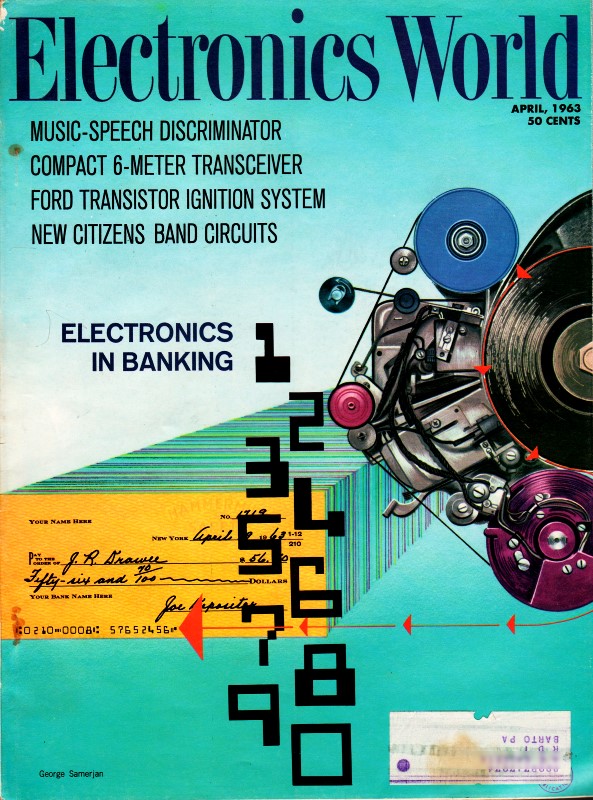
$15.1 billion was a lot of money back in 1963 when this story was published in Electronics World magazine. It was the value of the electronics market at the time. $15.1 billion is still a lot of loot today, but according to the Bureau of Labor Statistics' Inflation Calculator it is now the equivalent of $147 billion. The Consumer Electronics Association projects a 2015 electronics gadget market value of $223B, which does not include military, medical, and industrial electronics. The World Semiconductor Trade Statistics group predicts a $333B semi market value for 2014. Apple alone just hit the $700B market cap benchmark - that's just one electronics company. By any measure, electronics has enjoyed a continual, significant gain since the early 20th century. $15.1-Billion Electronics Market in 1963 - For the Record
Another year has passed, and once again, the electronics industry has achieved an unbroken record of yearly sales increases since 1949. The Electronic Industries Association accumulated sales volume in 1962 showed an increase of 2.8 percent over the previous year. There seems little doubt, particularly after President Kennedy's recent State of the Union Message in Congress, that 1963 will show a further increased dollar sales volume. EIA's predictions are that the electronics industry will reach $15.1-billion in 1963, which will make it the fourth largest in our country. It is interesting to note that the government's military expenditures for electronic equipment in the coming year are expected to reach an all-time high of $9-billion, which is almost 60 percent of the total U.S. electronics output. (See Table below). Unit sales of transistors will, according to L. Berkeley Davis of General Electric, increase to between 280 million and 310 million transistors. However, as Mr. Davis pointed out, if current price trends continue and the product market continues to change as it has over the last months, industry's dollar volume from sales of transistors will do well to equal the $289-million figure of 1962.
Sales of integrated semiconductor circuits can be expected to increase dramatically in 1963. Although last year's sales were below $5-million, the current interest displayed by users indicates that a market between $10-million and $20-million is expected to be realized by the manufacturers of these devices for 1963. The coming year should also see a continued healthy growth in the markets for semiconductor rectifier devices. It is expected that there will be a $20-million increase over the 1962 volume of $166-million. Although written off many times by a number of industry forecasters because of foreign competition and displacement by semiconductor devices, the domestic receiving tube industry continues to be a major segment of the electronic components industry. Depending on the strength of the general economy, 1963 factory sales may be as high as $230-million to $270-million. This compares with a $295-million sales volume in 1962. According to General Electric, 9.7 million TV picture tubes will be sold domestically. The total market should be about $221-million. According to Ross D. Siragusa of Admiral Corporation, 1963 television sales should be in the neighborhood of 6 million black-and-white and 700,000 color sets. Admiral alone expects to produce 100,000 color sets in 1963. Although the industrial electronics market is not as impressive today as the government and military aspects of our industry, it is still viewed as an area that will offer the greatest potential for expansion during the coming years. As pointed out by Charles F. Horne, President of EIA, the profit ratios seem to be much brighter in this area when compared to the other segments of our industry. It seems quite obvious that our accelerated government and military expenditures will certainly bring mounting pressures for profit controls and restrictions upon the decision-making powers of company managements. While signs point to a prosperous 1963 and a progressive future, one serious problem still exists within the industry. There is a greater need for qualified electronics engineers and technicians than existed a year ago. A downtrend in the supply of trained technical personnel has continued now for quite a few years and there are no signs that this will change. Unfortunately, there are less engineering students graduating from our colleges today than in the past. It has been estimated that by 1970 there will be a shortage of 2 million electronically oriented technicians, not to mention the shortage of engineering personnel. |
|||||||||||||
 |
|||||||||||||
|
|||||||||||||
 By W. A. Stocklin, Editor

|
||||||||||||||||||||||||||||||||||||