|
|||||||||||||
 |
|||||||||||||
The Race to Space - Are We Losing Prestige?
|
|||||||||||||
In this 1959 Electronics Illustrated magazine article, C. M. Stanbury argues that the U.S. is losing the Space Race not due to a lack of technology, but due to a critical failure in propaganda and prestige warfare against the Soviet Union. While American satellites use more reliable VHF for precise scientific data, their signals are only received by a handful of specialized monitoring stations. In contrast, all Russian spacecraft broadcast on shortwave frequencies around 20 mc, allowing thousands of amateur radio enthusiasts worldwide to directly hear their satellites, a tangible proof of communist achievement. The author, who personally received a verification card from Moscow for tracking Sputnik I, contends this publicity strategy brilliantly sways unaligned nations in Africa and Asia. He concludes the U.S. must immediately add simple shortwave transmitters to its payloads to provide the world with audible, undeniable evidence of American prowess, a small cost for immense prestige gains. The Race to Space - Are We Losing Prestige?
For practical purposes, the real bread-and-butter conquest of space probably won't begin for another 10 years or more. Yet the space programs in the United States and Russia are desperate and immediate efforts. Why? If it were merely a matter of developing weapons, you can bet there wouldn't be half the publicity. The real and very vital issue is prestige. Democracy or communism - which system can take man the farther faster? Outer space certainly isn't the only test, but it is the most dramatic and clear-cut one. And right now the free world is losing the ball game - and not because we lack technology! As we go to press, Russia has successfully launched three satellites and one space probe. The United States has countered with two space probes and six satellites. But hits don't necessarily win ball games and these figures aren't winning the space race. They convince the average American. So what? He was already sold! Turning the coin over, it's a pretty safe bet that Russia has juggled the facts and convinced Ivan that his own country is white-washing Western competition. And there isn't very much we can do about this. What's at stake? Those nations and their peoples who are neither communist nor solidly in the western camp - the hundreds of millions in Africa, India and Southeast Asia, and those of our allies who lack confidence in Western achievement.
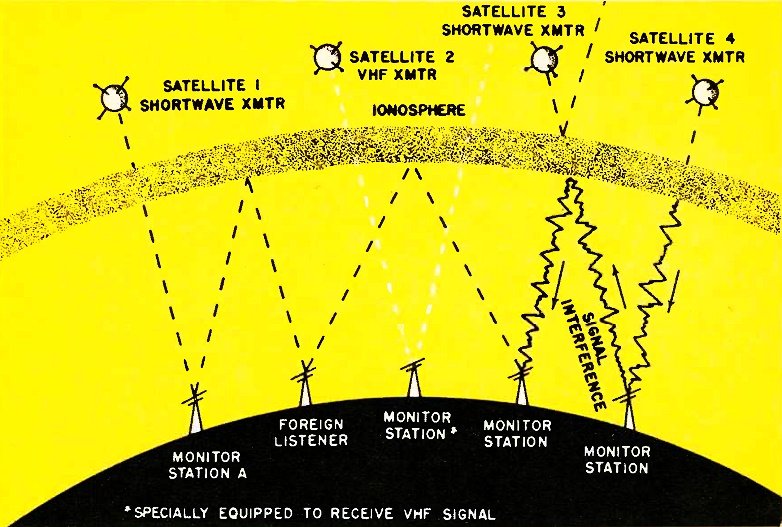
VHF is more reliable than short wave, but short wave reaches more listeners. SW signals from satellite pass through ionosphere and skip between it and the earth many times. They are heard not only by monitor stations, but also by almost anyone with an SW receiver. One drawback: direction finder receiving a second or third "hop" signal will give false satellite position. VHF signals from satellite 2 travel reliably in line of sight to monitor, but reflected signals go right back into space. SW is subject to ionospheric disturbances while VHF transmissions are not. Signals from satellite 3 did not even penetrate ionosphere and those from satellite 4 are garbled.
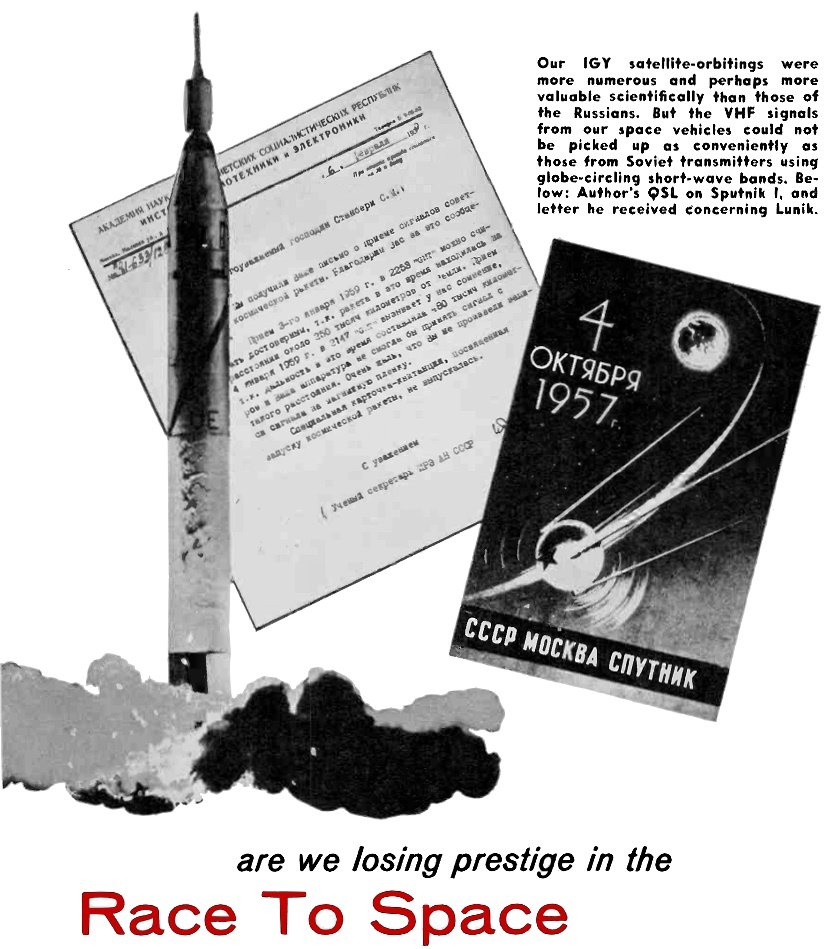
If these people in foreign lands could actually hear a satellite or lunar rocket - not a rebroadcast - they would have something fairly tangible to hang their belief and admiration upon. If they happen to be interested enough to request confirmation of the signals and receive an attractive QSL in return, then so much the better. This is exactly the kind of "tangible" proof the Russians are providing. All Russian space vehicles have transmitted on short wave around 20 mc. All successful U.S. space vehicles have sent back tracking and telemetering signals via the higher frequency VHF. As a result, many thousands of persons throughout the world have been able to hear the satellites launched from the USSR, while only a mere handful with special equipment have been able to listen to their American counterparts. Short wave is reflected back to earth by the ionosphere and because there is little absorption of short-wave frequencies, signals often can be heard clear around the globe. On the other hand, VHF signals do not "hop" between earth and ionosphere. Reception is usually limited to line of sight. In other words, the signal from the satellite transmitting VHF goes directly to the monitoring station. The Russians have even gone so far as to verify reception of their sputniks and lunik. I personally have received an attractive QSL card from the Russians for my report on Sputnik I. Thousands of other short-wave listeners around the world have received the same. It reads: To Mr. C. M. Stanbury, observer of the Soviet sputniks, the first artificial earth satellites in the world. Thank you for your reports. The information is of scientific value and will be used in the processing of material in accordance with the program of the International Geophysical Year. We hope to receive further reports of observations from you in the future. The U.S.S.R. Committee on the International Geophysical Year The conservative tone of this QSL gives it greater propaganda impact. And the repeated allusion to the International Geophysical Year makes it sound as if the Russians were really trying to cooperate with that distinguished worldwide scientific effort. Editor's Note An official spokesman for the National Aeronautics and Space Agency (NASA) in Washington has informed us just as we go to press that Explorer VI will be carrying 20, 40 and 60 mc transmitters - a departure from previous satellite communications. Space and weight problems in earlier launchings precluded inclusion of such a complete communications package, but more powerful rockets, such as Juno II, now permit heavier payloads. Also it has been pointed out that a 20 mc transmitter had been installed in an early Explorer satellite which, unfortunately, failed to enter orbit. We have also been informed that NASA does not plan to QSL satellite re- ports. They want to keep our space program on a high, scientific level and will continue to rely on the government-sponsored Minitrack network for tracking reports. However, Electronics Illustrated has learned that NASA certainly would welcome tape recordings of satellite signals taken off the air by shortwave listeners and radio amateurs, if these recordings are accompanied by complete reception information. However, the fact that the Russians did not use an IGY recommended frequency (around 108 mc), and the fact that they did not see fit to announce the satellite launching until after Sputnik I was in orbit, points to non-cooperation rather than cooperation.
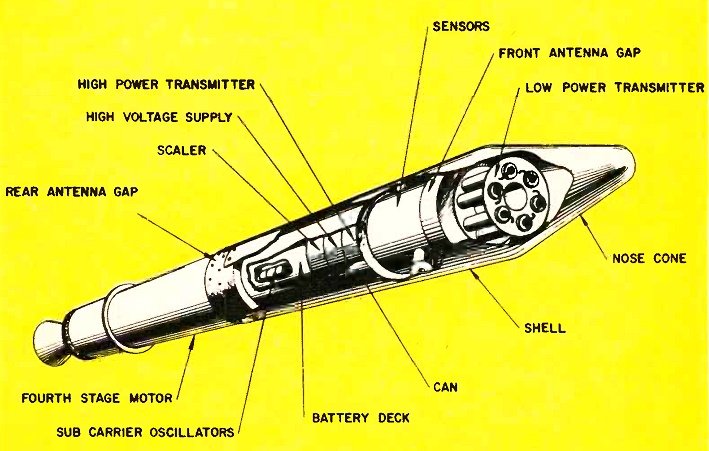
U.S. "talking" satellite is ready to be launched, but few heard VHF signal. Bottom of page, diagram of Explorer IV radio set-up. Taking the Russians' invitation to submit further observation reports at face value, I hurried to my receiver upon hearing the announcement of the launching of a Russian lunar rocket, now called Lunik. At about 2253 GMT on January 3rd of this year, I tuned to 19.995 mc. About 5 kc below WWV I heard what sounded like a 300 cycle modulated continuous wave. The next day I heard the same signal, but weaker. I wrote to the Academy of Sciences in Moscow and received a reply dated February 6, 1959. It was signed by the Academy's scientific secretary. That letter is reproduced on these pages. Translation reveals that the Russians confirmed my first report, but expressed doubt about my second report since the lunar rocket no longer was a lunar rocket, but rather a cosmic one heading into orbit around the sun. Why are we using VHF? For some excellent technical reasons. From the start, our space program, now directed by the National Aeronautics and Space Agency, has been a scientific data-gathering endeavor, not a propaganda effort. VHF is far less subject to interference than short wave and therefore a more reliable means of transmitting data. With short wave there is the danger of the ionosphere, under certain conditions, completely blocking the signals off from the earth. Also, short wave's multi-hop reception could result in ambiguous tracking reports making the satellite appear at a point in the heavens far removed from its actual position.
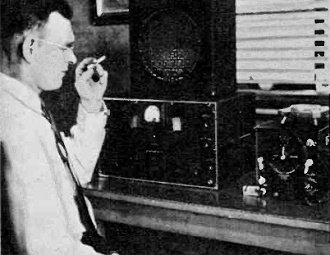
Author monitors gear that picked up Sputnik I and Lunik. Hammerlund ham set feeds signal to GE aero receiver for further amplification. From a data -gathering standpoint, VHF telemetering and tracking are technically superior and the United States should continue using VHF. However, how about also installing a simple, inexpensive short-wave transmitter in at least one satellite and possibly one space probe? Power could be provided by small, but long lasting batteries. Sputnik I, the most widely heard of all the space vehicles, used only one watt and yet its signals frequently bounced around the globe. Such a short-wave transmitter in an American satellite may be operated exclusively for foreign listeners and amateur monitors, or it could be used to transmit scientific information. Of course, a repeater tape loop bearing a voice message would be highly effective as a propaganda gimmick, although higher power and a more complicated transmitter would be required. Signals from a space probe would, of course, have to span much greater distances than those from an orbiting satellite. Again, small lightweight batteries could be used, but with higher power compensated by shorter life, say two or three days. The additional cost of such a project would be small beside the millions of dollars spent on the Voice of America every year. The cost of mailing a QSL card by the government would also be small, yet would certainly pay off in added prestige for America. |
|||||||||||||
 |
|||||||||||||
|
|||||||||||||


|
||||||||||||||||||||||||||||||||||||