|
|||||||||||||
 |
|||||||||||||
If It's Made in Japan, Is It Good?
|
|||||||||||||
In this 1959 Electronics Illustrated magazine article, J.R. Popkin-Clurman examines Japan's burgeoning electronics industry, noting its capacity for high-quality manufacturing hampered by inferior local materials. This limitation is less critical for mass-market items like transistor radios, which meet strict standards and succeed through a combination of reliability and low cost. For precision instruments, however, Japanese laboratories still rely on superior American-made equipment. The author documents Japan's tendency to copy and improve upon Western designs while also developing unique innovations. He accurately predicts that affordable Japanese color TVs would eventually dominate the U.S. market and argues against protective tariffs, believing competition would stimulate American industry. This foresight was later reflected in pop culture when Marty McFly, in "Back to the Future," rebuts Doc Brown's skepticism (from a 1955 viewpoint) about Japanese electronics by declaring, "All the best stuff is made in Japan." BTW, that Kowa tape recorder that sold for $80 in 1959 is equal to $884 in 2025 (per BLS Inflation Calculator). The Race to Space - Are We Losing Prestige?
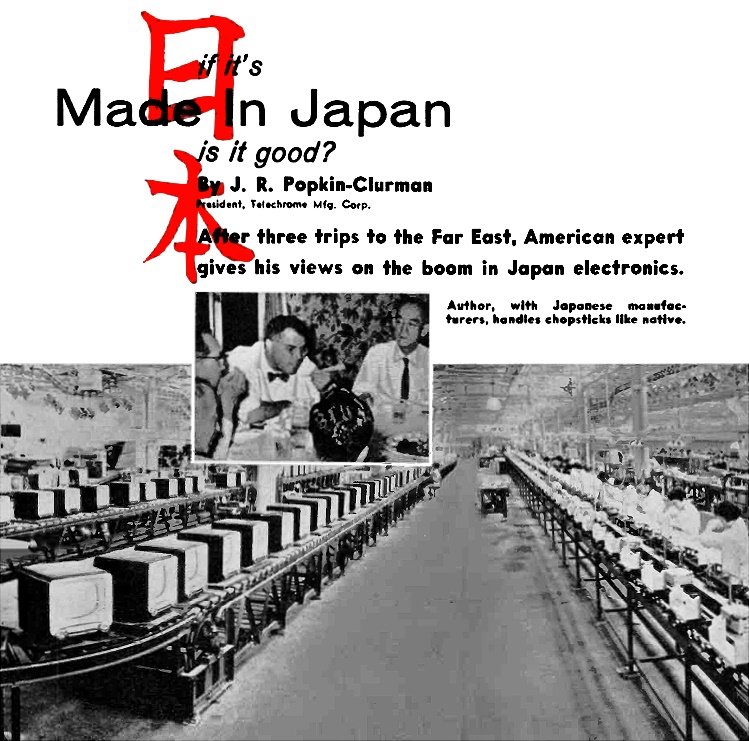
Huge television set factory in Japan turns out 17" TV. mostly for Japanese local markets, but author believes country has a future in low-cost color TV. If it's Made in Japan - is it good? By J. R. Popkin-Clurman After three trips to the Far East, American expert gives his views on the boom in Japan electronics. I have made made three extended tours of the Japanese electronics industry in the past two years. These visits have taught me to respect what is one of the most vigorous and rapidly growing electronics industries outside of the United States. The hard-working Japanese, with their comparatively low labor costs, could make any electronic device as well as we can. But the big qualifying factor is the materials available in Japan. Frankly, some are not as good as American materials and as a result some Japanese components, although often satisfactory, are generally not as good as corresponding American parts. The difference is not noticeable in transistor radios, which are subject to rigid industry -wide inspection standards. Indeed, these Japanese -set standards certainly help to account for the transistor radio's great success in this country. The quality is there, alongside favorable prices. However, in fine electronic instruments the highest quality materials must be used. Therefore, it did not come as too much of a surprise to me to see American-made test equipment, scopes, etc., in many Japanese plants and laboratories, even though they cost much more than locally made instruments.
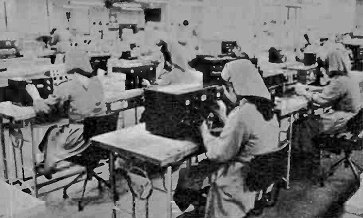
While these girls at Sony transistor plant perform electronic quality control tests...
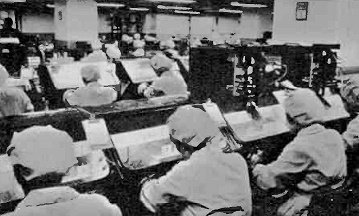
...other women, with their hands in special chambers, execute hermetic sealing process.
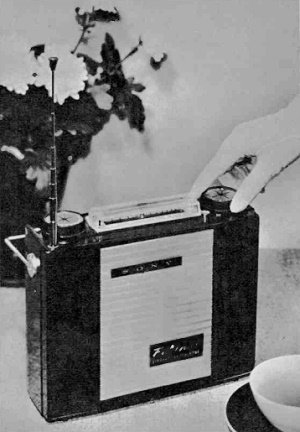
Typical of Japanese products that have been designed to capture the consumer market in transistorized radios is the first AM-FM portable. It contains 15 transistors and operates on flashlight batteries. List price is $150
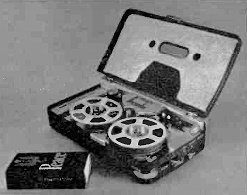
Tiny Kowa tape recorder, shown beside 10-pack of cigarettes, runs at 33/4 ips and has 3 transistors. It will retail here for about $80.
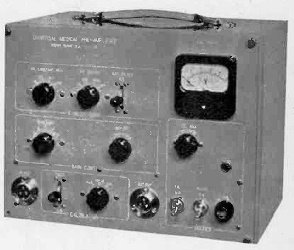
Unit is medical electronics preamp. Most Japanese instruments, even those for local use in Japan, are labeled in English. The quality of American instruments and the enormous prestige of our own electronics industry have produced some curious practices in Japan. Nearly all Japanese instruments carry dial titles and indications in English, although few are exported - so far. Many Americans scorn the Japanese as copy cats. Actually, there's good reason for copying. When you copy a successful radio or other appliance, there's not as much risk as there would be of a new design. Don't forget that nearly all American manufacturers "borrow" good ideas and circuit features from each other. They'd be fools not to. I've discovered that the Japanese generally improve on the equipment whose basic circuits they copy. For instance, I saw some video tape recorders in Japan that beat the American originals in performance. In addition, the Japanese have invented some original electronic devices that are almost unknown in America. One company, Taiko Electric, makes a burglar and fire alarm that connects to the telephone. If a burglar enters the guarded premises, the machine automatically - and silently - dials the police and repeats over and over again a recorded message including the address of the place. In case of fire, the machine calls the fire department. It only costs $261 in Japan. What would happen if the Japanese started shipping color TV sets to this country? My knowledge of the American electronics industry and my tours of Japan have convinced me that if the prices of color TV receivers drop to a level at which the great mass of American families will rush to buy them, the sets will be imported from Japan.
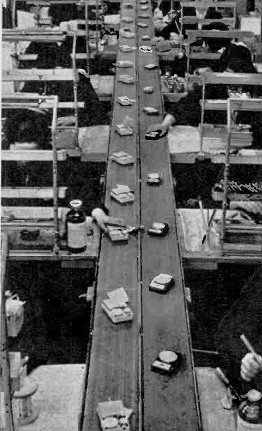
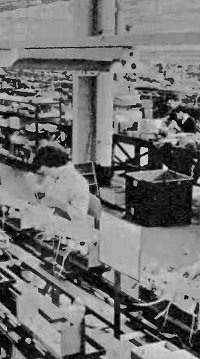
Pocket transistor radios are being mass produced on assembly lines.
Low-cost labor and semi-automation help keep prices down. Using the difference in price between American transistor radios and the Japanese models that are taking over the market as a guide, high-quality Japanese color consoles might be sold in the United States as low as $250. This is just one-half the suggested list price for the most inexpensive color set made by RCA. General Electric has recently announced that color TV is going no place at present. But Admiral has gone back into the manufacture of color sets. There seems to be some confusion. Does the American consumer want color TV or doesn't he? I think he would want it - if the price were right. I urged my many Japanese friends, as well as those government officials concerned, to standardize on a 21" color picture tube. My argument was that the only way for color TV to become a paying proposition in Japan was through heavy exports of the same sets to America. At present they have agreed on a 17" tube, which is more than adequate for the small Japanese equivalent of our living room. However, I believe that the Japanese electronics industry will go to a 21" color set within the next year or so, since that is the only size that can sell a color set in the U. S. The increase in picture size would take little effort since it doesn't cost very much more to make a 21" color set than a 17-incher. Incidentally, the pictures on the Japanese TV sets I have watched are excellent. There's a lot of grumbling in the American electronics industry about Japanese imports, although many American manufacturers are buying Japanese transistors, tubes and parts to incorporate in their own finished products. Some Americans are calling for protective tariffs against Japanese electronic goods in an effort to tax them right out of the American market. I think that would be a costly mistake. First of all, it would mean loss of the substantial Japanese market for American instruments and high-grade components. More important, the Japanese are our good friends and staunch allies. Let's keep them that way by competing only with new ideas and automatic production, instead of through tariffs or quotas. In this competition some American companies may lose a few rounds because the Japanese have undoubtedly appealed to the American consumer with the one thing the consumer understands best - low prices. But I am convinced that these imports will only stimulate, not ruin, the American electronics industry. |
|||||||||||||
 |
|||||||||||||
|
|||||||||||||

|
||||||||||||||||||||||||||||||||||||