|
|||||||||||||
 |
|||||||||||||
Signal Propagation Time |
|||||||||||||
|
If a radar system is being evaluated where a round trip out and back needs to be accounted for, then double the range figure. A "radar mile," which is a nautical mile out and a nautical mile back, is 12.36 μs. Note: When using these formulas, be sure to keep dimensional units consistent; i.e., do not mix kHz with MHz, mm with inches, etc. It is safer to use base units (e.g., Hz, m) for calculation, then convert result to desired units. Two charts of propagation time vs. distance are provided below - one for units of km and one for units of miles. Here is information on Doppler, radar equation and path loss. A 1-Way and 2-Way Path Loss Calculator is included in Espresso Engineering Workbook™ for FREE.
|
|||||||||||||
 |
|||||||||||||
|
|||||||||||||
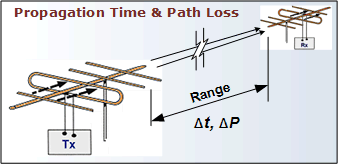 A finite
amount of time is required for a signal to travel from one place to another. In
a vacuum, electromagnetic energy travels at 2.9979*105 km/s (186,282
mi/s). The following equation holds for signal propagation time in a vacuum (and
in the air), where the relative dielectric constant (εr) is 1. In keeping
with a radar theme, 'R' is used for range rather than the more common 'd' for distance.
Be sure to keep dimensional units consistent across all values.
A finite
amount of time is required for a signal to travel from one place to another. In
a vacuum, electromagnetic energy travels at 2.9979*105 km/s (186,282
mi/s). The following equation holds for signal propagation time in a vacuum (and
in the air), where the relative dielectric constant (εr) is 1. In keeping
with a radar theme, 'R' is used for range rather than the more common 'd' for distance.
Be sure to keep dimensional units consistent across all values.



|
||||||||||||||||||||||||||||||||||||