|
Here is the "Electrician's Mate 3 - Navy Training Courses"
(NAVPERS 10548) in its entirety (or will be eventually). It should provide one of
the Internet's best resources for people seeking a basic electricity course - complete
with examples worked out. See
copyright.
See Table of Contents.
¶ U.S. GOVERNMENT PRINTING OFFICE;
1949
CHAPTER 2
MAGNETISM
IMPORTANCE OF MAGNETISM
NOTICE: This page has not been proofed yet!
Magnetism is so common and many of its characteristics have been known by every boy for so many years that its
real importance in the electrical world is apt to be overlooked. Magnets and magnetism are involved vitally in the
operation of nearly all electrical machinery. Without it there would not be any motors, telephones, radios,
telegraphs, and hundreds of other common items. In fact, electricity would still be an infant of no particular
value to anyone instead of a powerful giant, if the use of magnetism to generate electricity had not been
discovered.
Since magnetism plays such an important role in electricity, a good review of what you have
learned in the Basic Electricity text added to your own practical experience will insure that you are off on the
right track.
NATURAL MAGNETS
Many different stories are told of how magnetism was discovered, but all relate how ancient shepherds of
Magnesia, a section of Asia Minor, found a stone that had the ability to attract the iron tips of their staffs.
Naturally the full meaning of this phenomenon was not understood, but little by little the ancient shepherds, then
sailors, and later scientists, assembled the important characteristics of magnetism.
d MAGNETITE. Because
of its tendency to attract iron objects, and because it always tends to assume a northsouth direction, it was
given the name LEADING STONE, later shortened to the name LODESTONE.
The lodestone had obtained its
magnetism from the magnetic field of the earth. The stone had spots where the magnetism seemed to concentrate like
the earth's north and south magnetic poles, so the lodestone also was said to have magnetic poles.
Lodestones are considered NATURAL magnets. They are not powerful in their ability to attract iron objects, so are
seldom used in any electrical machinery. Their chief use is for demonstration and to produce ARTIFICIAL magnets of
iron and steel.
MAGNETIC MATERIALS
Iron, and its derivative steel, make the strongest artificial magnets. Several other metals-nickel, cobalt,
magnesium, cerium, and chromium-also possess magnetic properties but these are weaker than in iron. Recently,
alloys formed of the magnetic materials and some nonmagnetic substances such as aluminum have shown magnetic
properties of far greater strength than iron or steel. Alnico is one of these alloys. Other examples are
permalloy, perminvar, and hiperuick.
NONMAGNETIC MATERIALS
Any material not attracted by a magnet is considered nonmagnetic. This includes practically all materials
except those mentioned in the preceding paragraph. Air, copper, aluminum, rubber, wood, fiber, and Bakelite are a
few of the nonmagnetic materials with which an electrician's mate is familiar.
You should not confuse
nonmagnetic materials with nonconductors of electricity. While nonmagnetic substances are not affected by
magnetism, they are TRANSPARENT to magnetic forces. You cannot insulate magnetism as you do electricity. A. magnet
will attract iron filings through air, paper, wood, or glass.
ARTIFICIAL MAGNETS, PERMANENT AND TEMPORARY
When a bar of hardened steel is stroked along its length in a single direction by one end of a lodestone, the
bar acquires magnetic properties similar to those of the lodestone. Magnets formed in this manner are artificial
magnets. If a bar of soft iron is placed end-to-end with the hard steel, artificial magnetism will be INDUCED in
it. The soft iron bar will also be an artificial magnet, but if the soft iron bar is taken away from the hard
steel bar the soft iron bar quickly loses its magnetism, while the hard steel retains its magnetic powers. The
hard steel forms a PERMANENT magnet, while the soft iron is a TEMPORARY magnet.
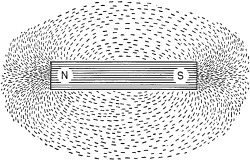
Figure 25. - Magnetic Field about a magnet.
Artificial magnets, made of hard steel and certain alloys, are much more powerful than natural magnets, which
are relatively weak. The natural magnets have no practical use in any practical electrical machinery. Artificial
magnets may be made in various shapes, such as a straight bar, horseshoe or U-shaped.
MAGNETIC FIELD ABOUT A BAR MAGNET
Iron filings sprinkled on a thin sheet of cardboard placed over a bar magnet will arrange themselves in curved
lines about the magnet as in figure 25. The arrangement of the filings will be more pronounced if the cardboard is
tapped gently as the filings are sprinkled.
Magnetism shows itself as if "lines" existed from one pole to
the other, as seen in figure 26. These lines are called LINES OF MAGNETISM or MAGNETIC LINES OF FORCE. The whole
arrangement usually is called the MAGNETIC FLUX. The space occupied by these lines is called the MAGNETIC FIELD.
The path through which magnetic lines pass is called the MAGNETIC CIRCUIT.
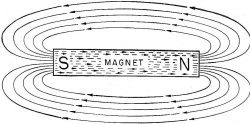
Figure 26. - Magnetic lines.
Exploring the field about a bar magnet with a magnetic compass will show the field to exist all about the
magnet. It is probable that if the lines of magnetism were visible, they would completely hide all parts of the
magnet from view.
MAGNETIC FIELD STRENGTH
/The number of lines of force in the cross-section area of a magnetic field describes the STRENGTH of the magnet.
This strength is often referred to as FLUX DENSITY and is expressed in so many thousand LINES PER SQUARE INCH of
cross section. The unit of flux density is the GAUSS. Remember these terms. You will be hearing them many times.
When a magnet is dipped in iron filings, most of the filings will adhere to the ends of the magnet in tufts as
shown in figure 27. The portion where there is little attraction is called the NEUTRAL REGION or EQUATOR. The
areas where the attraction is greatest are called the POLES. The two poles of a bar magnet are distinguished by
the position they "seek" or" point" to if the bar magnet is suspended so it can move freely. The one pointing
north is called NORTHSEEKING, or just NORTH pole for short, and the other SOUTHSEEKING pole, or SOUTH pole. In
practice the lines of magnetism are assumed to leave at the north pole and re-enter the magnet at the south pole,
as shown in figure 26. Within the magnet the lines continue from the south pole to the north pole, permitting each
line to form a closed loop.
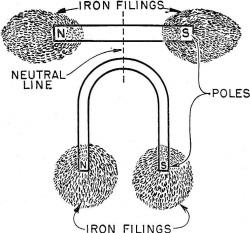
Figure 27. - Magnets holding iron Filings.
PROPERTIES OF MAGNETIC LINES OF FORCE
Magnetic lines have certain properties that every EM must know. Some are self-evident, others will be
explained later.
There is no insulator for magnetic lines; they pass through all materials.
Magnetic. lines pass through magnetic materials easily.
They tend to crowd into a magnetic material
instead of passing through the air.
Magnetic lines tend to shorten themselves as though they were
stretched rubber bands.
Magnetic lines flowing in the same direction tend to push each other apart.
Magnetic lines never cross each other.
Each magnetic line forms a complete (closed) loop.
ATTRACTION AND REPULSION OF MAGNETS
Suspend a bar magnet in a manner that leaves it free to swing, and approach each end with the north pole of
another magnet. You will find that the north pole of the suspended magnet is repelled and the south pole is
attracted. Then if you approach each pole of the suspended magnet with the south pole of the other magnet the
north pole is attracted and and the south pole repelled. This demonstrates two very important laws of magnetic
attraction.
UNLIKE POLES ATTRACT each other while LIKE POLES REPEL each other.
The ATTRACTION
between unlike poles IS EQUAL TO the REPULSION between like poles of the same magnets.
This property of
magnetic attraction and repulsion is very important because nearly every piece of rotating electrical equipment
depends on this simple principle for its operation.
Figure 28 shows the reaction between the fields of two
bar magnets with like poles near each other. Lines of force cannot cross, so they are forced to turn aside and go
in the same direction between the magnets. Since lines of force flowing in the same direction tend to push each
other apart, the magnets mutually repel each other.
On the other band, if you turn one of the magnets around so a north pole is opposite a south pole, the lines
of force travel directly from the north pole of one into the south pole of the other. See figure 29. Since the
magnetic lines behave if they are stretched bands, they try to shorten themselves, drawing the magnets together.
Note that the magnetic lines of force are crowded more closely together, and therefore the force of attraction or
repulsion is much greater, when the two poles are very nearly touching each other then when they are farther
apart.
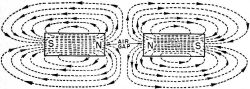
Figure 28. - Like poles repel.
Experimentally, the FORCE OF ATTRACTION OR REPULSION between poles of different magnets has been found to be
DIRECTLY PROPORTIONAL TO THE POLE STRENGTH of the magnets, and INVERSELY PROPORTIONAL TO THE SQUARE OF THE
DISTANCE between them. In other words, while the force between two magnets increases with the strength of the
magnets, it will increase at a much faster rate if the distance between the two poles is decreased.

Figure 29. - Unlike poles attract.
WEBER'S THEORY OF THE MOLECULAR NATURE OF MAGNETISM
Stroking a piece of iron or steel with a natural magnet causes the piece of iron or steel to take on the same
magnetic properties as when it is stroked with a lodestone. Why is this true? What change takes place in the iron
or steel causing it to acquire magnetic properties? Why can't copper, aluminum, wood, and most other materials be
magnetized? The answer to these questions is found in the structure of matter. You will recall (from your study
of Basic Electricity) that all matter is made up of tiny units called molecules, and that one or more atoms make
up each molecule. Each atom is composed of a central, positively charged nucleus surrounded by one or more
rapidly moving electrons (negative particles) traveling around the nucleus in orbits.
Figure 30.-Experiment for producing a magnetic field.
It has been demonstrated experimentally that electrons in motion create a magnetic field about themselves, and
this field is at right angles to the direction of their motion. Here is how it was done. Small circular pieces of
tinfoil were glued to the surface of a glass disk near its rim. Large negative charges were placed on the pieces
of tinfoil. Tl. '1 glass disk was then placed on a spindle and rotated at high speed by a motor. This rotation of
the negative charges set up a magnetic field in the direction shown in figure 30.
This rotating disk with
the electrons on the tinfoil is similar to a huge atom with all its electrons lined up in a single plane and
rotating at great speed. Thus if the electrons an atom all have their orbits of rotation in the same plane, and
they all rotate in the same direction like the charges on the disk, the atom will have a magnetic field of
definite polarity, as indicated in figure 31.

Figure 31.-An atom of a magnetic material.
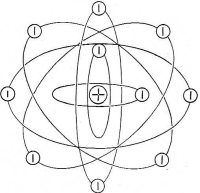
Figure 32.-An atom of a nonmagnetic material.
If, in the atom, the orbits of rotation of the electrons are not in a single plane, a condition as shown in
figure 32 exists. Such an atom will not exhibit magnetic properties because the different planes of rotation of
the electrons will produce tiny magnetic poles which act in different directions, hence cancel each other, leaving
no over-all magnetic effect in the atom.
It is therefore believed that magnetic materials are made up of
atoms similar to the one in figure 31, while nonmagnetic materials are made up of atoms similar to the one in
figure 32.
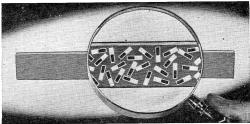
Figure 33. - Molecular arrangement, unmagnetized material.
This theory, that the individual atoms of a magnetic material are tiny magnets, was first evolved by a German
scientist named Weber. According to this theory, under ordinary conditions the molecule-magnets are arranged in a
haphazard way, as represented in figure 33, hence the north poles (black) and the south poles (white), cancel each
other's magnetic force, and so no external magnetic field is produced.

Figure 34. - Magnetizing a bar.
MAGNETIZING A MAGNETIC MATERIAL
Upon applying a magnetizing force, the small molecular magnets tend to arrange themselves so their magnetic
axes are parallel, with their like poles all pointing in the same direction, as illustrated in figure 34 .. The
forces of the molecular magnets will then be additive and will produce an external magnetic field.
EFFECT OF BREAKING A BAR MAGNET
The molecular theory of magnetism is supported by the fact that if a brittle bar of hard steel,
such as a hacksaw blade, is magnetized and then broken, each piece will be a magnet, as shown in figure 35.
Theoretically, if each piece could be broken up into smaller and smaller pieces until each was a molecule, all
would still be individual magnets.

Figure 35. - Effect of breaking a bar magnet.
CONSEQUENT POLES
Although the least number of poles a magnet can have is two, it may possess any number greater than two. All
these poles, except the two end poles, are called CONSEQUENT poles. If like poles of a weak and a strong magnet
approach each other, as a compass needle and a strong permanent magnet, the strong magnet may overcome the weak
one and reverse its polarity. Magnetic needles sometimes have their polarity reversed this way. In making tests
with a magnetic needle, always allow it to come to rest in the earth's field first, to see if its polarity
markings are correct. (The end which is supposed to point north is often painted blue or black and stamped with an
"N".)
If the polarity of a magnet has been reversed this may be detected by plunging its entire length into iron
filings or by exploring its field with a small pocket compass. If it has one or more consequent poles it will have
a field arrangement as shown in figure 36. Observe how the end marked "s" is now a north pole, . the same as the
end marked "N." Lines of force from the north poles of BOTH ends consequently are forced to enter the center
region of the magnet, forming a south pole there.
Figure 36. - Discovering consequent poles.
A reversed magnet like the needle in figure 36 may have its polarity corrected by stroking its entire length
in one direction with one pole of a permanent magnet, as shown in figure 34.
PERMANENT ARTIFICIAL MAGNETS
Hard steel is not as easily magnetized as soft steel, but it will retain its magnetism for a longer time.
Thus, hard steel makes good permanent artificial magnets. This may be explained by the molecular theory of
magnetism. In hard steel the molecules are tightly packed. When they are swung around to line up with a
magnetizing force, there is a high frictional resistance opposing the movement. However, once alined, this same
frictional resistance makes it difficult for the molecules to get out of line. Therefore hard steel retains its
magnetism well, even though there is normally a lot of motion going on within the individual molecules.
1£
a permanent magnet is jarred, vibrated, or hammered, some of its molecules will get out of line and weaken its
field. 1£ magnets are heated, the motion of the molecules will become violent and this also causes many molecules
to get out of line, weakening the field. Permanent artificial magnets are used in galvanometers, voltmeters,
ammeters, ohmmeters, meggers, magnetos, loudspeakers, telephone transmitters and receivers, magnetic' compasses,
and many other devices. The accuracy of these instruments depends on the strength of their permanent magnets
remaining constant. Therefore, a permanent magnet or ANY INSTRUMENT CONTAINING A PERMANENT MAGNET SHOULD NOT BE
JARRED, VIBRATED, HAMMERED, OR HEATED.
been developed it is possible to make permanent magnets powerful
enough to provide the magnetic fields of small d-c motors. Such motors are used as driving motors in some
amplidyne type power drives. Therefore, if you have to assemble or disassemble such a permanent-magnet-field
motor, be extra careful, because jarring or hammering the field magnets may kill their magnetism, and this will
destroy the usefulness of the motor.
LAMINATED MAGNETS
Thin steel magnets are stronger in proportion to their weight than thick ones. For a given amount of material,
a magnet made of several laminations (thin sheets), as shown .in figure 37, is more powerful than one made of
solid piece of metal. This is due largely to the fact that during heat treatment, the material within the thicker
magnets is not properly tempered throughout. The laminated permanent magnets are used mostly in electrical
measuring instruments.
TEMPORARY ARTIFICIAL MAGNETS
Soft iron and soft steel are easily magnetized because there is low frictional resistance between the
molecules, thus making it easy to swing them into line. However, when the magnetizing force is removed, the
motion within the molecules tends to make them lose their alignment. In many electrical machines such as motors,
generators, transformers, relays, and lifting magnets, a temporary magnet is desirable, and therefore they use
temporary artificial magnets.
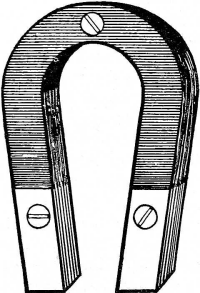
Figure 37.-A laminated horseshoe magnet.
MAGNETIC INDUCTION-MAGNETIC MATERIALS ATTRACTED BY A MAGNET
A piece of unmagnetized soft iron, placed in the magnetic field of a permanent magnet, assumes the properties
of the magnet; that is, it becomes magnetized. The magnetizing of a piece of iron or steel by the field of a
nearby magnet is called MAGNETIC INDUCTION. Magnetic induction in a magnetic material may be explained by the
properties of magnetic lines and the molecular theory of magnetism in this way:
Magnetic lines tend to pass
through a magnetic material rather than through air, as shown in figure 38. When the lines of the magnetic field
pass through the iron, the molecules readily line up parallel with the lines of force, and with their north poles
pointing in the direction that the lines of force are traveling through the iron. Thus, magnetism is INDUCED in
the iron. Remembering that where lines of force _eave the magnet in a north pole and where they enter is a south
pole, it will be observed that an unlike pole is formed in the end of the iron bar next the permanent magnet.
Between unlike poles the magnetic lines act as stretched rubber bands, so the unlike poles attract. Therefore, the
iron is attracted to the permanent magnet.
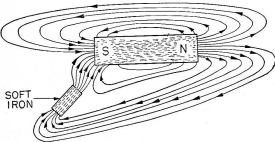
Figure 38.-Effect of a soft iron bar in a magnetic Field.
MAGNETIC SCREENING OR SHIELDING
No material is known that will effectively insulate against magnetic flux. Because of this, it is
sometimes difficult to eliminate the effect which stray magnetic fields have upon instruments such as magnetic
compasses, ammeters, voltmeters, etc. The stray magnetic fields in the vicinity of generators, motors,
transformers, and cables carrying large currents will therefore affect seriously the accuracy of these
instruments. Since lines of flux cannot be insulated, it is necessary to use something that will divert flux
around the 5trument. This is accomplished by placing a soft iron called a MAGNETIC SCREEN OR SHIELD, about the
instrument. Since the flux flows more readily through the iron than through the air, the instrument is effectively
shielded, as shown in figure 39. Even with a shield a few. lines may still pass through the instrument so all
instruments, even if magnetically shielded, should be kept away from strong magnetic fields as far as possible.
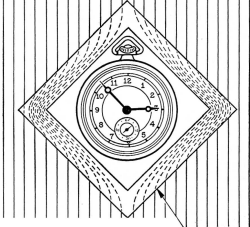
Figure 39. - Magnetic screen.
THE MAGNETIC COMPASS
A magnetic compass is merely a thin bar magnet, accurately balanced and suspended on a pivot so that it may
rotate freely. This thin bar, usually called the COMPASS NEEDLE, always tends to align itself parallel to the
lines of force of the field in which it is placed. The north end, usually painted blue or black, points in the
direction the magnetic lines are flowing, as shown in figure 40.

Figure 40. - Position of a compass needle.

Figure 41. - Pocket compass.
A pocket compass of the type shown in figure 41 is used to detect the presence of a magnetic field or to
determine its polarity. It is therefore often used to determine the polarity of poles in a generator or motor,
which in turn will indicate whether the field coils are connected correctly.
DETERMINING POLARITY OF UNMARKED MAGNETS
The fact that unlike poles attract and like poles repel can be used to determine whether a piece of material
is magnetized and, if magnetized, its polarity. If a compass is brought near one end of a supposed magnet, the
near end of the compass needle will be attracted or repelled. If the north pole of the needle swings toward the
object, the end nearest the compass appears to be a south pole. However, bear in mind that either end of a compass
needle will be attracted to a piece of unmagnetized iron or steel. As a check, place the other end of the compass
needle near the unmarked magnet. It will be repelled if the unmarked magnetic material is actually magnetized.
Chapter 2 Quiz
(click
here)
|