If you happen to be a fan of the M*A*S*H
television series from the 1970s, then undoubtedly you are familiar with Corporal
Maxwell Q. Klinger's multiple mentions of his old neighborhood
of Toledo, Ohio haunts - some manufactured and some real.
 His
Toledo Mud
Hens ball team, for instance, is real. Uncle Abdul (Klinger is of Lebanese-American
descent) and his original wife Laverne Esposito (from the Hungarian side of Toledo)
were obviously fictional; however, it was because of Laverne that Klinger was introduced
to Tony Packo's Cafe - a
real place.
His
Toledo Mud
Hens ball team, for instance, is real. Uncle Abdul (Klinger is of Lebanese-American
descent) and his original wife Laverne Esposito (from the Hungarian side of Toledo)
were obviously fictional; however, it was because of Laverne that Klinger was introduced
to Tony Packo's Cafe - a
real place.
 The Hungarian style hot dogs from Tony Packo's
were tops according to Max. In fact, his mention on the television show launched
Tony Packo's to stardom and to being a highly prized tourist destination. On Feb.
24, 1976, Jamie Farr (Klinger) put Tony Packo's on the map when during the show
a touring TV newsman at the 4077th M*A*S*H interviewed him for a special interest
piece. Farr, a native Toledoan himself, ad libbed, "If you're ever in Toledo, Ohio,
on the Hungarian side of town, Tony Packo's got the greatest Hungarian hot dogs.
Thirty-five cents..."
The Hungarian style hot dogs from Tony Packo's
were tops according to Max. In fact, his mention on the television show launched
Tony Packo's to stardom and to being a highly prized tourist destination. On Feb.
24, 1976, Jamie Farr (Klinger) put Tony Packo's on the map when during the show
a touring TV newsman at the 4077th M*A*S*H interviewed him for a special interest
piece. Farr, a native Toledoan himself, ad libbed, "If you're ever in Toledo, Ohio,
on the Hungarian side of town, Tony Packo's got the greatest Hungarian hot dogs.
Thirty-five cents..."

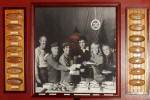
Here are some photos from the M*A*S*H television show where the
crew is eating Tony Packo's hot dogs.
 Well, I can now tell you that
Tony Packo's hot dogs cost a bit more than 35¢ today, but they are still really
good. On our way to Michigan last week, Melanie and I stopped by Tony Packo's to
visit the establishment of legend. It was less than a mile off of I-80, and very
easy to access, being on the edge of town.
Well, I can now tell you that
Tony Packo's hot dogs cost a bit more than 35¢ today, but they are still really
good. On our way to Michigan last week, Melanie and I stopped by Tony Packo's to
visit the establishment of legend. It was less than a mile off of I-80, and very
easy to access, being on the edge of town.
 The menu featured many Hungarian items, but
we stuck with the famous Original Hot Dog and a bowl of Kraut Cabbage. There are
many cool artifacts from the M*A*S*H television show including photographs and hot
dog buns signed by M*A*S*H actors (and many other celebrities), and also the package
actually used in the TV show from when Klinger placed an order to be mailed to Korea.
See photos.
The menu featured many Hungarian items, but
we stuck with the famous Original Hot Dog and a bowl of Kraut Cabbage. There are
many cool artifacts from the M*A*S*H television show including photographs and hot
dog buns signed by M*A*S*H actors (and many other celebrities), and also the package
actually used in the TV show from when Klinger placed an order to be mailed to Korea.
See photos.
 One unexpected treasure I found
was a vintage Silvertone console style radio. Silvertone was a brand name of Sears,
Roebuck & Co. Per a book by Mark V. Stein there were over 30 radio brands that
supplied Silvertone radios for Sears including King, Colonial, Stewart-Warner, Air
King, Emerson, Kadette, Wilcox-Gay, Arvin, Case, RCA and Admiral.
One unexpected treasure I found
was a vintage Silvertone console style radio. Silvertone was a brand name of Sears,
Roebuck & Co. Per a book by Mark V. Stein there were over 30 radio brands that
supplied Silvertone radios for Sears including King, Colonial, Stewart-Warner, Air
King, Emerson, Kadette, Wilcox-Gay, Arvin, Case, RCA and Admiral.
 An Internet image search did not turn up
an exact duplicate of the model at Tony Packo's. The radio has been converted into
a podium or dais of sorts, probably once used at the door to greet customers. I
found it tucked back in a corner near the maintenance closet. The back has been
covered with plywood so I wasn't able to snoop inside for a model number or date.
There are versions close to this one, but most have five knobs under the dial, and
the dial is usually larger. It doesn't even appear on the
Radio
Attic website. Can you identify the model number and year for me?
(see Update below)
An Internet image search did not turn up
an exact duplicate of the model at Tony Packo's. The radio has been converted into
a podium or dais of sorts, probably once used at the door to greet customers. I
found it tucked back in a corner near the maintenance closet. The back has been
covered with plywood so I wasn't able to snoop inside for a model number or date.
There are versions close to this one, but most have five knobs under the dial, and
the dial is usually larger. It doesn't even appear on the
Radio
Attic website. Can you identify the model number and year for me?
(see Update below)
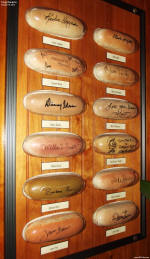
 These hot dog buns have the
signatures of Radar O'Rielly (Gary Burgoff), and Klinger (Jamie Farr), amongst others
like Barbara Bush (former 1st Lady), Michael Dukakis (presidential candidate), Willard
Scott (weatherman), Danny Glover (washed-up actor), Morton Dowey, Jr. (insane TV
host), Leslie Uggams (actress / singer), Jerry Lewis (comedian / actor), Sawyer
Brown (country music group), Melissa Ethridge (rock singer), and Bob Knight (basketball
coach).
These hot dog buns have the
signatures of Radar O'Rielly (Gary Burgoff), and Klinger (Jamie Farr), amongst others
like Barbara Bush (former 1st Lady), Michael Dukakis (presidential candidate), Willard
Scott (weatherman), Danny Glover (washed-up actor), Morton Dowey, Jr. (insane TV
host), Leslie Uggams (actress / singer), Jerry Lewis (comedian / actor), Sawyer
Brown (country music group), Melissa Ethridge (rock singer), and Bob Knight (basketball
coach).
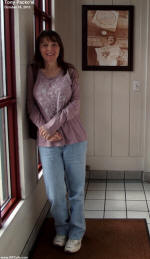
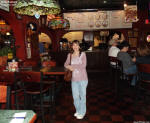 Here is Melanie inside the
front section of Tony Packo's Cafe. You can see the menu in the background. To the
right is a photo of Jamie Farr holding a copy of the Toledo Blade newspaper in front
of Tony Packo's Cafe.
Here is Melanie inside the
front section of Tony Packo's Cafe. You can see the menu in the background. To the
right is a photo of Jamie Farr holding a copy of the Toledo Blade newspaper in front
of Tony Packo's Cafe.
December 30, 2015 Update:
 RF Cafe visitor Mike H.
sent me these two photos of the same type Silvertone radio as I discovered in Tony
Packo's. He says there is no part number marked anywhere, so its identity was still
a mystery.
RF Cafe visitor Mike H.
sent me these two photos of the same type Silvertone radio as I discovered in Tony
Packo's. He says there is no part number marked anywhere, so its identity was still
a mystery.  Well, no more! I decided to
use my paid subscription to newspapers.com to search for an advertisement from an old newspaper.
Sure enough, there was a full-page advertisement by Sears, Roebuck, and Co., in
the October 23, 1936 edition of the Rio Grande Farmer that appears to include
this model. Until proven otherwise, I hereby declare the Tony Packo's radio to be
the '7 Tube Silvertone Battery Console.'
Well, no more! I decided to
use my paid subscription to newspapers.com to search for an advertisement from an old newspaper.
Sure enough, there was a full-page advertisement by Sears, Roebuck, and Co., in
the October 23, 1936 edition of the Rio Grande Farmer that appears to include
this model. Until proven otherwise, I hereby declare the Tony Packo's radio to be
the '7 Tube Silvertone Battery Console.'
|

Sears Silvertone 7-Tube Console Radio Found in Tony Packo's
|

1937 Sears, Roebuck and Co. Advertisement
(newspapers.com image)
|
Battery powered radios were quite common in 1937 because commercial AC power
distribution lines did not extend to many rural locations, and a lot of urban homes
did not have service, either. Lead-acid storage batteries powered appliances and
lights in those homes without AC service. For more than a decade it was not unusual
to find both AC and DC wiring in homes and businesses. During that transition period,
many companies designed products that could operate on either AC or DC, too often
using circuits that placed exposed metal parts at potentially fatal voltage levels.