|
|||||||||||||
 |
|||||||||||||
Computing the Harmonic Content of Any Periodic Complex Waveform
|
|||||||||||||
|
1 | 2 | 3 | 4 | 5 | 6 | 7 | 8 | 9 | 10 | 11 | 12 | 13 | 14 | 15 | 16 | 17 | 18 | 19 | 20 | 21 | 22 | 23 | 24 | 25 | 26 | 27 | 28 | 29 | 30 | 31 | 32 | 33 | 34 | 35 | 36 | 37
12-element Fourier-type analysis for calculating up to 6th harmonic of periodic waveform.
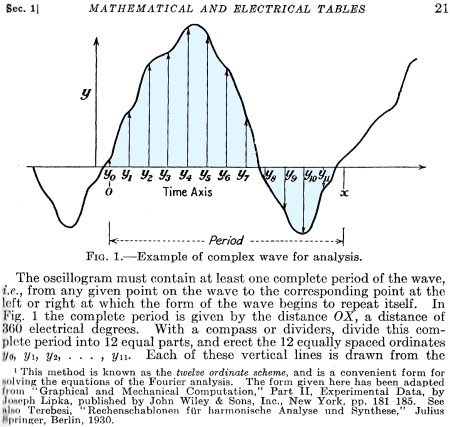
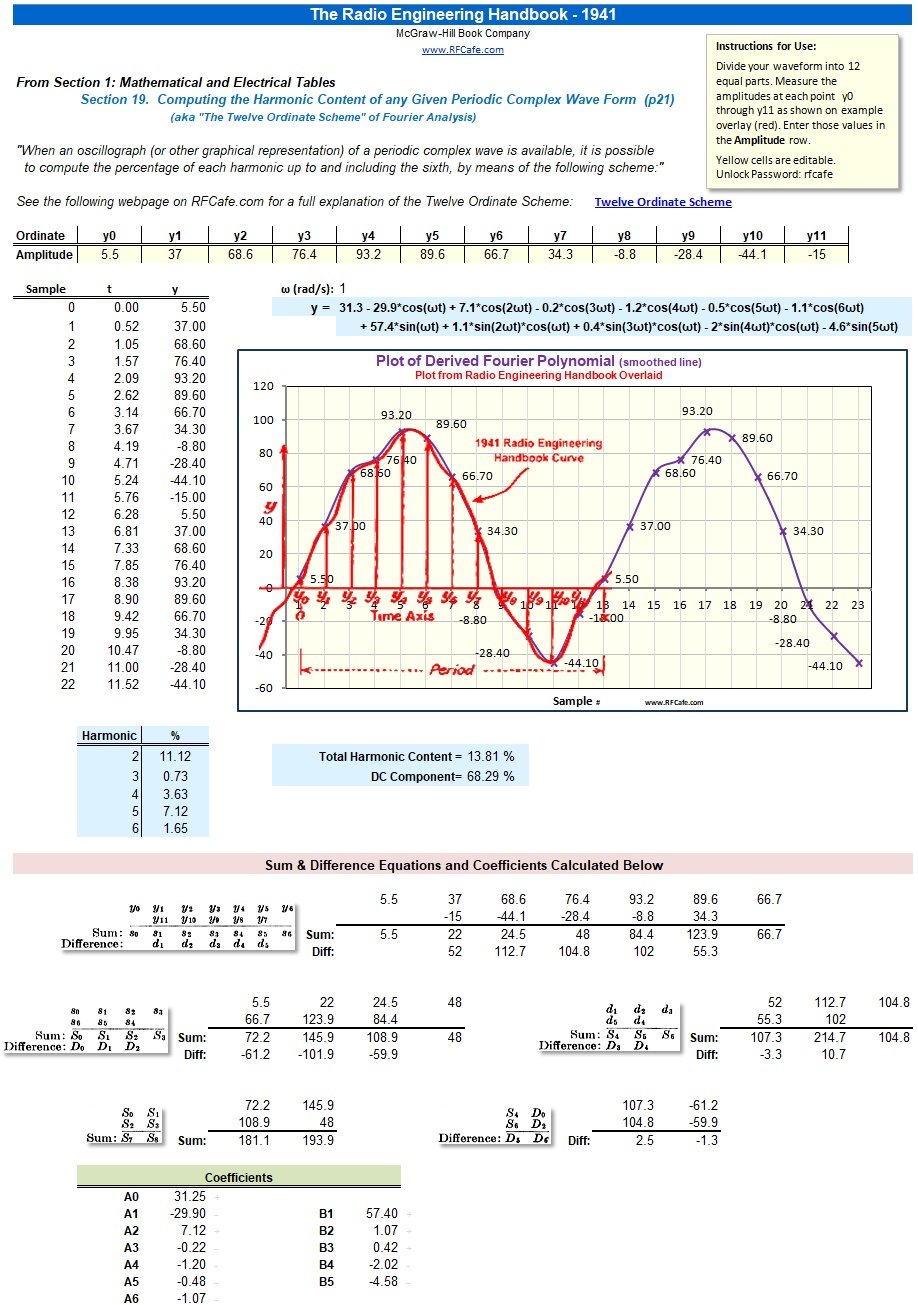
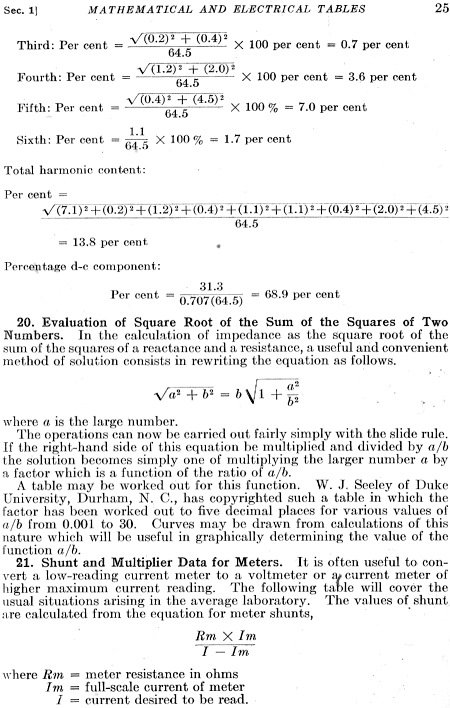
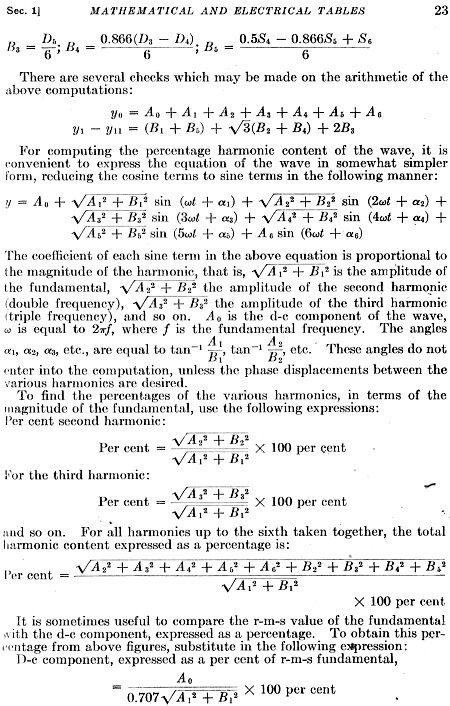
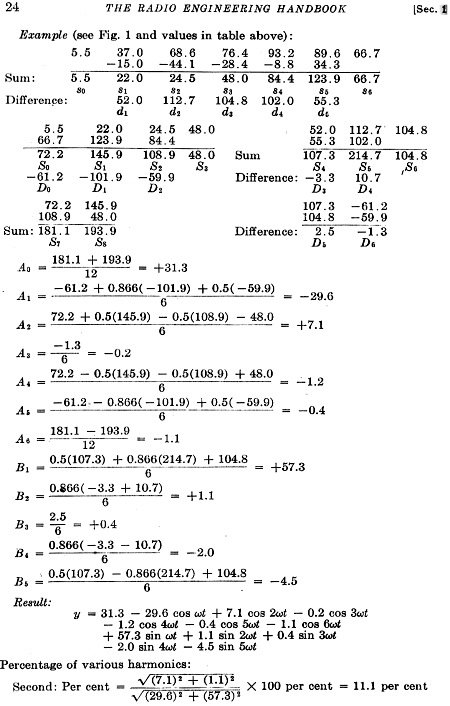
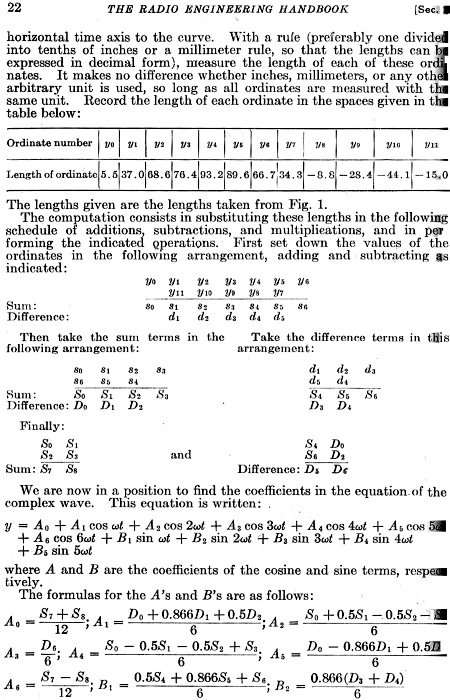
Note that the example waveform does not actually repeat itself. I found a copy of the 1941 Radio Engineering Handbook, by McGraw-Hill Book Company at a Goodwill store. The cover was beat-up, but the inside pages are all good. The "Mathematical and Electrical Tables" section has an interesting method for calculating up to the sixth harmonic of any periodic waveform by dividing the period into twelve equal parts (in time) and noting the amplitudes at each point - aka "The Twelve Ordinate Scheme." Those values are plugged into a host of equations that yield essentially the Fourier coefficients for a 12-element polynomial describing the curve. The text also provides equations for calculating harmonic content. Calculating the polynomial coefficients is a simple process of doing iterations of sums and differences of amplitudes, a la the Fourier analysis. Care must be taken to get the numbers right or the resulting equation will not reproduce the original waveform. In 1941, the user needed to look up in a table or find on a slide rule the sines and cosines of nωt angles associated with each term, then multiply that by the calculated coefficient. Finally, after all twelve points were figured, a plot was made to verify results. Of course some manual curve fitting was needed to make it look like the original.
Spreadsheet screenshot for Periodic Waveform Harmonics Calculation via the 12 Ordinate Scheme. <download> When I first saw the example waveform, I thought the second cycle did not look a lot like the first cycle. Superimposing the first onto the second, as done in the upper left image, shows that is the case, and therefore the example waveform as presented is not truly periodic and would not qualify for the analysis. It really does not matter for the purposes of the exercise. My interest in the process was piqued, so I created a spreadsheet to do all the hard work - although creating and verifying the spreadsheet took quite a bit of time, too. I am happy to report that the outlined process does indeed reproduce the original curve within reasonable accuracy. Scans of the original pages from which I obtain the equations are included at the bottom of this page. Section 19. Computing the Harmonic Content of any Given Periodic Complex Wave Form - The Twelve Ordinate Scheme "When an oscillograph (or other graphical representation) of a periodic complex wave is available, it is possible to compute the percentage of each harmonic up to and including the sixth, by means of the following scheme:"
<Previous Next>
Posted July 15, 2021 |
|||||||||||||
 |
|||||||||||||
|
|||||||||||||
 "
"


|
||||||||||||||||||||||||||||||||||||