|
 |
Lawrence Livermore's National Ignition Facility Achieves Record Laser Energy
in Pursuit of Fusion Ignition |
This story was retrieved from the Lawrence Livermore National Laboratory website. Neither
Lawrence Livermore National Laboratory nor any other entity represented in the article endorses this
website.
LIVERMORE, Calif. -- The National Ignition Facility (NIF), the world's most energetic laser, surpassed a
critical milestone in its efforts to meet one of modern science's greatest challenges: achieving fusion ignition
and energy gain in a laboratory setting. NIF's 192 lasers fired in perfect unison, delivering a record 1.875
million joules (MJ) of ultraviolet laser light to the facility's target chamber center.
This historic laser
shot involved a shaped pulse of energy 23 billionths of a second long that generated 411 trillion watts (TW) of
peak power (1,000 times more than the United States uses at any instant in time).
The record-breaking shot
was made March 15.
"This event marks a key milestone in the National Ignition Campaign's drive toward
fusion ignition," said NIF Director Edward Moses. "While there have been many demonstrations of similar equivalent
energy performance on individual beams or quads during the completion of the NIF project, this is the first time
the full complement of 192 beams has operated at this energy. This is very exciting, like breaking the sound
barrier."
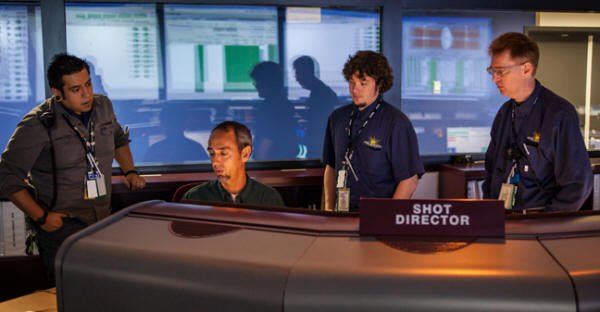
Control room staff at the National Ignition Facility monitor the progress of the world's most energetic
laser shot on March 15. From left: Rodrigo Miramontes-Ortiz, Dean LaTray, Scott Phillip Rogers, Dean Steven
Felzkowski.
Photos by Damien Jemison/NIF
High Resolution
Image
The ultraviolet energy produced by NIF (after conversion from the original infrared laser pulse to the final
ultraviolet light) was 2.03 MJ before passing through diagnostic instruments and other optics on the way to the
target chamber. As a result, NIF, located at Lawrence Livermore National Laboratory, is now the world's first 2 MJ
ultraviolet laser, generating nearly 100 times more energy than any other laser in operation.
 Norris Lao and Dean LaTray
smile as they view the results of the world's most energetic laser shot on March 15.
High
Resolution Image
Satisfying the NIF objective coincides with the third anniversary of the startup of NIF operations in March 2009,
when 1 MJ operation was first achieved. Since then, NIF has increased its operational energy about 1 kilojoule
each day for three years, a remarkable achievement. Today, NIF is fully operational around the clock, completing
important steps toward the goal of ignition and providing experimental access to national and international user
communities.
The 1.875 MJ shot exceeds NIF's original design specification and sets the stage for full-power
experiments over the coming months. Not only did the shot achieve the highest recorded energy threshold, it also
was one of the most precise ever fired at NIF: The energy produced was within 1.3 percent of its goal. Such
precision is vital because the energy distribution among the beams determines how symmetrical an implosion is
obtained in capsules containing fusion fuel. Implosion symmetry is a critical factor in achieving the pressures
and temperatures required for ignition. Moses said that NIF will pursue operations at even higher power and higher
energy levels to achieve ignition.
"Our facility's ability to demonstrate this level of precision performance as part of routine operations is a
testament to the efforts of multiple teams supporting laser operations, target chamber operations, transport and
handling and optics refurbishment," Moses said.
"For the past 15 years, since NIF groundbreaking in 1997,
the scientific community has regarded the 1.8 MJ milestone as a tremendous technical challenge," said NIF
Operations Manager Bruno Van Wonterghem. "In 2003, we demonstrated this performance level on a single beam line,
and in 2008 we repeated the demonstration on a single quad of four beams. To achieve this performance level with
this kind of precision, quality and reliability on all 192 beams is unprecedented and very exciting."
Van Wonterghem points in particular to the enormous progress NIF scientists and engineers have made in
economically maintaining the facility's optics system while operating at unprecedented energy levels.
Located at Lawrence Livermore National Laboratory, NIF is funded by the National Nuclear Security Administration
(NNSA), a semi-autonomous agency within the U.S. Department of Energy responsible for enhancing national security
through the application of nuclear science to the nation's national security enterprise.
NIF is the
nation's premiere facility for
stockpile stewardship, the NNSA program to ensure the safety, security and effectiveness of the nuclear
deterrent without underground testing. NIF also is providing unique experimental opportunities for scientists to
enhance our understanding of the universe by creating the same extreme states of matter that exist in the centers
of planets, stars, and other celestial objects. Experiments at NIF are also laying the groundwork for a
revolutionary compact electrical power plant design called Laser Inertial Fusion Energy (LIFE), which would
provide abundant and sustainable amounts of clean energy.
More Information
National Ignition Facility
Laser Inertial
Fusion Energy (LIFE)
Enhanced damage
resistance for NIF optics, Science and Technology Review, September 2011
Department of Energy
announces completion of world's largest laser, LLNL news release, March 31, 2009
National Ignition
Facility achieves unprecedented 1 megajoule laser shot, LLNL news release, Jan. 27, 2010
World's largest laser
sets records for neutron yield and laser energy, LLNL news release, Nov. 8, 2010
National Ignition Campaign
Founded in
1952, Lawrence Livermore National Laboratory provides solutions to our nation's most important national security
challenges through innovative science, engineering and technology. Lawrence Livermore National Laboratory is
managed by Lawrence Livermore National Security, LLC for the U.S. Department of Energy's National Nuclear Security
Administration.
|
|
|
|
|