|
Please go to the
RF Cascade Workbook 2018™
webpage for features and purchasing information.
Thank you.
RF Cascade Workbook 2005 is now included with the purchase of
RFCW vL!
User's Guide
System Requirements:
Microsoft Excel 2007 or newer.
(file
will be sent via e-mail shortly after receipt of payment)
Complete
User's Guide
is Online
-- RF Cascade Analysis --
-- Now
Includes Filter and Mixer/LO
Frequency Calculations --
Graham Seale has provided an example of RF Cascade Workbook 2005 running under
the Linux
OS.
 RF Cascade
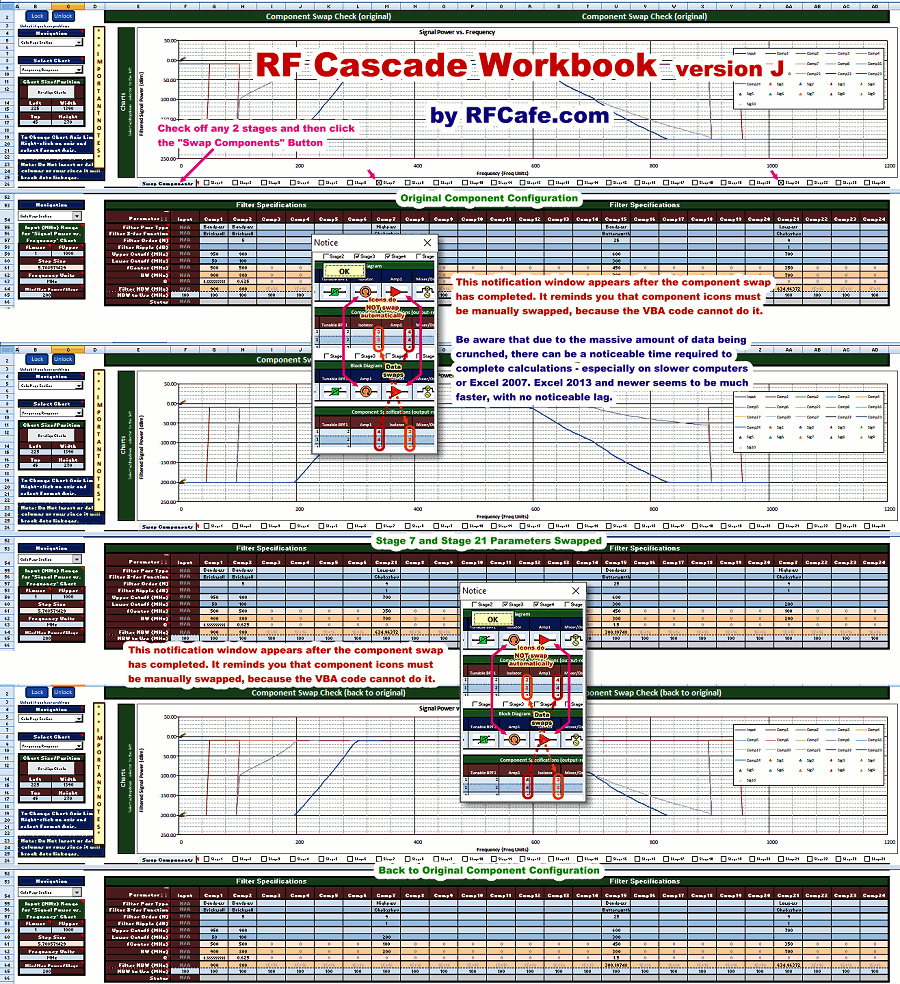
Workbook 2005 (RFCW2005), a sophisticated Excel spreadsheet workbook, is built on
the format of RFCW2003, and now includes filter response and frequency conversion.
The number of filters and mixers that can be used are limited only by Excel and
your computer. Additionally, 2nd-order calculations that were introduced in RFCW2004
are included. A return to the RF Cascade Workbook 2003 format was chosen because
the necessary multi-page format makes adding and deleting components simpler. RF
cascade analysis. RF Cascade
Workbook 2005 (RFCW2005), a sophisticated Excel spreadsheet workbook, is built on
the format of RFCW2003, and now includes filter response and frequency conversion.
The number of filters and mixers that can be used are limited only by Excel and
your computer. Additionally, 2nd-order calculations that were introduced in RFCW2004
are included. A return to the RF Cascade Workbook 2003 format was chosen because
the necessary multi-page format makes adding and deleting components simpler. RF
cascade analysis.
 All
of the formulas used in RF Cascade Workbook 2005 are presented in the highly detailed
User's
Guide to assist in understanding the operation of the spreadsheet. All
of the formulas used in RF Cascade Workbook 2005 are presented in the highly detailed
User's
Guide to assist in understanding the operation of the spreadsheet.
 Most
calculations are implemented in VBA code, which makes customization more convenient
and keeps clutter out of the cells. This is especially helpful in the case of conditional
formulas. Expansion of the workbook to include custom calculations is a simple matter. Most
calculations are implemented in VBA code, which makes customization more convenient
and keeps clutter out of the cells. This is especially helpful in the case of conditional
formulas. Expansion of the workbook to include custom calculations is a simple matter.
 Note: The file is saved in a format that
accommodates back through Excel 95. If you are using Excel version 2002 or newer,
re-saving the file in the newer format will reduce the file to about half its current
size. Note: The file is saved in a format that
accommodates back through Excel 95. If you are using Excel version 2002 or newer,
re-saving the file in the newer format will reduce the file to about half its current
size.
  The User's guide presents useful system
design information such as one of the best graphical explanations of spectral inversion
you will see (IMHO). Click here to view the entire User's Guide, and then order the software
☺. I have a
PDF version of the User's Guide for owners if you write to request it. Thanks. The User's guide presents useful system
design information such as one of the best graphical explanations of spectral inversion
you will see (IMHO). Click here to view the entire User's Guide, and then order the software
☺. I have a
PDF version of the User's Guide for owners if you write to request it. Thanks.
Note: Version 1.11 changes the value used for testing saturation conditions
from P[sig]min to P[sig]max.
This assures that the worst-case combination of
power and signal gain are accounted
for.
Thanks to Ken H. for the suggestion.
|