|
There are so many pages on the Internet with information on π
(pi) that I will not even attempt to outdo them. However, if you happened upon this website and are looking for
series expansions for calculating π, then you have come to the
right place. Here are a few of the most popular. The earliest renditions of
π resulted from estimating the relationship of measurements of
the circumference of a circle to its diameter. Here are a few early values, which were all ratios of whole numbers
because at the time it was inconceivable that something "irrational" could exist:
- 3 = value implied in the Bible in I Kings 7:23
-
 = upper bound by Archimedes
-
 = lower bound by Adriaan
-
 = Otho's value
-
 = Ptolemy's value (he used 3.14167 in his calculations).
- A few others:

Here's an interesting property I just noticed myself about Ptolemy's value (even though it is of no consequence):
the numerator is the impedance of free space, and the denominator times
π yields the numerator, so, rearranged, 120π=377!
π was calculated to 200 places in 1844 by Johann
Martin Zacharias Dase (1824-1861).
 and since
  , then , then
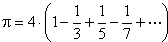 , ,
which is the first infinite series ever found for π, by James
Gregory (1638-1675). The problem is that this series (called the Gregory-Leibniz series) converges very slowly on
π: 300 terms are needed to be accurate to only two decimal
places! Newton (1656-1742) had a better idea (many, actually) and discovered the following:
 ,
and since  , then
 ,
which converges much more quickly.
He then determined that
 ,
which produces π to 16 decimal places using only 22 terms. ,
which produces π to 16 decimal places using only 22 terms.
Another series by Gregory was produced using two arctangents which resulted in:

Euler (1707-1783) determined that
 , exactly. Of course, the
arctangents are irrational. Euler calculated π to 20 decimal
places in one hour using this formula. , exactly. Of course, the
arctangents are irrational. Euler calculated π to 20 decimal
places in one hour using this formula. This series by David and Gregory Chudnovsky of Columbia
University produced over 4 billion digits in 1994, and each term gives an additional 14 digits:
The incredibly simple series here was recently discovered:

...and was used as the basis for a handy algorithm that produces any digit of
π one might desire, albeit in hexadecimal - see Reference 2,
below, for the formula (too much involved to repeat it here). (thanks to Hugo K. for these last three
items and for Reference 2, below)
1. For a very extensive treatise on
π, please read the source of this material, "A History of Pi"
by Petr Beckmann2. "The Quest for Pi" by David H. Bailey, Jonathan M. Borwein, Peter B. Borwein and Simon
Plouffe
June 25, 1996 Ref: Mathematical Intelligencer, vol. 19, no. 1
(Jan. 1997), pg. 50–57
|