|
Chapter 1,
2,
3,
4,
5,
6,
7,
8,
9,
10,
11,
12,
13
Version 1.11 by Kirt Blattenberger
RF Cafe Website (www.rfcafe.com)
Chapter 10
10
DC Power Budget
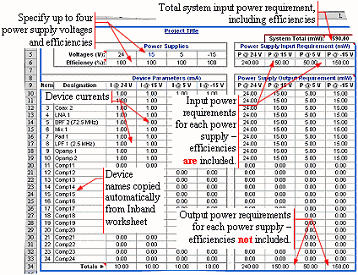
On this worksheet,
cells are provided for entering the power supply voltages and
currents for each device. Efficiencies are also assigned to
each supply to permit the total system input power to be calculated.
Enter the supply
voltage(s) in the cells at the top. Negative values do not affect
the power calculation. The titles of the current and power columns
will automatically change to reflect the values entered for
the voltages.
Enter the efficiency
of each supply to permit a total system power requirement to
be calculated. Enter “100” for the efficiency otherwise.
|
Parameter
|
Description
|
Range
|
Tolerance
|
Units
|
Voltages |
Power supply nominal
output voltages |
-500 to +500
|
-
|
V
|
Efficiency |
Efficiency in
converting from input voltage to output voltage |
1 to 100
|
-
|
%
|
Device Parameters |
Device current
requirement |
-105 to +105
|
-
|
mA
|
|
|
Table 7 DC Power
Budget Input Parameters
|
|
Power calculation is straight forward
as follows, where the power is the required output power from
the associated supply:
|
|

|
|
The system supply input power requirement
is calculated using the efficiency value for each voltage:
|
|

|
|
|
|
Figure 18 DC
Power Budget
|
|
Chapter 1,
2,
3,
4,
5,
6,
7,
8,
9,
10,
11,
12,
13
|
Version 1.11 by Kirt Blattenberger
RF Cafe Website (www.rfcafe.com)
|
Chapter 10
|
|