Radar Equation, 2-Way |
|
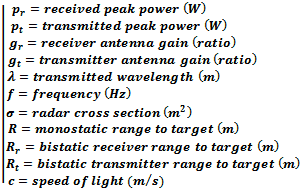
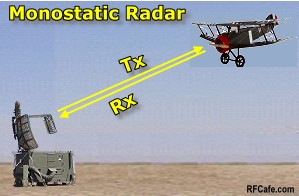
These are the tried & true radar equations used for decades and can be found in many textbooks and desk references. Transmitter power, target distance and radar cross-section (RCS) are used along with free-space loss (Friis equation), and antenna gains to calculate the power that arrives at the input of the receiver. These equations cover both monostatic radar where the transmitter and receiver are in the same location and bistatic radar where the transmitter and receiver are in different locations (see drawings).
Here is information on propagation time, path loss, and Doppler. Keep all units consistent. Losses due to atmospheric absorption and antenna polarization are not included. Monostatic Radar Equation (Tx and Rx in same location)
Bistatic Radar Equation (Tx and Rx in different locations)
Related Pages on RF Cafe - Introduction to Radar (Air University) - Radar Equation, 2-Way (another) - Radar Techniques - Primer (1945 QST) - RF Cafe Quiz #7 - Radar Principles - EW/Radar Handbook - Doppler Shift - Identification Friend or Foe (IFF) |
 (wavelength)
 (frequency)
 (convert to dBW)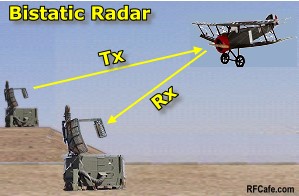
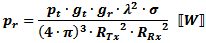 (wavelength)
 (frequency)