|
October 1958 Popular Electronics
 Table of Contents Table of Contents
Wax nostalgic about and learn from the history of early electronics. See articles
from
Popular Electronics,
published October 1954 - April 1985. All copyrights are hereby acknowledged.
|
I like the title: "Put PEP in
Your Antenna Tuner." For those not familiar with transmitter lingo, PEP is Peak
Envelope Power, but of course the word "pep," as in energy, is a clever double entendre.
This tuner is for the receive side of operations, so it is not a high power
circuit for blasting out signals for DX'ers to hear on the other side of the
world.
If you aren't averse to building a vacuum tube circuit and happen have a 6AG5 in
your parts box, then here's a simple antenna tuner circuit for you. Otherwise,
I'm guessing there are many modern, transistorized tuners you can build instead.
It appeared in a 1958 issue of Popular Electronics magazine.
Put PEP in Your Antenna Tuner
 By Joseph W. Doherty, K2SOO By Joseph W. Doherty, K2SOO
The coupler you built last November grows up with just a few extra parts.
If you built the pi-section receiver antenna coupler described in November POP'tronics
("Soup Up Your DX with an Antenna Tuner"), here is a worthwhile addition you can
make at slight expense and in little time.
If you have not yet built the coupler, you can put together the complete unit
in one evening. It is sure to pay extra dividends in improved reception. As a matter
of fact, this unit, which started out as a simple antenna tuner and grew into a
preselector and signal booster, can make your old receiver practically jump right
off the table.
How It Works
The pi-network coupler is the tuned grid circuit of the 6AG5
tube. An untuned plate circuit is used to prevent oscillation. The output is resistance-capacity-coupled
and fed directly to the receiver input terminals where it may be peaked by the receiver
input circuits, depending on design.
Choke RFC1 maintains a high impedance to ground in the grid circuit
of the amplifier, and provides a grid return circuit. Capacitor C8 provides an r.f,
grounding path from the negative side of the power supply.
Parts List
CI-360-μμfd. variable capacitor
C2-140-μμfd. variable capacitor
C3-100-μμfd.
disc ceramic capacitor
C4, C5, C8-0.001-μμfd. disc ceramic capacitor
C6-100-μμfd.
disc ceramic capacitor
C7a/C7b-50-30 μfd., 150-volt electrolytic capacitor
L1-3" x 1" coil (B & W Miniductor #3015-48 turns, tapped as shown in schematic)
R1-280-ohm, 1/2-watt resistor
R2-12,000-ohm, 1/2-watt resistor
R3-40,000-ohm,
1/2-watt resistor
R4-100-ohm, 1-watt resistor
R5-10-ohm, 1-watt resistor
R6-2700-ohm, 1-watt resistor
R7-390-obm resistance line cord (JFD #2190)
RFC1-2.5-mh. r.f. choke
S1-2-p., 5-pos. shorting switch (Centralab #1404)
S2-S.p.s.t. toggle switch
SR1-Silicon diode Type 1N1084 (Sarkes Tarzian
-see text)
V1-6AG5 tube
It combines the impedance-matching properties of the pi-network coupler with a signal
booster amplifier. The power supply is self-contained but, if desired, an external
supply can be used. No expensive components are required and the layout is extremely
simple.
Design Features
This signal booster will provide amazing improvement even in a well-matched antenna
system. There is a band selector switch position which allows you to bypass the
coupler without having to disconnect the antenna and reconnect it to the receiver.
The power supply is of the a.c./d.c. type. However, neither leg of the line is
connected to the chassis, thus eliminating the shock hazard associated with power
supplies of this type. The rectifier is a silicon diode #1N1084 which comes complete
with mounting hardware and 10-ohm resistor in the Sarkes Tarzian Replacement Kit
#M150. Any other type rectifier with a 20-ma. or higher rating may properly be substituted.
To conserve space, a resistance-type line cord was used. Take care not to coil
or bunch this cord, since it must be allowed to give off heat. Also, do not attempt
to shorten it. The built-in resistor is 390 ohms "long."
Construction Details. The original design was modified to accommodate
the r.f. amplifier with minimum expense and fewest circuit changes. Follow this
procedure.
First remove the original Bypass jumper from S1a, S1b. Disconnect the lead to
the junction of L1 and C2. Then disconnect the antenna input lead from S1a.
Connect the antenna input lead to the wiper contact of S1b. Connect a lead from
the 80-meter position on S1b to the S1a 80-meter position and S1a wiper. Now connect
the Bypass lead from S1b to the ungrounded output terminal and, finally, connect
the grid lead from C3 to the junction of L1 and C2.
Since there is considerable gain in the amplifier, it is recommended that the
input and output leads be kept well separated or oscillation may result. As an example
of the gain obtainable, one station heard in the bypass position was read on the
receiver S-meter at "S6." The preselector raised this same signal to 40 db over
"S9," thus pulling it well out of the noise.
The coupler should be grounded to a cold water pipe or similar good ground. If
the receiver used is of the a.c./d.c. variety, connect the coupler output terminals
to the receiver antenna terminals only.
Tuning the Preselector
Tuning is not difficult if you remember that C1 is the loading capacitor and
C2 is the frequency-determining capacitor. There is some interaction between the
two but, to keep it simple, adjust both alternately for the loudest signal. It is
best to start out with C1 at maximum capacitance, tuning C2 until the signal is
loudest. Keep in mind that the bandswitch must be in the proper position.
Decrease the capacitance of C1 gradually until the signal starts to fade. Readjust
C2 for the loudest signal. If the signal has increased, decrease C1 still further
and repeat the process until the greatest signal strength is achieved.
In most cases, a point will be reached where advancing C1 will cut the signal
strength in spite of adjusting C2. This point is just beyond optimum coupling, which
means that the antenna is over-coupled. At this point, rotate C1 in the other direction
slowly while adjusting C2 through resonance until the optimum adjustment is found.
Note: While we normally bar a.c./d.c. chassis projects because
of the possibility of shock hazard, in this case - since the antenna preamp was
built up from an earlier project on the same chassis - using a transformer would
have been difficult due to lack of space. While all B -- points are raised above
chassis ground, there is still some possibility of leakage. Therefore, we advise
using an isolation transformer with this project. The Editors


The B-return shown on the schematic must be kept above chassis ground; this can
be done by using a tie strip as return point. Note that R7 is the line cord dropping
resistor. SR1 and R5 are included in the replacement kit as indicated in the text.
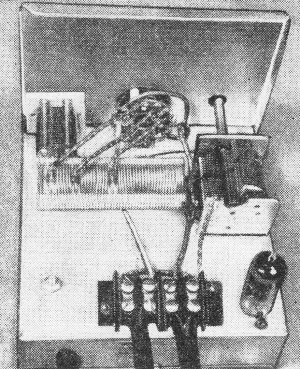
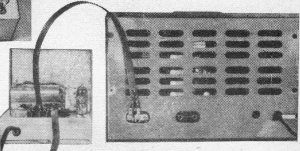
Photo on opposite page shows completed under-chassis wiring. Photo at top left shows
top of tuner, while photo above indicates proper method of connecting tuner to receiver's
antenna input.
Posted November 3, 2022
(updated from original post
on 9/12/2011
|