July 1960 Popular Electronics
 Table of Contents Table of Contents
Wax nostalgic about and learn from the history of early electronics. See articles
from
Popular Electronics,
published October 1954 - April 1985. All copyrights are hereby acknowledged.
|
If this 1960 Popular
Electronics magazine article was written
today, the title would more likely be, "One IC Pocket Radio," and rather than a
couple dozen resistors, capacitors, and inductors (and a transformer), and there
might be one or two decoupling capacitors. Everything else would be contained
within the integrated circuit. There are plenty of single-chip radio circuits
available from distributors like Digi-Key, Newark Electronics, etc. Oh, and how
many of you even know what a phenolic board looks like? Better yet, how many of
you can identify
the unique smell of one heating up or burning due to component overheating? If you
can't, then consider yourself lucky, because that probably means you're 40-50 years
younger than I am, and you have that much longer to live then me ;-)One Transistor Pocket Radio
Reflex and regenerative circuits are combined in this sensitive and stable radio.
 Designing and constructing a one-transistor
pocket receiver is a challenge to any experimenter. A good many "pocket" receivers
are either too large or too bulky for true "pocket" operation. Or they simply don't
possess enough sensitivity and gain to pull in stations without an external antenna. Designing and constructing a one-transistor
pocket receiver is a challenge to any experimenter. A good many "pocket" receivers
are either too large or too bulky for true "pocket" operation. Or they simply don't
possess enough sensitivity and gain to pull in stations without an external antenna.
By Alvin Mason
The little receiver described here gets around both of these weaknesses. It uses
a combination of reflex and regenerative action to cut size and components to a
minimum and increase sensitivity to striking proportions. The complete unit measures
only 4" x 2 1/2" X 3/4". And it's powerful enough to pull in every local station
on the dial with no external antenna at all!
Reflex Circuit
Because of the "reflex" action of the circuit, a single transistor is made to
amplify the signal twice - once at radio frequencies and again, after detection,
at audio frequencies (see "How It Works"). To simplify the circuit, a diode is used
as a detector, leaving the transistor free to do nothing but amplify.
Also acting to increase the circuit's simplicity and stability is the regeneration
hookup. The circuit is designed so that the amount of positive feedback or regeneration
doesn't control the overall sensitivity as is usually the case with regenerative
detectors. What's more, there is no regeneration control or annoying oscillation
to contend with.
Parts List
B1-15 volt battery (two Eveready 404E's or . equivalent in parallel)
C1-365·µµf.
variable capacitor (Lafayette MS-445 or equivalent)
C2-10-µf., 25-volt miniature
electrolytic capacitor C3-30-µf., 25-volt miniature electrolytic capacitor C4-.0005-µf.,
ceramic capacitor
C5-.01-µf., ceramic capacitor
C6-Gimmick capacitor (see
text)
D1-1N60 diode
L1-Antenna coil for C1 (Superex 2004 or equivalent)
L2-Six turns of #26 insulated wire wound on L1 (see text)
Q1-2N78 transistor
R1-10,000 ohms
R2-22,000 ohms
All resistors 1/4 watt
R3-560 ohms
R4-10,000-ohm volume control with s.p.s.t.
switch S1 (Lafayette VC-28 or equivalent)
S1-S.p.s.t. switch (on R4)
T1-Coupling
transformer (Philco 32-4763-2 or equivalent-see text) 1-2000-ohm impedance earphone
(Lafayette MS-368 or equivalent)
1-Transistor socket
1-4" x 2 1/2" x 3/4"
plastic box
1-4" x 2 1/2" x 1/16" phenolic board
Misc.-Tuning dial, knob
for volume control, wire, solder, etc.
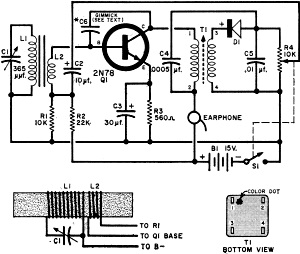
One transistor does the work of two in this highly efficient
circuit. The signal is amplified twice-once at radio frequencies ,and, after detection,
at audio frequencies.
How It Works
One transistor and one diode are employed in a circuit that combines the advantages
of both reflex and regenerative action. Because the signal passes through transistor
Q1 twice - once as r. f. and once as a.f. - the transistor is properly described
as operating in a "reflex" circuit. Adding to the already high efficiency of this
circuit is the regeneration furnished by gimmick capacitor C6.
In operation, the r.f. signal picked up by antenna coil L1 is tuned by coil-capacitor
combination L1-C1 and induced into secondary coil L2. Fed directly into the base
of transistor Q1, the r.f. signal is amplified and passed to transformer T1. A portion
of the signal from Q1's collector is returned to Q1's base by capacitor C6 to provide
additional gain through regeneration , The signal induced in T1's secondary is detected
by diode D1, smoothed by capacitor C5, and returned to the base of Q1 through volume-control
R4 and coupling capacitor C2.
Transistor Q1 again amplifies the signal, this time at audio frequencies. The
audio signal from Q1's collector is fed through the primary of T1 to the earphone.
Since the remarkable efficiency of this little set doesn't depend on regeneration
alone, only a limited amount of regeneration is used. Its stability is evidenced
by the fact that, once adjusted, the set is as stable as most non-regenerative detectors.
Although a Philco r.f. transformer was used as T1 in the model, this particular
transformer is available only from authorized Philco distributors and may prove
hard to get. However, T1 is in no way critical - a number of transformers were substituted
for the Philco unit, and most of them worked satisfactorily.
The Argonne AR-162 (available from Lafayette Radio, 165-08 Liberty Ave., Jamaica
33, N. Y., for $2.95) seems to be a good substitution. A miniature output transformer
measuring only 1" x 3/4" x 3/4", the AR-162 has identical center-tapped primary
and secondary windings of 500 ohms with a d.c. resistance of 18 ohms. You'll have
to remove the transformer's strap and laminations to fit the unit in the small plastic
box specified in the parts list. But you'll find that this bit of disassembling
proves no problem (see illustration on next page). The windings are light enough
to be held in place with a strip of transparent tape. The center-taps are not used.
Construction
The chassis is a piece of Formica or phenolic
board about 4" x 2 1/2" x 1/16". Depending on the size of the components, the chassis
should fit into a small plastic box measuring about 4" x 2 1/2" x 3/4". Homemade
printed circuitry was used on the model, but standard wiring will do just as well.
Most of the component leads are long enough to permit point-to-point wiring, but
a transistor socket was used to prevent possible damage to the transistor when soldering.
Coil L2 consists of six to nine turns of No. 26 insulated hookup wire wound on
the "ground" end of L1 and spaced 1/16" from it. "Gimmick" capacitor C6 is made
up of two 1/2" lengths of insulated hookup wire twisted together several times to
form a small capacitor.
It's a good idea to layout all parts and drill most of the holes in the chassis
before starting assembly. Since the wiring is relatively simple, you should be able
to take your time and do a good job. As with any construction project, time spent
in careful wiring will payoff in the long run.
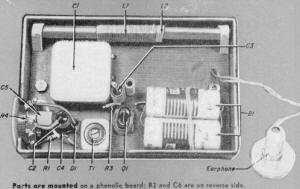
Parts are mounted on a phenolic board; R2 and C6 are on the reverse
side.
Operation
After ail parts have been mounted and soldered in
place, double-check all connections. Now, with the switch off and battery B1 in
place, plug in the transistor. Turn on the set and rotate the volume control to
full on. Select a station, preferably the strongest one on the dial. Listen for
distortion. If necessary, either loosen the coupling in capacitor C6 by untwisting
the leads slightly or by snipping off the leads bit by bit until the distortion
disappears.
Once adjusted, the set should be nearly as stable as the superhet in your living
room. And it's a safe bet that in sensitivity and portability this little unit will
have few equals.
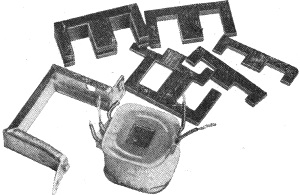
Coupling transformer T1 must be a miniature unit. If Arqonne
Type AR-162 is used, it can be reduced in size by removing the strap and laminations.
Posted December 1, 2022
(updated from original
post on 11/30/2011)
|