Operational Amplifiers (Opamps) |
||||||
|
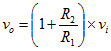
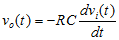
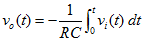
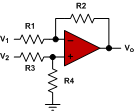
The introduction of the μA741 operational amplifier (opamp, op-amp, op amp) integrated circuit in 1968 significantly changed the analog design philosophy from on where every amplifier circuit was designed with individual transistor amplifiers, to a more "packaged" approach. Due to the opamp's unique characteristics (see below), it became possible to apply simple formulas to standard configurations for creating many circuits. There are many "cookbooks" available that contain hundreds of configurations covering everything from simple amplifiers to complex filters, differentiators, integrators, multi-break-point frequency responses, even logarithmic amplifiers. Standard nodal analysis can be used to perform opamp circuit analysis, including the properties of superposition. Here are a few of most often found opamp configurations that are found either by themselves, or as part of more complex circuits. Ideal opamps assume the following properties: * Infinite open loop gain * Zero output impedance * Infinite input impedance * Infinite bandwidth
|
||||||