 Radio control (R/C) systems operating in
the 2.4 GHz ISM band, using one of or a combination of frequency hopping and
direct sequence spread spectrum scheme, have been in widespread use since the early
2000s. As with any new technology, there was a lot of reluctance to adoption of
the systems based on a few reports (valid or not) of performance issues - primarily
lack of control range where communications between the transmitter (Tx) and receiver
(Rx) with a pilot and aircraft was lost and a crash ensued. Tx power was already
at the FCC-mandated maximum, so manufacturers quickly improved receivers by adding
diversity with a second Rx antenna. The receiver...
Radio control (R/C) systems operating in
the 2.4 GHz ISM band, using one of or a combination of frequency hopping and
direct sequence spread spectrum scheme, have been in widespread use since the early
2000s. As with any new technology, there was a lot of reluctance to adoption of
the systems based on a few reports (valid or not) of performance issues - primarily
lack of control range where communications between the transmitter (Tx) and receiver
(Rx) with a pilot and aircraft was lost and a crash ensued. Tx power was already
at the FCC-mandated maximum, so manufacturers quickly improved receivers by adding
diversity with a second Rx antenna. The receiver...
 As reported in this 1967 Electronics World
magazine piece, lasers were still the things of science fiction to most people.
Real-world applications seemed to be far off in the future, but in fact, work was
underway setting the stage for today's blazingly fast communications systems. The
author here references attaining 5 THz optical transmission speeds through
fiber and through the air. At the time, a laboratory filled with bulky prototypes
chassis and optical tables were required to get those results. I can remember reading
articles in the 1970s when laser power output was measured in "Gillette
power," referring to the beam's ability to burn through a number of razor blades
(a big deal...
As reported in this 1967 Electronics World
magazine piece, lasers were still the things of science fiction to most people.
Real-world applications seemed to be far off in the future, but in fact, work was
underway setting the stage for today's blazingly fast communications systems. The
author here references attaining 5 THz optical transmission speeds through
fiber and through the air. At the time, a laboratory filled with bulky prototypes
chassis and optical tables were required to get those results. I can remember reading
articles in the 1970s when laser power output was measured in "Gillette
power," referring to the beam's ability to burn through a number of razor blades
(a big deal...
 A column entitled "Radio-Electronics
Monthly Review" appeared in each issue of Radio-Craft magazine. As now, things
were moving quickly at the time. With WWWII recently ended, a lot of the new technology
developed to help beat back Nazism and Communism was being transferred to peacetime
uses. The May 1947 issue contained, amongst other items, info regarding how radio
servicemen were organizing efforts to get its ranks educated on FM sets as AM was
being replaced and/or supplemented with the new miracle noise-free broadcast systems.
It also reported that the IRS decided not to go forward with earlier plans to tax
television shows being displayed in public...
A column entitled "Radio-Electronics
Monthly Review" appeared in each issue of Radio-Craft magazine. As now, things
were moving quickly at the time. With WWWII recently ended, a lot of the new technology
developed to help beat back Nazism and Communism was being transferred to peacetime
uses. The May 1947 issue contained, amongst other items, info regarding how radio
servicemen were organizing efforts to get its ranks educated on FM sets as AM was
being replaced and/or supplemented with the new miracle noise-free broadcast systems.
It also reported that the IRS decided not to go forward with earlier plans to tax
television shows being displayed in public...
 Take a
break from the drudgery with some of these
tech-centric jokes, song parodies,
anecdotes and assorted humor that has been collected from friends & from websites
across the Internet. This humor is light-hearted and sometimes slightly offensive
to the easily-offended, so you are forewarned. I have taken care to censor out "humor"
with reproductive function innuendo and hateful tirades, so it is all workplace-safe.
I have also tried to warn of any links that will result in audio clips so you can
take appropriate precautions. As usual, there is no easy way to determine the true
origin of any of these jokes. Unless otherwise noted, that prolific author "Anon"
is the progenitor...
Take a
break from the drudgery with some of these
tech-centric jokes, song parodies,
anecdotes and assorted humor that has been collected from friends & from websites
across the Internet. This humor is light-hearted and sometimes slightly offensive
to the easily-offended, so you are forewarned. I have taken care to censor out "humor"
with reproductive function innuendo and hateful tirades, so it is all workplace-safe.
I have also tried to warn of any links that will result in audio clips so you can
take appropriate precautions. As usual, there is no easy way to determine the true
origin of any of these jokes. Unless otherwise noted, that prolific author "Anon"
is the progenitor...
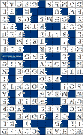 Working crossword puzzles can be contagious.
This April 12, 2020,
tech-themed crossword puzzle may even go viral - the second in a series. It
contains only clues and terms associated with engineering, science, physical, astronomy,
mathematics, chemistry, etc., which I have personally built over nearly two decades.
That includes the cause for our planet's current dilemma. Many new words and company
names have been added that had not even been created when I started in the year
2002. You will never find a word taxing your knowledge of a numbnut soap opera star
or the name of some obscure village in the Andes mountains. You might, however,
encounter the name of a movie star like Hedy Lamarr...
Working crossword puzzles can be contagious.
This April 12, 2020,
tech-themed crossword puzzle may even go viral - the second in a series. It
contains only clues and terms associated with engineering, science, physical, astronomy,
mathematics, chemistry, etc., which I have personally built over nearly two decades.
That includes the cause for our planet's current dilemma. Many new words and company
names have been added that had not even been created when I started in the year
2002. You will never find a word taxing your knowledge of a numbnut soap opera star
or the name of some obscure village in the Andes mountains. You might, however,
encounter the name of a movie star like Hedy Lamarr...
 If you are going to write an article about
etching crystals for radio frequency circuits, having a last name like Gene
Brizendine's couldn't be much better. It just sounds like a mineral or a compound
(benzidine, etc.). Amateur radio operators have for a long time adjusted the resonant
frequency of their crystals by either grinding or chemical etching. Mr. Brizendine
recommends etching as a more controllable method that does not reduce the quality
of the crystal like improper grinding can do. Ammonium bifluoride is mentioned as
the etchant. It is said to have cost about $1/pound in 1954, and sells on Amazon
today for about $23/pound. According to the BLS Inflation Calculator, $1 in 1954...
If you are going to write an article about
etching crystals for radio frequency circuits, having a last name like Gene
Brizendine's couldn't be much better. It just sounds like a mineral or a compound
(benzidine, etc.). Amateur radio operators have for a long time adjusted the resonant
frequency of their crystals by either grinding or chemical etching. Mr. Brizendine
recommends etching as a more controllable method that does not reduce the quality
of the crystal like improper grinding can do. Ammonium bifluoride is mentioned as
the etchant. It is said to have cost about $1/pound in 1954, and sells on Amazon
today for about $23/pound. According to the BLS Inflation Calculator, $1 in 1954...
 The other day a song entitled "Western Union" played
on my local over-the-air oldies radio station. It was released by the group, The
Five Americans, in 1967. The full lyrics of "Western Union" can be found at the
bottom of the page, but notice the "Dah-Dit-Dah-Dit-Dah" repeats in the refrain.
My lack of a Morse code deciphering ability required that I rely on an
online translator for considering what the code might be. Depending on how you separate
the dits and dahs, the string of characters can be interpreted as TETET (- . - .
-), TAA (- .- .-), KA (-.- .-), NK (-. -.-), CT (-.-. -) or other combinations.
RF Cafe visitor Alan Dewey has provided new insight on the characters...
The other day a song entitled "Western Union" played
on my local over-the-air oldies radio station. It was released by the group, The
Five Americans, in 1967. The full lyrics of "Western Union" can be found at the
bottom of the page, but notice the "Dah-Dit-Dah-Dit-Dah" repeats in the refrain.
My lack of a Morse code deciphering ability required that I rely on an
online translator for considering what the code might be. Depending on how you separate
the dits and dahs, the string of characters can be interpreted as TETET (- . - .
-), TAA (- .- .-), KA (-.- .-), NK (-. -.-), CT (-.-. -) or other combinations.
RF Cafe visitor Alan Dewey has provided new insight on the characters...
 Prior to the advent of personal computers
and handy-dandy antenna design software like EZNEC, determining the effects of varying
parameters - element spacing, angles and length, ground plane distance and extent,
feedpoint impedance, the presence of conductive structures, etc. - it was necessary
to make a series of often complex mathematical calculations and ultimately perform
real-world measurement. Huge amounts of time would be invested in the design and
verification process. It has been know for a long time that the distance an antenna
sits above a ground plane has a significant effect on the radiation pattern - particularly
the vertical pattern. The information provided in this 1954 Radio & TV News
magazine article undoubtedly required many hours to assimilate and required someone
(author William Harrison) with a lot of knowledge in the science/art of antennas.
While some empirical testing is still needed for critical applications, in most
cases these days the results of computer simulations suffice...
Prior to the advent of personal computers
and handy-dandy antenna design software like EZNEC, determining the effects of varying
parameters - element spacing, angles and length, ground plane distance and extent,
feedpoint impedance, the presence of conductive structures, etc. - it was necessary
to make a series of often complex mathematical calculations and ultimately perform
real-world measurement. Huge amounts of time would be invested in the design and
verification process. It has been know for a long time that the distance an antenna
sits above a ground plane has a significant effect on the radiation pattern - particularly
the vertical pattern. The information provided in this 1954 Radio & TV News
magazine article undoubtedly required many hours to assimilate and required someone
(author William Harrison) with a lot of knowledge in the science/art of antennas.
While some empirical testing is still needed for critical applications, in most
cases these days the results of computer simulations suffice...
 Popular comic strips (aka "funnies") in
the 1930s and 1940s featured numbskulls, ne'er-do-wells, and simpletons. There was
usually one character in the strip's cast that was smart - at least in a relative
way if not absolute. Being familiar with some of the old comics like Blondie, Barney
Google, Krazy Kat, Beetle Bailey, Gasoline Alley, etc., I can see a definite relationship
between the story line of "Entertaining
Uncle Oscar" and the comics of the era in this short story that appeared in
a 1939 edition of the ARRL's QST magazine. As you might guess, the
feller named "Ham" is the smart one. Q: Is it irony, coincidence, or premonition
on the author's part that the uncle's name is the same as...
Popular comic strips (aka "funnies") in
the 1930s and 1940s featured numbskulls, ne'er-do-wells, and simpletons. There was
usually one character in the strip's cast that was smart - at least in a relative
way if not absolute. Being familiar with some of the old comics like Blondie, Barney
Google, Krazy Kat, Beetle Bailey, Gasoline Alley, etc., I can see a definite relationship
between the story line of "Entertaining
Uncle Oscar" and the comics of the era in this short story that appeared in
a 1939 edition of the ARRL's QST magazine. As you might guess, the
feller named "Ham" is the smart one. Q: Is it irony, coincidence, or premonition
on the author's part that the uncle's name is the same as...
 When really good researchers set out to
write books on history, they do not simply cull information from the publications
of fellow contemporary authors; instead, they look for sources that were published
during or around the time of the subject being covered. Doing so helps minimize
the possibility that inaccuracies have crept into the knowledge pool and that information
other authors might have either deemed insignificant or have missed can be recovered.
That
is part of my motivation for going to the trouble of buying these vintage magazines
and posting articles like this one which reports on early
maser
developments. It delves fairly deeply into the solid state physics of rare earth...
When really good researchers set out to
write books on history, they do not simply cull information from the publications
of fellow contemporary authors; instead, they look for sources that were published
during or around the time of the subject being covered. Doing so helps minimize
the possibility that inaccuracies have crept into the knowledge pool and that information
other authors might have either deemed insignificant or have missed can be recovered.
That
is part of my motivation for going to the trouble of buying these vintage magazines
and posting articles like this one which reports on early
maser
developments. It delves fairly deeply into the solid state physics of rare earth...
 Plastic is one of those materials that seems
like it has been around since the dawn of time - like metal. There was an Iron Age
in the 1,000 BC timeframe (depends on location), but the Plastic Age - not
that there officially was one - did not begin in the commercial world until World
War II. If you note in older photos and films, there was not much, if any,
in the way of objects made of
plastic before the 1940s. In fact, the formulation and production of some types
of plastic like Plexiglas and polycarbonates was considered a matter of national
security for a while both for Allied and Axis powers. Bomber and fighter aircraft
windshields were made of the material. After the war, use of plastics...
Plastic is one of those materials that seems
like it has been around since the dawn of time - like metal. There was an Iron Age
in the 1,000 BC timeframe (depends on location), but the Plastic Age - not
that there officially was one - did not begin in the commercial world until World
War II. If you note in older photos and films, there was not much, if any,
in the way of objects made of
plastic before the 1940s. In fact, the formulation and production of some types
of plastic like Plexiglas and polycarbonates was considered a matter of national
security for a while both for Allied and Axis powers. Bomber and fighter aircraft
windshields were made of the material. After the war, use of plastics...
 Question: If a fuse is rated at 3 amps, at
what value of current should it "blow?" Answer: Not at 3 amps. As this
Littelfuse
company advertisement from a 1954 issue of Radio & Television News
magazine informs us, fuse ratings do not indicate the current value at which a fuse
opens to protect a circuits, but rather the maximum current level at which it will
NOT blow (open circuit). The same goes for circuit breakers. Various types of fuses
are available to handle certain types of applications. For instance, a highly capacitive
load will according to the well-known equation iC(t) = C * dv/dt could draw a
very large amount of initial (inrush) current if there is not enough series
resistance to limit it to prevent...
Question: If a fuse is rated at 3 amps, at
what value of current should it "blow?" Answer: Not at 3 amps. As this
Littelfuse
company advertisement from a 1954 issue of Radio & Television News
magazine informs us, fuse ratings do not indicate the current value at which a fuse
opens to protect a circuits, but rather the maximum current level at which it will
NOT blow (open circuit). The same goes for circuit breakers. Various types of fuses
are available to handle certain types of applications. For instance, a highly capacitive
load will according to the well-known equation iC(t) = C * dv/dt could draw a
very large amount of initial (inrush) current if there is not enough series
resistance to limit it to prevent...
 Randy Rogers, AD7ZU, mentioned in the May
2020 issue of QST magazine the Smith Chart software called "SimSmith,"
by Ward Harriman, AE6TY. SimSmith first appeared around 2011. Being written in
Java, it will run on any operating system that supports Java. Recent versions incorporate Numerical
Electromagnetics Code (NEC) code and bear the name "SimNEC." At present, several
versions of SimSmith/SimNEC are available. If you are following a video and want
to use the SimSmith release closest to that used in the video, look at the top
of the screen to see the version of SimSmith being used and then choose between
older versions. If you new to the software, he strongly...
Randy Rogers, AD7ZU, mentioned in the May
2020 issue of QST magazine the Smith Chart software called "SimSmith,"
by Ward Harriman, AE6TY. SimSmith first appeared around 2011. Being written in
Java, it will run on any operating system that supports Java. Recent versions incorporate Numerical
Electromagnetics Code (NEC) code and bear the name "SimNEC." At present, several
versions of SimSmith/SimNEC are available. If you are following a video and want
to use the SimSmith release closest to that used in the video, look at the top
of the screen to see the version of SimSmith being used and then choose between
older versions. If you new to the software, he strongly...
 Here's a little dose of Ham comedy to help
take the edge off a busy day - straight from the ARRL's QST magazine in
a piece entitled, "Blonde QRM." It's
a little bit kooky by today's standards, but in 1940 the style of humor it fits
right in. This could easily have been the plot in an old TV show like The Honeymooners,
or one of the radio sitcom programs like The Life of Riley. It reminds me of how
in the "Nancy Drew Detective," movie from the 1930s, Ted is a Ham radio operator,
and he tells his fellow Ham that he has experienced "local QRM" when Nancy Drew
suddenly enters his shack (Nancy is a blonde). QRM, by the way, is Ham lingo for
man-made signal interference, as opposed to QRN, which is atmospheric or "natural"
signal interference...
Here's a little dose of Ham comedy to help
take the edge off a busy day - straight from the ARRL's QST magazine in
a piece entitled, "Blonde QRM." It's
a little bit kooky by today's standards, but in 1940 the style of humor it fits
right in. This could easily have been the plot in an old TV show like The Honeymooners,
or one of the radio sitcom programs like The Life of Riley. It reminds me of how
in the "Nancy Drew Detective," movie from the 1930s, Ted is a Ham radio operator,
and he tells his fellow Ham that he has experienced "local QRM" when Nancy Drew
suddenly enters his shack (Nancy is a blonde). QRM, by the way, is Ham lingo for
man-made signal interference, as opposed to QRN, which is atmospheric or "natural"
signal interference...
 This Bell Telephone Laboratories (aka Bell
Labs) advertisement appearing on the inside back cover of the 1958 issue of
Radio & TV News magazine celebrated the 10th anniversary of their
announcement of the world's first
point contact transfer resistance (transresistance) semiconductor device
- aka the transistor. John Bardeen, William Shockley and Walter Brattain recorded
the monumental event in a lab notebook on December 23, 1947 - a nice Christmas present
for the world! The trio's invention was not like the robust bipolar transistors
used today, or even ten years later in 1958. Rather than employing point-contact
"cat's whisker" metallic probes for making the emitter and collector...
This Bell Telephone Laboratories (aka Bell
Labs) advertisement appearing on the inside back cover of the 1958 issue of
Radio & TV News magazine celebrated the 10th anniversary of their
announcement of the world's first
point contact transfer resistance (transresistance) semiconductor device
- aka the transistor. John Bardeen, William Shockley and Walter Brattain recorded
the monumental event in a lab notebook on December 23, 1947 - a nice Christmas present
for the world! The trio's invention was not like the robust bipolar transistors
used today, or even ten years later in 1958. Rather than employing point-contact
"cat's whisker" metallic probes for making the emitter and collector...