 A large percentage of people today do not
remember or were not alive during the days of analog over-the-air (OTA) broadcast
television, so the question, "What Ever Happened to Channel 1?" is moot for them. For that matter,
the standard VHF selector knob beginning with the number 2 and not 1 was probably
was never a matter of concern. I do remember wondering why there was no channel
1, but it wasn't until a few years ago that I learned why that was. By that
time, the Internet is full of explanations, as is the case for most information
you want to know. This article from a 1982 issue of Radio-Electronics magazine
lays out the answer to the question in great detail, and provides some...
A large percentage of people today do not
remember or were not alive during the days of analog over-the-air (OTA) broadcast
television, so the question, "What Ever Happened to Channel 1?" is moot for them. For that matter,
the standard VHF selector knob beginning with the number 2 and not 1 was probably
was never a matter of concern. I do remember wondering why there was no channel
1, but it wasn't until a few years ago that I learned why that was. By that
time, the Internet is full of explanations, as is the case for most information
you want to know. This article from a 1982 issue of Radio-Electronics magazine
lays out the answer to the question in great detail, and provides some...
 In our continuing saga Wireless Networking
in the Developing World, we now turn our attention to
transmission lines and coaxial connectors, where we find: The
transmitter that generates the RF power to drive the antenna is usually located
at some distance from the antenna terminals. The connecting link between the two
is the RF transmission line. Its purpose is to carry RF power from one place to
another, and to do this as efficiently as possible. From the receiver side, the
antenna is responsible for picking up any radio signals in the air and passing them
to the receiver with the minimum amount of distortion and maximum efficiency, so
that the radio has its best chance to decode the signal. For these...
In our continuing saga Wireless Networking
in the Developing World, we now turn our attention to
transmission lines and coaxial connectors, where we find: The
transmitter that generates the RF power to drive the antenna is usually located
at some distance from the antenna terminals. The connecting link between the two
is the RF transmission line. Its purpose is to carry RF power from one place to
another, and to do this as efficiently as possible. From the receiver side, the
antenna is responsible for picking up any radio signals in the air and passing them
to the receiver with the minimum amount of distortion and maximum efficiency, so
that the radio has its best chance to decode the signal. For these...
 Here is a 1950s
vintage crossword puzzle from Popular Electronics magazine.
Unlike the weekly crosswords from RF Cafe that use only relevant technical words,
this one uses some common words unrelated to electronics and science to fill in
where needed. It's still a good puzzle, though. Print it out for use during
your next boring meeting or 12-hour flight to China. A list of many other puzzle
from Popular Electronics and Electronics World is presented at
the bottom of the page. Have fun...
Here is a 1950s
vintage crossword puzzle from Popular Electronics magazine.
Unlike the weekly crosswords from RF Cafe that use only relevant technical words,
this one uses some common words unrelated to electronics and science to fill in
where needed. It's still a good puzzle, though. Print it out for use during
your next boring meeting or 12-hour flight to China. A list of many other puzzle
from Popular Electronics and Electronics World is presented at
the bottom of the page. Have fun...
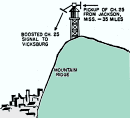 Once World War II was over and the
peoples of the world could breathe and start enjoying life again, television, which
had just begun to take off before the war, quickly gained widespread adoption in
homes. As with so many areas of technology and science, advancements in electronics
and wireless communications during the war years redounded very beneficially to
the
TV industry. Early schemes for television combined both electronics
and mechanical elements using rotating discs, vibrating mirrors, and other far-out
schemes to convert electrical signals to moving pictures. Due to the small size
of the first cathode ray tubes (CRTs), commonly called kinescopes...
Once World War II was over and the
peoples of the world could breathe and start enjoying life again, television, which
had just begun to take off before the war, quickly gained widespread adoption in
homes. As with so many areas of technology and science, advancements in electronics
and wireless communications during the war years redounded very beneficially to
the
TV industry. Early schemes for television combined both electronics
and mechanical elements using rotating discs, vibrating mirrors, and other far-out
schemes to convert electrical signals to moving pictures. Due to the small size
of the first cathode ray tubes (CRTs), commonly called kinescopes...
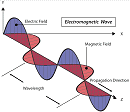 Here is the electromagnetic wave section
of the "Wireless Networking in the Developing World," book (open source). "Wireless
communications make use of
electromagnetic waves to send signals across long distances. From
a user's perspective, wireless connections are not particularly different from
any other network connection: your web browser, email, and other applications all
work as you would expect. But radio waves have some unexpected properties compared
to Ethernet cable. For example, it's very easy to see the path that an Ethernet
cable takes: locate the plug sticking out of your computer, follow the cable to
the other end, and you've found it..."
Here is the electromagnetic wave section
of the "Wireless Networking in the Developing World," book (open source). "Wireless
communications make use of
electromagnetic waves to send signals across long distances. From
a user's perspective, wireless connections are not particularly different from
any other network connection: your web browser, email, and other applications all
work as you would expect. But radio waves have some unexpected properties compared
to Ethernet cable. For example, it's very easy to see the path that an Ethernet
cable takes: locate the plug sticking out of your computer, follow the cable to
the other end, and you've found it..."
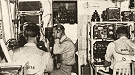 Naval communications and their communicators
have always been held in high regard. Operating and maintaining sophisticated electronics
equipment is difficult enough on solid ground, but doing it on the ocean with winds
and waves tossing the platform (ship) relentlessly can exacerbate the problem tremendously.
It is a wonder that radar systems can even be useful with the antenna constantly
rotating about pitch, roll, and yaw axes while simultaneously shifting in the x,
y and z axes. Sure, airborne platforms have the same sort of challenge, but their
perturbations are not typically as violent, as great in magnitude, or as prolonged
as a naval vessel in rough seas. For the record, I'm a former USAF radar...
Naval communications and their communicators
have always been held in high regard. Operating and maintaining sophisticated electronics
equipment is difficult enough on solid ground, but doing it on the ocean with winds
and waves tossing the platform (ship) relentlessly can exacerbate the problem tremendously.
It is a wonder that radar systems can even be useful with the antenna constantly
rotating about pitch, roll, and yaw axes while simultaneously shifting in the x,
y and z axes. Sure, airborne platforms have the same sort of challenge, but their
perturbations are not typically as violent, as great in magnitude, or as prolonged
as a naval vessel in rough seas. For the record, I'm a former USAF radar...
 Punch cards have been used in computer systems
since the very early days of digital programming. They were probably the first form
of read-only memory (ROM), come to think of it. I hate to have to admit it, but
the meager computer used in my high school computer lab (circa early-mid 1970s)
used
punched cards. I never took the class, but stories abounded of
how pranksters would shuffle a stack of punch cards while the student programmer
wasn't watching and then get a good laugh when nothing worked. There are also
plenty of cases where a stack was inadvertently knocked onto the floor and had to
be laboriously re-ordered. IBM is the brand that comes to most people's minds
when thinking...
Punch cards have been used in computer systems
since the very early days of digital programming. They were probably the first form
of read-only memory (ROM), come to think of it. I hate to have to admit it, but
the meager computer used in my high school computer lab (circa early-mid 1970s)
used
punched cards. I never took the class, but stories abounded of
how pranksters would shuffle a stack of punch cards while the student programmer
wasn't watching and then get a good laugh when nothing worked. There are also
plenty of cases where a stack was inadvertently knocked onto the floor and had to
be laboriously re-ordered. IBM is the brand that comes to most people's minds
when thinking...
 Contributors to the Wikipedia article on
the
Yagi-Uda antenna credit Japanese professor Shintaro Uda primarily
for the antenna's development, with Hidetsugu Yagi having played a 'lesser role."
Other sources assign the primary role to Yagi. Regardless, history - and this article's
author, rightly or wrongly, has decreed that this highly popular design be referred
to commonly as the Yagi antenna and not the Uda antenna. I don't recall seeing
advertisements for 'Uda' television or amateur radio antennas. Harold Harris,
of Channel Master Corporation, does a nice job explaining the fundamentals of the
Yagi antenna...
Contributors to the Wikipedia article on
the
Yagi-Uda antenna credit Japanese professor Shintaro Uda primarily
for the antenna's development, with Hidetsugu Yagi having played a 'lesser role."
Other sources assign the primary role to Yagi. Regardless, history - and this article's
author, rightly or wrongly, has decreed that this highly popular design be referred
to commonly as the Yagi antenna and not the Uda antenna. I don't recall seeing
advertisements for 'Uda' television or amateur radio antennas. Harold Harris,
of Channel Master Corporation, does a nice job explaining the fundamentals of the
Yagi antenna...
 I ran across a really nice e-book entitled "Wireless
Networking in the Developing World," which is a collaborative work by many authors,
and it is published under the Creative Commons licensing scheme (a la Wikipedia).
That permits reprinting with attribution. Some of the more pertinent sections will
be posted here on RF Cafe. "The exact theory of Fresnel zones is quite complicated.
However, the concept is quite easy to understand: we know from the Huygens principle
that at each point of a wavefront new circular waves start, we know that microwave
beams widen as they leave the antenna, we know that waves of one frequency can interfere
with each other. Fresnel zone theory simply..."
I ran across a really nice e-book entitled "Wireless
Networking in the Developing World," which is a collaborative work by many authors,
and it is published under the Creative Commons licensing scheme (a la Wikipedia).
That permits reprinting with attribution. Some of the more pertinent sections will
be posted here on RF Cafe. "The exact theory of Fresnel zones is quite complicated.
However, the concept is quite easy to understand: we know from the Huygens principle
that at each point of a wavefront new circular waves start, we know that microwave
beams widen as they leave the antenna, we know that waves of one frequency can interfere
with each other. Fresnel zone theory simply..."
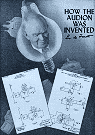 A few days ago I mentioned that a popular
early form of radio detector circuit involved the used of a flame - yes, the flame
of a fire, not a romantic significant other. The subject arose in a couple articles
in the January 1947 issue of Radio-Craft magazine that celebrated the 40th
anniversary of
Lee de Forest's Audion vacuum tube invention. This particular
piece was authored by de Forest himself, who was a personal friend of Radio-Craft
editor Hugo Gernsback. It is a very interesting autobiographical account of the
early days of experimentation and the evolution of what eventually became the world's
first mass producible signal amplifying device. You will also read that de Forest
created the designation...
A few days ago I mentioned that a popular
early form of radio detector circuit involved the used of a flame - yes, the flame
of a fire, not a romantic significant other. The subject arose in a couple articles
in the January 1947 issue of Radio-Craft magazine that celebrated the 40th
anniversary of
Lee de Forest's Audion vacuum tube invention. This particular
piece was authored by de Forest himself, who was a personal friend of Radio-Craft
editor Hugo Gernsback. It is a very interesting autobiographical account of the
early days of experimentation and the evolution of what eventually became the world's
first mass producible signal amplifying device. You will also read that de Forest
created the designation...
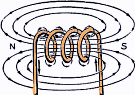 After previously presenting the permanent
magnet, chapter 12 of the NAVPERS series of courses takes a look at the
electromagnet. It is like a natural or artificial magnet in its
attraction but unlike in its control. Its attraction is tremendous-it can hold tons
of iron. But because this magnet is powered by an electric current, the magnetism
can be turned on and off with the flick of a switch. Electrically-powered magnets
are called electromagnets. Electromagnets come in all sizes and shapes - and do
all kinds of jobs. All electromagnets use a coil of wire and a core of iron to produce
their magnetism. The coil furnishes the magnetic flux and the iron concentrates
it. To understand how it...
After previously presenting the permanent
magnet, chapter 12 of the NAVPERS series of courses takes a look at the
electromagnet. It is like a natural or artificial magnet in its
attraction but unlike in its control. Its attraction is tremendous-it can hold tons
of iron. But because this magnet is powered by an electric current, the magnetism
can be turned on and off with the flick of a switch. Electrically-powered magnets
are called electromagnets. Electromagnets come in all sizes and shapes - and do
all kinds of jobs. All electromagnets use a coil of wire and a core of iron to produce
their magnetism. The coil furnishes the magnetic flux and the iron concentrates
it. To understand how it...
 Despite all the prefabricated, relatively
inexpensive products available these days, there are still many people who like
to build their own projects. Whether electrical or mechanical - or both - some sort
of
enclosure is usually involved. Often, you can cannibalize an existing,
retired project to use its chassis or find a product at Walmart or a home improvement
store that does not cost too much that you can buy just to get its enclosure. Buying
a pre-formed chassis for your project can get expensive, so there are times when
the best option is to obtain a piece of sheet metal (which can also be expensive)
and bend it yourself. If you have never attempted such an endeavor, believe me it
can be...
Despite all the prefabricated, relatively
inexpensive products available these days, there are still many people who like
to build their own projects. Whether electrical or mechanical - or both - some sort
of
enclosure is usually involved. Often, you can cannibalize an existing,
retired project to use its chassis or find a product at Walmart or a home improvement
store that does not cost too much that you can buy just to get its enclosure. Buying
a pre-formed chassis for your project can get expensive, so there are times when
the best option is to obtain a piece of sheet metal (which can also be expensive)
and bend it yourself. If you have never attempted such an endeavor, believe me it
can be...
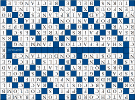 As with my hundreds of previous
science and engineering-themed crossword puzzles, this one for
March 1, 2020, contains only clues and terms associated with engineering, science,
physical, astronomy, mathematics, chemistry, etc., which I have built up over nearly
two decades. Many new words and company names have been added that had not even
been created when I started in the year 2002. You will never find a word taxing
your knowledge of a numbnut soap opera star or the name of some obscure village
in the Andes mountains. You might, however, encounter the name of a movie star like
Hedy Lamarr or a geographical location like Tunguska, Russia, for...
As with my hundreds of previous
science and engineering-themed crossword puzzles, this one for
March 1, 2020, contains only clues and terms associated with engineering, science,
physical, astronomy, mathematics, chemistry, etc., which I have built up over nearly
two decades. Many new words and company names have been added that had not even
been created when I started in the year 2002. You will never find a word taxing
your knowledge of a numbnut soap opera star or the name of some obscure village
in the Andes mountains. You might, however, encounter the name of a movie star like
Hedy Lamarr or a geographical location like Tunguska, Russia, for...
 While
FM broadcasting (frequency modulation) began in the United States
in the late 1930s, it was not until after World War II and even the Korean
War, in the 1950s, that the major shift to FM took place. It took even longer for
FM to get a foothold in Europe mainly due to the emphasis on rebuilding essential
infrastructure and manufacturing destroyed by the war. As this article points out,
the newer FM radio features allowed it to thwart some of the propaganda efforts
of the Soviets in East Germany who would be stuck in technologies that lag two or
more decades behind the free world even to this day (ain't Communism / Socialism
great?). The "medium-wave band" referenced...
While
FM broadcasting (frequency modulation) began in the United States
in the late 1930s, it was not until after World War II and even the Korean
War, in the 1950s, that the major shift to FM took place. It took even longer for
FM to get a foothold in Europe mainly due to the emphasis on rebuilding essential
infrastructure and manufacturing destroyed by the war. As this article points out,
the newer FM radio features allowed it to thwart some of the propaganda efforts
of the Soviets in East Germany who would be stuck in technologies that lag two or
more decades behind the free world even to this day (ain't Communism / Socialism
great?). The "medium-wave band" referenced...
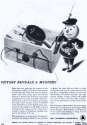 Development of the
cavity magnetron during World War II helped change the destiny
of Allied forces through using high frequency radar with enough power to detect
distant targets while using frequencies which were out of the normal detection bands
of Axis forces' receivers. Most equipment at the time could not operate efficiently
(or at all) above a few hundred MHz. It was considered a top-level secret with great
concern that the technology not fall into the hands of German and Japanese scientists.
According to this early post-war advertisement in a 1945 issue of Radio News,
Bell Labs was totally consumed by the development of magnetrons, and was relieved
to finally be able to boast of its...
Development of the
cavity magnetron during World War II helped change the destiny
of Allied forces through using high frequency radar with enough power to detect
distant targets while using frequencies which were out of the normal detection bands
of Axis forces' receivers. Most equipment at the time could not operate efficiently
(or at all) above a few hundred MHz. It was considered a top-level secret with great
concern that the technology not fall into the hands of German and Japanese scientists.
According to this early post-war advertisement in a 1945 issue of Radio News,
Bell Labs was totally consumed by the development of magnetrons, and was relieved
to finally be able to boast of its...