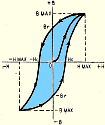
 This first installment in a multi-part series
on magnetism appeared in the October 1947 issue of Radio-Craft magazine.
At the time, there was great interest in
magnetic tape and even magnetic wire recorders. Lots of articles were published
on the electronics and mechanics of recorders, but relatively few discussed the
physics of magnetics. Although the title says it is about permanent magnetic theory,
there is also a lot of information on electromagnets. Terms such as reluctivity,
magnetomotive force, magnetic flux, conductivity of electrical and magnetic circuits,
conductance, B-H curves, maxwells, oersteds, and gilberts are introduced, along
with some simple equations...
This first installment in a multi-part series
on magnetism appeared in the October 1947 issue of Radio-Craft magazine.
At the time, there was great interest in
magnetic tape and even magnetic wire recorders. Lots of articles were published
on the electronics and mechanics of recorders, but relatively few discussed the
physics of magnetics. Although the title says it is about permanent magnetic theory,
there is also a lot of information on electromagnets. Terms such as reluctivity,
magnetomotive force, magnetic flux, conductivity of electrical and magnetic circuits,
conductance, B-H curves, maxwells, oersteds, and gilberts are introduced, along
with some simple equations...
 Proficiency in Morse code is no longer required
as part of obtaining an Amateur Radio license. A proposal to drop the 5 wpm requirement
was first floated by the FCC in 2005. It was actually at the request of the ARRL;
to wit, "In 2004, the League called on the FCC to create a new entry-level license,
reduce the number of actual license classes to three and drop the Morse code testing
requirement for all classes except for Amateur Extra." ARLB018 FCC Proposes Dropping
Morse Code Requirement Entirely Now, there is no code requirement for any license
class, not even the Amateur Extra. A lot of Hams are not happy about it, but times
have changed and the need for code...
Proficiency in Morse code is no longer required
as part of obtaining an Amateur Radio license. A proposal to drop the 5 wpm requirement
was first floated by the FCC in 2005. It was actually at the request of the ARRL;
to wit, "In 2004, the League called on the FCC to create a new entry-level license,
reduce the number of actual license classes to three and drop the Morse code testing
requirement for all classes except for Amateur Extra." ARLB018 FCC Proposes Dropping
Morse Code Requirement Entirely Now, there is no code requirement for any license
class, not even the Amateur Extra. A lot of Hams are not happy about it, but times
have changed and the need for code...
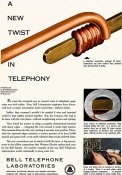 After getting out of the U.S. Air Force
in 1982, I was fortunate to get a job at the Oceanic Division of Westinghouse Electric
Corporation in Annapolis, Maryland. Most of the guys who worked in the area with
me were former electronics technicians from the armed forces. We spent most of our
days (and often evenings) building small quantity specialty systems for the U.S. Navy.
The facility was fairly small and was not set up for high volume production; that
was the purview of the much larger operation based adjacent to the Baltimore / Washington
International Airport (BWI), which built ground-based and airborne radar systems.
Whilst there, I did a lot of
wire-wrap assemblies that went...
After getting out of the U.S. Air Force
in 1982, I was fortunate to get a job at the Oceanic Division of Westinghouse Electric
Corporation in Annapolis, Maryland. Most of the guys who worked in the area with
me were former electronics technicians from the armed forces. We spent most of our
days (and often evenings) building small quantity specialty systems for the U.S. Navy.
The facility was fairly small and was not set up for high volume production; that
was the purview of the much larger operation based adjacent to the Baltimore / Washington
International Airport (BWI), which built ground-based and airborne radar systems.
Whilst there, I did a lot of
wire-wrap assemblies that went...
 The
unijunction transistor (UJT), invented in 1953, was originally known as a "double-base
diode" and explains why to this day the terminals are labeled "E," "B1,' and B2."
It is commonly modeled as a diode connected between two resistors, with one resistor
being variable. As the name implies, unlike a bipolar junction transistor (BJT)
that is more familiar to most people and has two semiconductor junctions connected
to the base, a UJT has just one junction. As is explained in detail in this 1970
Popular Electronics article, the net effect of the UJT's arrangement is a region
of negative resistance which makes it good for use as an oscillator. In fact, the
relaxation oscillator...
The
unijunction transistor (UJT), invented in 1953, was originally known as a "double-base
diode" and explains why to this day the terminals are labeled "E," "B1,' and B2."
It is commonly modeled as a diode connected between two resistors, with one resistor
being variable. As the name implies, unlike a bipolar junction transistor (BJT)
that is more familiar to most people and has two semiconductor junctions connected
to the base, a UJT has just one junction. As is explained in detail in this 1970
Popular Electronics article, the net effect of the UJT's arrangement is a region
of negative resistance which makes it good for use as an oscillator. In fact, the
relaxation oscillator...
 A month before Bell Laboratories' announcement
of the transistor invention by Mssrs. Bardeen, Shockley and Brattain, Radio-Craft
magazine editor Hugo Gernsback published a piece extolling the virtues of a newly
developed
microtube, aka a "rice-grain" tube. As connected as Gernsback was in the electronics
industry, it is doubtful he knew of the impending game-changing invention. Commercialization
of the transistor took a few years to get to the point where the devices could be
manufactured cheaply and reliably enough to begin being integrated (pun intended)
into products, so vacuum tubes still reigned for another decade or more. While the
microtubes were designed into such...
A month before Bell Laboratories' announcement
of the transistor invention by Mssrs. Bardeen, Shockley and Brattain, Radio-Craft
magazine editor Hugo Gernsback published a piece extolling the virtues of a newly
developed
microtube, aka a "rice-grain" tube. As connected as Gernsback was in the electronics
industry, it is doubtful he knew of the impending game-changing invention. Commercialization
of the transistor took a few years to get to the point where the devices could be
manufactured cheaply and reliably enough to begin being integrated (pun intended)
into products, so vacuum tubes still reigned for another decade or more. While the
microtubes were designed into such...
 For the sake of all the avid cruciverbalists
amongst us, this
technical-term-themed
crossword puzzle contains only words and clues related to engineering, mathematics,
chemistry, physics, and other technical words. As always, this crossword contains
no names of politicians, mountain ranges, exotic foods or plants, movie stars, or
anything of the sort unless it/he/she is related to this puzzle's technology theme
(e.g., Hedy Lamarr or the Bikini Atoll)...
For the sake of all the avid cruciverbalists
amongst us, this
technical-term-themed
crossword puzzle contains only words and clues related to engineering, mathematics,
chemistry, physics, and other technical words. As always, this crossword contains
no names of politicians, mountain ranges, exotic foods or plants, movie stars, or
anything of the sort unless it/he/she is related to this puzzle's technology theme
(e.g., Hedy Lamarr or the Bikini Atoll)...
 Most people have heard of the incredibly
accurate
Norden bombsight (see video of the Norden bombsight) that was credited for revolutionizing
accuracy of heavy bombers like B-17s, B-24s, and B-29s. It was an electromechanical
device that took bombardier inputs of altitude, airspeed, heading, and wind speed
and direction, then calculated the impact point of the bomb. An accuracy of 75 feet
was claimed under ideal conditions - provided by a mechanical computing device.
By 1956 when this article was published (eleven years after WWII and three years
after Korea), the Norden had been replaced by radar-integrated bombing systems.
Additionally, ground-based radar measurement systems were in use to train aircrews
without the need to drop physical bombs. Instead, virtual bombs were launched and
computers in a Radar Bomb Scoring (RBS) unit...
Most people have heard of the incredibly
accurate
Norden bombsight (see video of the Norden bombsight) that was credited for revolutionizing
accuracy of heavy bombers like B-17s, B-24s, and B-29s. It was an electromechanical
device that took bombardier inputs of altitude, airspeed, heading, and wind speed
and direction, then calculated the impact point of the bomb. An accuracy of 75 feet
was claimed under ideal conditions - provided by a mechanical computing device.
By 1956 when this article was published (eleven years after WWII and three years
after Korea), the Norden had been replaced by radar-integrated bombing systems.
Additionally, ground-based radar measurement systems were in use to train aircrews
without the need to drop physical bombs. Instead, virtual bombs were launched and
computers in a Radar Bomb Scoring (RBS) unit...
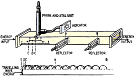 It has been many decades since I
have seen anything about a
Lecher Line, the last time in memory being in a college lab. It might have been
a physics lab, but most probably an EE lab. We used one to measure wavelengths of
signals from an RF generator. The apparatus looked sort of like the one in the Wikipedia
link, only just a little more modern (but not much more, being typical school equipment).
This new patents report from a 1947 issue of Radio-Craft magazine has a
waveguide version of a Lecher Line that supposedly was able to do more precise measurements
of very short wavelengths by providing for detecting the internal wave over multiple
wavelengths instead...
It has been many decades since I
have seen anything about a
Lecher Line, the last time in memory being in a college lab. It might have been
a physics lab, but most probably an EE lab. We used one to measure wavelengths of
signals from an RF generator. The apparatus looked sort of like the one in the Wikipedia
link, only just a little more modern (but not much more, being typical school equipment).
This new patents report from a 1947 issue of Radio-Craft magazine has a
waveguide version of a Lecher Line that supposedly was able to do more precise measurements
of very short wavelengths by providing for detecting the internal wave over multiple
wavelengths instead...
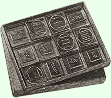 Even in this time of readily available computers
(including your smartphone) and printers, having a set of
rubber stamps for common electronics symbols would be pretty handy; there are
some Neanderthals among us who still use pencil and paper on occasion. Simpler symbols
like resistors and capacitors are easy enough to sketch by hand, but something like
a dual gate MOSFET with diode protection can take some time to produce legibly.
Common connector types like the DB signal/power series and some RF kinds (BNC, SMA,
etc.) would be useful, as would a set of oft-used logic gates for the digital designers.
The set shown here in a 1953 edition of Radio-Electronics...
Even in this time of readily available computers
(including your smartphone) and printers, having a set of
rubber stamps for common electronics symbols would be pretty handy; there are
some Neanderthals among us who still use pencil and paper on occasion. Simpler symbols
like resistors and capacitors are easy enough to sketch by hand, but something like
a dual gate MOSFET with diode protection can take some time to produce legibly.
Common connector types like the DB signal/power series and some RF kinds (BNC, SMA,
etc.) would be useful, as would a set of oft-used logic gates for the digital designers.
The set shown here in a 1953 edition of Radio-Electronics...
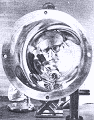 Albert Einstein published his paper on
Special Relativity in 1905 and on General Relativity in 1916. Since that time,
many experiments have been performed worldwide by scientists intent on both proving
and disproving Mr. Einstein. Laser and nuclear based timepieces have been improved
for precision and calculations refined to aid in the task. This 1959 Popular
Electronics magazine article reports on one of the first atomic clock experiments
used to test General Relativity. After more than 100 years, General Relativity stands
as originally presented. Even the rigors of quantum mechanics, which Einstein did
not embrace until much later in life, has not toppled its precepts...
Albert Einstein published his paper on
Special Relativity in 1905 and on General Relativity in 1916. Since that time,
many experiments have been performed worldwide by scientists intent on both proving
and disproving Mr. Einstein. Laser and nuclear based timepieces have been improved
for precision and calculations refined to aid in the task. This 1959 Popular
Electronics magazine article reports on one of the first atomic clock experiments
used to test General Relativity. After more than 100 years, General Relativity stands
as originally presented. Even the rigors of quantum mechanics, which Einstein did
not embrace until much later in life, has not toppled its precepts...
 Listen to the RF
Cafe Podcast! Hugo Gernsback, a name familiar to anyone who has been reading
some of the vintage electronics articles posted here on RF Cafe over the years,
was never short on ideas - both serious and fanciful. In 1947, when this editorial
appeared in his very popular Radio-Craft magazine, radio had become ubiquitous
in the commercial and consumer worlds, but he laments that the appliance had not
yet received its due compliment of
ancillary devices. Telephone, which had been around even longer that radio,
had a fair market of add-ons like a shoulder rest for the handset, an amplifier
for the hard-of-hearing, remote ringers, etc. There was not yet a selection...
Listen to the RF
Cafe Podcast! Hugo Gernsback, a name familiar to anyone who has been reading
some of the vintage electronics articles posted here on RF Cafe over the years,
was never short on ideas - both serious and fanciful. In 1947, when this editorial
appeared in his very popular Radio-Craft magazine, radio had become ubiquitous
in the commercial and consumer worlds, but he laments that the appliance had not
yet received its due compliment of
ancillary devices. Telephone, which had been around even longer that radio,
had a fair market of add-ons like a shoulder rest for the handset, an amplifier
for the hard-of-hearing, remote ringers, etc. There was not yet a selection...
 Listen to the RF
Cafe Podcast! "The Whistler and His Dog" is one of those tunes that you have
probably heard dozens of times but never knew the title of it (video at bottom of
page). It is mentioned in this installment of "Mac's
Radio Service Shop" from the November 1948 edition of Radio & Television
News magazine. Barney is said to have been whistling it while replacing an
output transformer on a receiver-recorder... a wire recorder that predated magnetic
tape types. The "20 Questions" theme is from the game where the player attempts
to guess the answer by asking a series of questions that narrows the possible results
until only the correct one is left - aka deductive reasoning...
Listen to the RF
Cafe Podcast! "The Whistler and His Dog" is one of those tunes that you have
probably heard dozens of times but never knew the title of it (video at bottom of
page). It is mentioned in this installment of "Mac's
Radio Service Shop" from the November 1948 edition of Radio & Television
News magazine. Barney is said to have been whistling it while replacing an
output transformer on a receiver-recorder... a wire recorder that predated magnetic
tape types. The "20 Questions" theme is from the game where the player attempts
to guess the answer by asking a series of questions that narrows the possible results
until only the correct one is left - aka deductive reasoning...
 November 1st's custom
Engineering Technology themed crossword puzzle contains only only words from
my custom-created lexicon related to engineering, science, mathematics, chemistry,
physics, astronomy, etc. (1,000s of them). You will never find among the words names
of politicians, mountain ranges, exotic foods or plants, movie stars, or anything
of the sort. You might, however, find someone or something in the otherwise excluded
list directly related to this puzzle's technology theme, such as Hedy Lamarr or
the Bikini Atoll, respectively. The technically inclined cruciverbalists amongst
us will appreciate the effort.
November 1st's custom
Engineering Technology themed crossword puzzle contains only only words from
my custom-created lexicon related to engineering, science, mathematics, chemistry,
physics, astronomy, etc. (1,000s of them). You will never find among the words names
of politicians, mountain ranges, exotic foods or plants, movie stars, or anything
of the sort. You might, however, find someone or something in the otherwise excluded
list directly related to this puzzle's technology theme, such as Hedy Lamarr or
the Bikini Atoll, respectively. The technically inclined cruciverbalists amongst
us will appreciate the effort.
 Listen to the
RF Cafe Podcast. At the time this Mac's Service Shop episode appeared in
a 1957 issue of Radio & TV News magazine, electronics technicians were
beginning to see a lot of
transistorized radios, televisions, record players, and tape recorders showing
up in place of the very familiar vacuum tube models. It was a whole new ballgame.
To complicate matters, biasing, interstage coupling, and tuning circuits were in
many ways different requiring re-learning what a "typical" circuit looked like,
and the introduction of printed circuit boards in place of point-to-point wiring
made changing components more difficult. Delaminating metal traces was easy to do
on early PCBs when using the big, high thermal inertia soldering irons required
for larger and more heat-tolerant components. Author John T. Frye used these
Mac's Service Shop stories...
Listen to the
RF Cafe Podcast. At the time this Mac's Service Shop episode appeared in
a 1957 issue of Radio & TV News magazine, electronics technicians were
beginning to see a lot of
transistorized radios, televisions, record players, and tape recorders showing
up in place of the very familiar vacuum tube models. It was a whole new ballgame.
To complicate matters, biasing, interstage coupling, and tuning circuits were in
many ways different requiring re-learning what a "typical" circuit looked like,
and the introduction of printed circuit boards in place of point-to-point wiring
made changing components more difficult. Delaminating metal traces was easy to do
on early PCBs when using the big, high thermal inertia soldering irons required
for larger and more heat-tolerant components. Author John T. Frye used these
Mac's Service Shop stories...
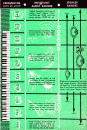 There are lots of audiophiles in the RF Cafe
audience who might appreciate this article on the characteristics of human hearing
and ways in which stereo hi-fi equipment attempts to reproduce realistic sound,
as if from a live performance. A handy-dandy chart is provided that shows the characteristics
of various audible frequency ranges, and the
kinds of speakers best suited for reproducing the sound. It was published in
a 1955 issue of Popular Electronics magazine when stereo hi-fi system building
was a major pastime, but still should be applicable today. If you do a search on
RF Cafe, you will find many articles covering stereo hi-fi equipment...
There are lots of audiophiles in the RF Cafe
audience who might appreciate this article on the characteristics of human hearing
and ways in which stereo hi-fi equipment attempts to reproduce realistic sound,
as if from a live performance. A handy-dandy chart is provided that shows the characteristics
of various audible frequency ranges, and the
kinds of speakers best suited for reproducing the sound. It was published in
a 1955 issue of Popular Electronics magazine when stereo hi-fi system building
was a major pastime, but still should be applicable today. If you do a search on
RF Cafe, you will find many articles covering stereo hi-fi equipment...