 Here
is a reprint of an article I had published in Wireless Design & Development
magazine in 1995. Some of the references are a bit dated, but the info is all still
very useful. Waypoint Software is now RF Cafe, and TxRx Designer is now Shareware
by the name of RF Workbench. With the advent of high speed personal computers, a
very insightful graphical method of determining inband mixer spurious products has
been largely forgotten. The
Spur Web™
(my name trademark, but used widely w/o attribution) chart rapidly identifies both
inband and out-of-band spurs, affording a pictorial view of where conversion system
frequencies lie with respect to all spur products. A comparison will...
Here
is a reprint of an article I had published in Wireless Design & Development
magazine in 1995. Some of the references are a bit dated, but the info is all still
very useful. Waypoint Software is now RF Cafe, and TxRx Designer is now Shareware
by the name of RF Workbench. With the advent of high speed personal computers, a
very insightful graphical method of determining inband mixer spurious products has
been largely forgotten. The
Spur Web™
(my name trademark, but used widely w/o attribution) chart rapidly identifies both
inband and out-of-band spurs, affording a pictorial view of where conversion system
frequencies lie with respect to all spur products. A comparison will...
 This March 15, 2020,
tech-themed crossword puzzle contains only clues and terms associated with engineering,
science, physical, astronomy, mathematics, chemistry, etc., which I have personally
built over nearly two decades. Many new words and company names have been added
that had not even been created when I started in the year 2002. You will never find
a word taxing your knowledge of a numbnut soap opera star or the name of some obscure
village in the Andes mountains. You might, however, encounter the name of a movie
star like Hedy Lamarr or a geographical location like Tunguska, Russia, for reasons
which, if you don't already know, might surprise you.
This March 15, 2020,
tech-themed crossword puzzle contains only clues and terms associated with engineering,
science, physical, astronomy, mathematics, chemistry, etc., which I have personally
built over nearly two decades. Many new words and company names have been added
that had not even been created when I started in the year 2002. You will never find
a word taxing your knowledge of a numbnut soap opera star or the name of some obscure
village in the Andes mountains. You might, however, encounter the name of a movie
star like Hedy Lamarr or a geographical location like Tunguska, Russia, for reasons
which, if you don't already know, might surprise you.
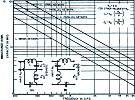 In this Radio & Television News
magazine article, author Jack Gallagher derives a formula for the number of turns
of wire to wind on a form of given dimensions for a parallel
constant-resistance network. He argues that although commonly used formulas
like that of Wheeler provide the number of turns needed to achieve a desired
value of inductance, it does not predict the size of cross-sectional shape of a
coil form that results in an optimal configuration. His work applies to audio
frequency divider networks like those used for speakers to steer specific
frequency ranges to a woofer, midrange, and tweeter trio; hence the need for
"constant resistance" (e.g., for standard 8 Ω or 16 Ω speakers)...
In this Radio & Television News
magazine article, author Jack Gallagher derives a formula for the number of turns
of wire to wind on a form of given dimensions for a parallel
constant-resistance network. He argues that although commonly used formulas
like that of Wheeler provide the number of turns needed to achieve a desired
value of inductance, it does not predict the size of cross-sectional shape of a
coil form that results in an optimal configuration. His work applies to audio
frequency divider networks like those used for speakers to steer specific
frequency ranges to a woofer, midrange, and tweeter trio; hence the need for
"constant resistance" (e.g., for standard 8 Ω or 16 Ω speakers)...
 In an effort to promote entry of women and
girls into the amateur radio hobby, Short Wave Craft magazine ran a few
contests for
Best "YL" Photos. Amazingly - and maybe there are still instances of it today
- many (if not most) of the YLs featured had built their own equipment. In 1935,
most people built their own equipment, so that is not too surprising. The winner
for this month was a 16-year-old young lady (i.e., "YL") who in fact built her rig.
Another winner was an 83-year-old grandma who was born before Marconi, Maxwell,
and Hertz did their best work! The third winner was a girl who earned her Ham license
at age 6, which back in the day required sending and receiving 5 words per minute
(WPM) in Morse code. BTW, according to the Bureau of Labor Statistics' (BLS) Inflation
Calculator says $5 in 1935 is the equivalent of $94.41 in 2020 money...
In an effort to promote entry of women and
girls into the amateur radio hobby, Short Wave Craft magazine ran a few
contests for
Best "YL" Photos. Amazingly - and maybe there are still instances of it today
- many (if not most) of the YLs featured had built their own equipment. In 1935,
most people built their own equipment, so that is not too surprising. The winner
for this month was a 16-year-old young lady (i.e., "YL") who in fact built her rig.
Another winner was an 83-year-old grandma who was born before Marconi, Maxwell,
and Hertz did their best work! The third winner was a girl who earned her Ham license
at age 6, which back in the day required sending and receiving 5 words per minute
(WPM) in Morse code. BTW, according to the Bureau of Labor Statistics' (BLS) Inflation
Calculator says $5 in 1935 is the equivalent of $94.41 in 2020 money...
 Multiple path transmission, diffraction around
obstacles, absorption by foliage, and reflection from moving objects have always
been challenges to the wireless system designer and/or user. Whether it concerns
communications between a WiFi router and a notebook computer, a cellphone and a
tower, an FM radio with a broadcast station, or deep space probe with an earth station,
all of the aforementioned mechanisms must be dealt with to some degree. Although
in a different way, even
transmissions within a waveguide or coaxial cable deal with those same issues
- reflections and the resulting standing waves have the same effect as multipath
in terms of vectorially additive versions of the same...
Multiple path transmission, diffraction around
obstacles, absorption by foliage, and reflection from moving objects have always
been challenges to the wireless system designer and/or user. Whether it concerns
communications between a WiFi router and a notebook computer, a cellphone and a
tower, an FM radio with a broadcast station, or deep space probe with an earth station,
all of the aforementioned mechanisms must be dealt with to some degree. Although
in a different way, even
transmissions within a waveguide or coaxial cable deal with those same issues
- reflections and the resulting standing waves have the same effect as multipath
in terms of vectorially additive versions of the same...
 Do you know how engineering whipping boy
Dilbert came to be called
by that name? Per Scott Adams, while working at Pacific Bell he ran an informal
name-the-comic-strip-engineer contest from his cubicle. A guy named Mike Goodwin
suggested Dilbert. "I ended the contest immediately and declared Mike the winner,"
says Adams. It sounded perfect. Years after the comic strip had become syndicated,
Mike commented that he believes the name idea might have come from seeing his father's
old WWII aviator comics with "Dilbert the Pilot." DtP was a screw-up, invented
by Navy artist Robert Osborn, whose purpose in life was to illustrate the wrong
way of doing things so that...
Do you know how engineering whipping boy
Dilbert came to be called
by that name? Per Scott Adams, while working at Pacific Bell he ran an informal
name-the-comic-strip-engineer contest from his cubicle. A guy named Mike Goodwin
suggested Dilbert. "I ended the contest immediately and declared Mike the winner,"
says Adams. It sounded perfect. Years after the comic strip had become syndicated,
Mike commented that he believes the name idea might have come from seeing his father's
old WWII aviator comics with "Dilbert the Pilot." DtP was a screw-up, invented
by Navy artist Robert Osborn, whose purpose in life was to illustrate the wrong
way of doing things so that...
 Those of us who have been around for six
or more decades have lived through two evolutions of video display types - raster
scanned
cathode ray tubes (CRTs) and digitally pixelated light-emitting diode (LED)
and liquid crystal (LCD) displays. Unlike with the latter display types that improved
in color depth, picture resolution and display size, the former had effectively
a fixed resolution of horizontal lines (525 vertical steps - only 484 visible, actually,
due to blanking). That meant for CRTs, designers needed to find ways to make images
appear in-focus while also looking continuous on larger screens. Doing so involved
cleverly adjusting the size and spacing of fluorescent...
Those of us who have been around for six
or more decades have lived through two evolutions of video display types - raster
scanned
cathode ray tubes (CRTs) and digitally pixelated light-emitting diode (LED)
and liquid crystal (LCD) displays. Unlike with the latter display types that improved
in color depth, picture resolution and display size, the former had effectively
a fixed resolution of horizontal lines (525 vertical steps - only 484 visible, actually,
due to blanking). That meant for CRTs, designers needed to find ways to make images
appear in-focus while also looking continuous on larger screens. Doing so involved
cleverly adjusting the size and spacing of fluorescent...
 Each year the Foundational Questions Institute
(FQXi) holds an essay contest inviting writers to submit missives addressing the
question chosen by the FQXi board as being particularly thought-provoking. In their
words, "FQXi catalyzes, supports, and disseminates research on questions at the
foundations of physics and cosmology, particularly new frontiers and innovative
ideas integral to a deep understanding of reality, but unlikely to be supported
by conventional funding sources." The 2011 question was "Is Reality Digital
or Analog?" Scientific American magazine, being one of three partners,
published the runner-up entry in the December 2012 issue: University of Cambridge
professor of theoretical physics professor David Tong's paper argues that the world
is in fact fundamentally analog. Professor Tong actually tied for second place,
but for some reason SciAm does not tell us whether the other second place paper
supported an analog or digital viewpoint...
Each year the Foundational Questions Institute
(FQXi) holds an essay contest inviting writers to submit missives addressing the
question chosen by the FQXi board as being particularly thought-provoking. In their
words, "FQXi catalyzes, supports, and disseminates research on questions at the
foundations of physics and cosmology, particularly new frontiers and innovative
ideas integral to a deep understanding of reality, but unlikely to be supported
by conventional funding sources." The 2011 question was "Is Reality Digital
or Analog?" Scientific American magazine, being one of three partners,
published the runner-up entry in the December 2012 issue: University of Cambridge
professor of theoretical physics professor David Tong's paper argues that the world
is in fact fundamentally analog. Professor Tong actually tied for second place,
but for some reason SciAm does not tell us whether the other second place paper
supported an analog or digital viewpoint...
 Other than vaguely recognizing the name,
do Millennials know who
Mickey Mantel was? Maybe hard-core Yankees fans of all ages still know. My having
been born in 1958, the kids in my neighborhood watched "The Mick" playing on TV,
witnessing real-time some of his final 536 career home runs being hit. When this
two-page Westinghouse advertisement appeared in a 1954 issue of Radio & Television
News magazine, he was only beginning in his forth season in Major League Baseball
(MLB), which ran through 1968. The promotion was for a contest where servicemen
who bought Westinghouse vacuum tubes submitted a witty response for the comic showing
a housewife asked...
Other than vaguely recognizing the name,
do Millennials know who
Mickey Mantel was? Maybe hard-core Yankees fans of all ages still know. My having
been born in 1958, the kids in my neighborhood watched "The Mick" playing on TV,
witnessing real-time some of his final 536 career home runs being hit. When this
two-page Westinghouse advertisement appeared in a 1954 issue of Radio & Television
News magazine, he was only beginning in his forth season in Major League Baseball
(MLB), which ran through 1968. The promotion was for a contest where servicemen
who bought Westinghouse vacuum tubes submitted a witty response for the comic showing
a housewife asked...
 The Klondike / Yukon Gold Rush is generally
credited with opening up the Alaskan territory to exploration and habitation. Gold
was first reported in August of 1896, just three decades prior to this advertisement
in a 1931 issue of QST magazine by the
De Forest Radio Company extolling its domination of the region with radio
communications stations. Company founder Lee De Forest was very successful
in exploiting the virtues of his famous Audion amplifier tube. A back-handed swipe
is taken at Government installations that used "whatever tubes the Government has..."
The Klondike / Yukon Gold Rush is generally
credited with opening up the Alaskan territory to exploration and habitation. Gold
was first reported in August of 1896, just three decades prior to this advertisement
in a 1931 issue of QST magazine by the
De Forest Radio Company extolling its domination of the region with radio
communications stations. Company founder Lee De Forest was very successful
in exploiting the virtues of his famous Audion amplifier tube. A back-handed swipe
is taken at Government installations that used "whatever tubes the Government has..."
 As with many relatively new technologies,
the
exuberance over radio peaked quickly once the benefits of communications over
long distances without the need for wires was realized by the public. After a couple
decades a lot of "authorities" began pontificating about how all the useful applications
of radio waves had been discovered and that any new innovation would be merely incremental
improvements in existing technology. Novel circuits for minimizing static over the
radio or maybe building more powerful transmitters for longer range were the only
concepts within reach of their limited imaginations. Similar phenomena occurred
for those who thought airplanes would always have two (or more) wings and that automobiles
would never be faster than a train. This 1935 issue of Short Wave Craft
magazine reported on the beginnings of investigations into the use of radio waves
for heating...
As with many relatively new technologies,
the
exuberance over radio peaked quickly once the benefits of communications over
long distances without the need for wires was realized by the public. After a couple
decades a lot of "authorities" began pontificating about how all the useful applications
of radio waves had been discovered and that any new innovation would be merely incremental
improvements in existing technology. Novel circuits for minimizing static over the
radio or maybe building more powerful transmitters for longer range were the only
concepts within reach of their limited imaginations. Similar phenomena occurred
for those who thought airplanes would always have two (or more) wings and that automobiles
would never be faster than a train. This 1935 issue of Short Wave Craft
magazine reported on the beginnings of investigations into the use of radio waves
for heating...
 "Ground
is ground the world around." That's a saying that I have often heard Ham radio
operators say aloud and in writing. In a general sense, it's true, but on a local
level grounds can vary widely from location to location, even within a few hundred
feet. It is true both for direct current and low frequencies and for frequencies
in to the GHz regions. It has to do with the conductivity of the soil and/or rock
in the area as well as the amount of moisture and other elements in the ground.
Antenna guys like to run conductive (usually copper) "radials" out from the mounting
pole or tower in order to create a sufficient local reference ground, and electric
power distribution engineers often need to salt the ground around substations with
ionic compounds in order to create sufficient conductivity to provide a safe grounding
system...
"Ground
is ground the world around." That's a saying that I have often heard Ham radio
operators say aloud and in writing. In a general sense, it's true, but on a local
level grounds can vary widely from location to location, even within a few hundred
feet. It is true both for direct current and low frequencies and for frequencies
in to the GHz regions. It has to do with the conductivity of the soil and/or rock
in the area as well as the amount of moisture and other elements in the ground.
Antenna guys like to run conductive (usually copper) "radials" out from the mounting
pole or tower in order to create a sufficient local reference ground, and electric
power distribution engineers often need to salt the ground around substations with
ionic compounds in order to create sufficient conductivity to provide a safe grounding
system...
 This March 22, 2020,
tech-themed crossword puzzle contains only clues and terms associated with engineering,
science, physical, astronomy, mathematics, chemistry, etc., which I have personally
built over nearly two decades. Many new words and company names have been added
that had not even been created when I started in the year 2002. You will never find
a word taxing your knowledge of a numbnut soap opera star or the name of some obscure
village in the Andes mountains. You might, however, encounter the name of a movie
star like Hedy Lamarr or a geographical location like Tunguska, Russia, for reasons
which, if you don't already know, might surprise you...
This March 22, 2020,
tech-themed crossword puzzle contains only clues and terms associated with engineering,
science, physical, astronomy, mathematics, chemistry, etc., which I have personally
built over nearly two decades. Many new words and company names have been added
that had not even been created when I started in the year 2002. You will never find
a word taxing your knowledge of a numbnut soap opera star or the name of some obscure
village in the Andes mountains. You might, however, encounter the name of a movie
star like Hedy Lamarr or a geographical location like Tunguska, Russia, for reasons
which, if you don't already know, might surprise you...
 Comics in modern magazines are a rather
rare phenomenon for some reason, but they were fairly regular features up until
a couple decades ago. This set of
comics from the July 1963 edition of Popular Electronics deals with
high fidelity (Hi-Fi) stereo equipment, which was considered somewhat exotic and
high-end for many people's budgets in the day. Inexplicably (not), that is about
the time that increases in hearing losses among younger people were first being
noticed in audiograms.
Comics in modern magazines are a rather
rare phenomenon for some reason, but they were fairly regular features up until
a couple decades ago. This set of
comics from the July 1963 edition of Popular Electronics deals with
high fidelity (Hi-Fi) stereo equipment, which was considered somewhat exotic and
high-end for many people's budgets in the day. Inexplicably (not), that is about
the time that increases in hearing losses among younger people were first being
noticed in audiograms.
 Since we seem to be on a roll of FM radio
theme articles printed in vintage electronics magazine, here is one from a 1973
issue of Popular Electronics. The author never explicitly tells us the date when
the Institute of High Fidelity (IHF) updated its
FM tuner specifications, and neither does he mention groundbreaking work of
IHF's Julian Hirsch, who is largely responsible for both the initial and updated
standards. If you read magazine stereo equipment reviews in the 1960s and 1970s,
then you probably recall the name. Anyway, this article discusses the improved specifications
made possible by more sophisticated circuits made possible by semiconductors and
miniaturized passive components. Interestingly, by 1973 magazines had gone from
abbreviating decibels from d.b. to dB, from k.c. and m.c. to kHz and MHz, from m.m.v.
to (μV), and from r.f. to RF, but they still used i.f. (intermediate frequency)
rather...
Since we seem to be on a roll of FM radio
theme articles printed in vintage electronics magazine, here is one from a 1973
issue of Popular Electronics. The author never explicitly tells us the date when
the Institute of High Fidelity (IHF) updated its
FM tuner specifications, and neither does he mention groundbreaking work of
IHF's Julian Hirsch, who is largely responsible for both the initial and updated
standards. If you read magazine stereo equipment reviews in the 1960s and 1970s,
then you probably recall the name. Anyway, this article discusses the improved specifications
made possible by more sophisticated circuits made possible by semiconductors and
miniaturized passive components. Interestingly, by 1973 magazines had gone from
abbreviating decibels from d.b. to dB, from k.c. and m.c. to kHz and MHz, from m.m.v.
to (μV), and from r.f. to RF, but they still used i.f. (intermediate frequency)
rather...