 This is a different type of
electronics-related quiz from Quizmaster Robert P. Balin. Mr. Balin
created many monthly quizzes for Popular Electronics magazine. Here you
are provided a series of images and a list of men's first names, and you need to
match the image to the name. There are nine in all. Sure, it's kind of hokey (especially
B and I), but it is a good end-of-the-work-day challenge challenge to help pass the time until
the weekend begins. Enjoy.
This is a different type of
electronics-related quiz from Quizmaster Robert P. Balin. Mr. Balin
created many monthly quizzes for Popular Electronics magazine. Here you
are provided a series of images and a list of men's first names, and you need to
match the image to the name. There are nine in all. Sure, it's kind of hokey (especially
B and I), but it is a good end-of-the-work-day challenge challenge to help pass the time until
the weekend begins. Enjoy.
 During World War II, the government
created a specification for military-grade cable and assigned the designation
RG-#/U, where "RG" stands for Radio Guide and the "U" stands for Utility. The
"dash number" was sequentially issued and has no bearing on the characteristics
of the cable. Founded in 1902 in St. Louis, Missouri, by Joseph Belden, the eponymously
named company has been and continues today designing and manufacturing coaxial cable.
Most of the RG-x/U coaxial cable types displayed in this 1951 Radio & Television
News magazine advertisement are still being used today, in particular the very familiar
RG-58/U (50 Ω), RG-59/U (75 Ω), RG-8/U (50 Ω), and RG-11/U (75 Ω)...
During World War II, the government
created a specification for military-grade cable and assigned the designation
RG-#/U, where "RG" stands for Radio Guide and the "U" stands for Utility. The
"dash number" was sequentially issued and has no bearing on the characteristics
of the cable. Founded in 1902 in St. Louis, Missouri, by Joseph Belden, the eponymously
named company has been and continues today designing and manufacturing coaxial cable.
Most of the RG-x/U coaxial cable types displayed in this 1951 Radio & Television
News magazine advertisement are still being used today, in particular the very familiar
RG-58/U (50 Ω), RG-59/U (75 Ω), RG-8/U (50 Ω), and RG-11/U (75 Ω)...
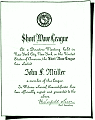 I tend to be a traditionalist for most things,
but do not go out of my way to make trouble for other people who don't appreciate
the way things are and have been... as long as, per Thomas Jefferson, "It neither
picks my pocket nor breaks my leg." In other words, if your actions cause me no
financial or physical harm, I'm not likely to oppose your actions - unless they're
illegal. Many older Hams are greatly offended at the FCC for having removed the
Morse code requirement in 2005 for obtaining an amateur radio operator's license.
They see it as a way to separate the wheat from the chaff, so to speak; that is
to say, to maintain a barrier that keeps non-serious aspirants from gaining entry
into the ranks of the elite group...
I tend to be a traditionalist for most things,
but do not go out of my way to make trouble for other people who don't appreciate
the way things are and have been... as long as, per Thomas Jefferson, "It neither
picks my pocket nor breaks my leg." In other words, if your actions cause me no
financial or physical harm, I'm not likely to oppose your actions - unless they're
illegal. Many older Hams are greatly offended at the FCC for having removed the
Morse code requirement in 2005 for obtaining an amateur radio operator's license.
They see it as a way to separate the wheat from the chaff, so to speak; that is
to say, to maintain a barrier that keeps non-serious aspirants from gaining entry
into the ranks of the elite group...
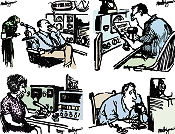 Found in what is the first issue of
Electronics Illustrated magazine that I have bought are these Amateur radio
related comics entitled, "Over
and Out." The cartoonist's signature is simply "Rodrigues," which according
to a Google search might be Charles Rodrigues (who also contributed to other tech
magazines as well as to National Lampoon). I have to admit to needing to
look up the "Yanqui aggressors" thing on the one comic, and then it made sense:
Yanqui= Yankee. The last comic with the parrot is pretty funny; it's sort of the
Ham radio equivalent to an auto-repeat telephone dialer like what you would use
to call into a radio show during a listener contest...
Found in what is the first issue of
Electronics Illustrated magazine that I have bought are these Amateur radio
related comics entitled, "Over
and Out." The cartoonist's signature is simply "Rodrigues," which according
to a Google search might be Charles Rodrigues (who also contributed to other tech
magazines as well as to National Lampoon). I have to admit to needing to
look up the "Yanqui aggressors" thing on the one comic, and then it made sense:
Yanqui= Yankee. The last comic with the parrot is pretty funny; it's sort of the
Ham radio equivalent to an auto-repeat telephone dialer like what you would use
to call into a radio show during a listener contest...
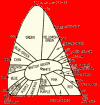 Like so many things in life that
we take for granted - aspirin, automatic clothes washers, drill motors and bits,
eyeglasses, rifles, bicycles, transistors, to name a few - we rarely think about
the effort that went behind the end product that is now enjoyed. Even relatively
simple devices like scissors are the result of someone saying to himself or herself,
"Self, I need something to make cutting fabric and paper and hair simpler and neater,
so what might that thing look like?" Then, after making a working prototype, improvements
are made based on empirical testing from usage, improvements are made in the form
factor, materials, size, etc., until evolution results in what can be purchased
today. If you have ever been in a product design cycle, either privately or corporately,
then you know the process well...
Like so many things in life that
we take for granted - aspirin, automatic clothes washers, drill motors and bits,
eyeglasses, rifles, bicycles, transistors, to name a few - we rarely think about
the effort that went behind the end product that is now enjoyed. Even relatively
simple devices like scissors are the result of someone saying to himself or herself,
"Self, I need something to make cutting fabric and paper and hair simpler and neater,
so what might that thing look like?" Then, after making a working prototype, improvements
are made based on empirical testing from usage, improvements are made in the form
factor, materials, size, etc., until evolution results in what can be purchased
today. If you have ever been in a product design cycle, either privately or corporately,
then you know the process well...
 Biographical historians spend endless hours
searching old media for bits of information on their subjects. Finding useful material
on more renowned personalities is not a problem, but filtering out relevant bits
for a particular theme can be daunting. On the other hand, finding useful information
on lesser known people can be frustrating because there is so little information
readily available. Great Britain's World War II era superstar
Winston Churchill undoubtedly falls into the former category. While scanning
through my many vintage electronics and science magazines for interesting fodder
to post on RF Cafe, I'm always on the lookout for cameo appearances like this one
of Prime Minister Churchill talking on a walkie-talkie (aka 'handie-talkie' at the
time) in this 1942 edition of Radio-Craft. It shows him participating in a parachuting
exercise at the U.S. Army's Fort Jackson training base, in South Carolina...
Biographical historians spend endless hours
searching old media for bits of information on their subjects. Finding useful material
on more renowned personalities is not a problem, but filtering out relevant bits
for a particular theme can be daunting. On the other hand, finding useful information
on lesser known people can be frustrating because there is so little information
readily available. Great Britain's World War II era superstar
Winston Churchill undoubtedly falls into the former category. While scanning
through my many vintage electronics and science magazines for interesting fodder
to post on RF Cafe, I'm always on the lookout for cameo appearances like this one
of Prime Minister Churchill talking on a walkie-talkie (aka 'handie-talkie' at the
time) in this 1942 edition of Radio-Craft. It shows him participating in a parachuting
exercise at the U.S. Army's Fort Jackson training base, in South Carolina...
 Bell Labs, having been responsible for creating
the first positive amplification point contact transistor just before Christmas
1947, continued to lead the way in semiconductor research and new product announcements
for many decades. This little tidbit was tucked away at the bottom of page 120 in
the May 1954 issue of Radio & Television News magazine. It reported on "the
purest substances in the world" being created there in the form of 99.99999999%
(aka 10N)
pure germanium crystals, which are used as seed for growing boules for device
production. That's one rogue impurity atom in ten billion germanium atoms. Modern
monocrystalline silicon boules are typically 7N or better...
Bell Labs, having been responsible for creating
the first positive amplification point contact transistor just before Christmas
1947, continued to lead the way in semiconductor research and new product announcements
for many decades. This little tidbit was tucked away at the bottom of page 120 in
the May 1954 issue of Radio & Television News magazine. It reported on "the
purest substances in the world" being created there in the form of 99.99999999%
(aka 10N)
pure germanium crystals, which are used as seed for growing boules for device
production. That's one rogue impurity atom in ten billion germanium atoms. Modern
monocrystalline silicon boules are typically 7N or better...
 Dr. Lee DeForest might have had something
like National Public Radio (est. 1970) in mind when he penned this article in 1933.
In it, the famous vacuum tube amplifier inventor lamented and criticized the commercialization
of broadcasts because of all the paid product announcements (aka commercials) that
had been steadily increasing over the years. He also was critical of the "hit-or-miss,
higgeldy-piggeldy mélange program basis" of programing; i.e., the same station playing
a mix of jazz, opera, swing, syndicated story-telling, etc. The good doctor did
not elaborate on where funding for such dedicated, uncorrupted broadcasts would
originate if not from paying advertisers, and I do not recall ever reading about
a DeForest Radio Network paid for by his vast fortune. I don't like commercials
any more than the next person, but a company deserves time to pitch its products
and/or services if it helps deliver a source of entertainment to you that...
Dr. Lee DeForest might have had something
like National Public Radio (est. 1970) in mind when he penned this article in 1933.
In it, the famous vacuum tube amplifier inventor lamented and criticized the commercialization
of broadcasts because of all the paid product announcements (aka commercials) that
had been steadily increasing over the years. He also was critical of the "hit-or-miss,
higgeldy-piggeldy mélange program basis" of programing; i.e., the same station playing
a mix of jazz, opera, swing, syndicated story-telling, etc. The good doctor did
not elaborate on where funding for such dedicated, uncorrupted broadcasts would
originate if not from paying advertisers, and I do not recall ever reading about
a DeForest Radio Network paid for by his vast fortune. I don't like commercials
any more than the next person, but a company deserves time to pitch its products
and/or services if it helps deliver a source of entertainment to you that...
 This news bit from a 1951 issue of Radio-Electronics
magazine reports on the FCC's declaration of illegality the practice by some FM
broadcasting stations of providing a means for
blanking out commercials and station identification to entities willing to pay
for the special receivers and pay for a subscription. Nobody I have ever known looks
forward to enduring commercials on television or radio (or Internet these days).
The only way most of us could listen to music without interruption was to by a record,
tape, or CD. VHS tapes and DVDs provide some relief from commercials, although even
though you pay for them there are typically promotions for other movies at the beginning.
Commercials on radio and television (and now the Internet) have consumed a larger
part of each hour of programming with each passing year. The DVD collections we
have of 1960s and 1970s Prime Time TV shows average run times of about 54-55 minutes...
This news bit from a 1951 issue of Radio-Electronics
magazine reports on the FCC's declaration of illegality the practice by some FM
broadcasting stations of providing a means for
blanking out commercials and station identification to entities willing to pay
for the special receivers and pay for a subscription. Nobody I have ever known looks
forward to enduring commercials on television or radio (or Internet these days).
The only way most of us could listen to music without interruption was to by a record,
tape, or CD. VHS tapes and DVDs provide some relief from commercials, although even
though you pay for them there are typically promotions for other movies at the beginning.
Commercials on radio and television (and now the Internet) have consumed a larger
part of each hour of programming with each passing year. The DVD collections we
have of 1960s and 1970s Prime Time TV shows average run times of about 54-55 minutes...
 Lemos International Technologies, founded
in 1996 when wireless technology developed for military and aerospace was beginning
to be transitioned into the commercial realm. As a technology adoption leader, Lemos
just published a white paper entitled
"Multi-Use Radio Service (MURS)" to promote the plug-and-play nature of transmitter
and receiver modules available at very low cost. Use of many type of these self-contained
modules enables wireless connectivity product development with the need for in-house
RF expertise and/or FCC emissions certification. Per the MURS Wikipedia article
: "In the United States, the Multi-Use Radio Service (MURS) is a licensed by rule
two-way radio service similar to Citizens Band (CB). Established by the U.S. Federal
Communications Commission in the fall of 2000, MURS created a radio service allowing
for licensed by rule (Part 95) operation in a narrow selection of the VHF band,
with a power limit of 2 watts. The FCC formally defines MURS as "a private, two-way,
short-distance voice or data...
Lemos International Technologies, founded
in 1996 when wireless technology developed for military and aerospace was beginning
to be transitioned into the commercial realm. As a technology adoption leader, Lemos
just published a white paper entitled
"Multi-Use Radio Service (MURS)" to promote the plug-and-play nature of transmitter
and receiver modules available at very low cost. Use of many type of these self-contained
modules enables wireless connectivity product development with the need for in-house
RF expertise and/or FCC emissions certification. Per the MURS Wikipedia article
: "In the United States, the Multi-Use Radio Service (MURS) is a licensed by rule
two-way radio service similar to Citizens Band (CB). Established by the U.S. Federal
Communications Commission in the fall of 2000, MURS created a radio service allowing
for licensed by rule (Part 95) operation in a narrow selection of the VHF band,
with a power limit of 2 watts. The FCC formally defines MURS as "a private, two-way,
short-distance voice or data...
 We
read a lot about the
early
radar system that was in operation at Pearl Harbor in December 1941 when the
surprise attack by Japanese naval airplanes decimated the fleet with a 3-hour-long
raid beginning at around 8:00 on that sleepy Sunday morning. According to "The Untold
Pearl Harbor Radar Story," by C.P. West, the SCR-270B (Signal Corps radio #270,
rev B) radar system had a range of 250 miles at an altitude of 50,000 feet. Westinghouse
built the system in 1940 following a development contract issued by the Army Signal
Corps in 1936. Historical documents report of the three systems on the island, two
had been shut down and that with the remaining system, operators Joseph Lockard
and George Elliot detected a formation of aircraft about 137 miles out to sea. They
were told it was a squadron of B-17s and to not worry about it...
We
read a lot about the
early
radar system that was in operation at Pearl Harbor in December 1941 when the
surprise attack by Japanese naval airplanes decimated the fleet with a 3-hour-long
raid beginning at around 8:00 on that sleepy Sunday morning. According to "The Untold
Pearl Harbor Radar Story," by C.P. West, the SCR-270B (Signal Corps radio #270,
rev B) radar system had a range of 250 miles at an altitude of 50,000 feet. Westinghouse
built the system in 1940 following a development contract issued by the Army Signal
Corps in 1936. Historical documents report of the three systems on the island, two
had been shut down and that with the remaining system, operators Joseph Lockard
and George Elliot detected a formation of aircraft about 137 miles out to sea. They
were told it was a squadron of B-17s and to not worry about it...
 This is another example of a multi-part article
of which I happen to have discovered only one of installments - Part 9. As is often
the case, each article is pretty much stand-alone and does not require that you
have already seen the previous sections. In 1951, computers were still mostly analog;
digital circuits were just beginning to get serious research thanks to the recent
advent of solid state devices. Boolean algebra, truth tables, and combinational
logic were just beginning to be taught in engineering courses.
ENIAC (Electronic Numerical Integrator and Computer), first used in 1945 at
the end of World War II, was the world's first general purpose digital computer,
and its active elements were vacuum tubes - about 20,000 of them. As you might expect,
there was a lot of excitement in the electronics, scientific, and finance world
about digital computers that would be inexpensive enough that individual corporations...
This is another example of a multi-part article
of which I happen to have discovered only one of installments - Part 9. As is often
the case, each article is pretty much stand-alone and does not require that you
have already seen the previous sections. In 1951, computers were still mostly analog;
digital circuits were just beginning to get serious research thanks to the recent
advent of solid state devices. Boolean algebra, truth tables, and combinational
logic were just beginning to be taught in engineering courses.
ENIAC (Electronic Numerical Integrator and Computer), first used in 1945 at
the end of World War II, was the world's first general purpose digital computer,
and its active elements were vacuum tubes - about 20,000 of them. As you might expect,
there was a lot of excitement in the electronics, scientific, and finance world
about digital computers that would be inexpensive enough that individual corporations...
 Radio-Craft magazine solicited
inputs from its readers for a series of
"Radio WittiQuiz"
questions and answers related to radio and electronics, with a stipulation being
that there had to be some aspect of humor included. That meant that some of the
multiple choice answer options needed to be inane. For most of the questions, the
process of elimination is pretty easy, but a couple could cause some head scratching
- especially if you are not really sure of the answer. This group starts at number
28, so obviously preceding issues had questions 1 through 27. At some point I will
probably acquire them and post other Radio WittiQuizzes.
Radio-Craft magazine solicited
inputs from its readers for a series of
"Radio WittiQuiz"
questions and answers related to radio and electronics, with a stipulation being
that there had to be some aspect of humor included. That meant that some of the
multiple choice answer options needed to be inane. For most of the questions, the
process of elimination is pretty easy, but a couple could cause some head scratching
- especially if you are not really sure of the answer. This group starts at number
28, so obviously preceding issues had questions 1 through 27. At some point I will
probably acquire them and post other Radio WittiQuizzes.
 For more than a decade, I have been posting
these
Radio Service Data Sheets for radios and various other audio and visual electronics
sets that appeared in vintage electronics magazines. This one for the Atwater Kent
Model 649 all-wave, 9 metal tube, superheterodyne console radio set was published
in the November 1935 issue of Radio Craft. "All-Wave" radios were popular
at the time because they provided access to shortwave bands so listeners could tune
in foreign broadband stations - often with the rudimentary built-in antenna. Short
Wave Listening was actually a worldwide sport that had its own cadre of enthusiastic
participants, including a dedicated magazine entitled Short Wave Listener.
Although not as popular today, there are still a few adherents remaining today.
For more than a decade, I have been posting
these
Radio Service Data Sheets for radios and various other audio and visual electronics
sets that appeared in vintage electronics magazines. This one for the Atwater Kent
Model 649 all-wave, 9 metal tube, superheterodyne console radio set was published
in the November 1935 issue of Radio Craft. "All-Wave" radios were popular
at the time because they provided access to shortwave bands so listeners could tune
in foreign broadband stations - often with the rudimentary built-in antenna. Short
Wave Listening was actually a worldwide sport that had its own cadre of enthusiastic
participants, including a dedicated magazine entitled Short Wave Listener.
Although not as popular today, there are still a few adherents remaining today.
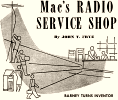 It has been a long time since I heard this
saying: "Well, they always say that if you want to find out the best and easiest
way of doing something, just put a lazy man at the job." Mac McGregor offered that
line to his service shop technician Barney - in jest of course - when Barney explains
his million dollar invention idea for a
fool-proof vacuum tube tester that can be used by just about anyone. Mac's Radio
Service Shop creator John Frye often used the monthly techno-drama to introduce
some good ideas for new inventions and/or new methods for troubleshooting problems.
Somewhere along the line I think I have seen an advertisement for a tube tester
that used the automation concept dreamed up by Barney...
It has been a long time since I heard this
saying: "Well, they always say that if you want to find out the best and easiest
way of doing something, just put a lazy man at the job." Mac McGregor offered that
line to his service shop technician Barney - in jest of course - when Barney explains
his million dollar invention idea for a
fool-proof vacuum tube tester that can be used by just about anyone. Mac's Radio
Service Shop creator John Frye often used the monthly techno-drama to introduce
some good ideas for new inventions and/or new methods for troubleshooting problems.
Somewhere along the line I think I have seen an advertisement for a tube tester
that used the automation concept dreamed up by Barney...