•−• ••−•  −•−• •− ••−• •
RF Cafe in Morse Code: ►Hear It
Search Site Map
RF Cafe Job Board
Engineering Forums
Component Directory
E-Mail RF Cafe
 Engineering Resources  Application Notes | Articles | Books | Calculators|
Calendar | Consulting| Design Data | Education | Engineering Sites | IC
Design | Magazines | Organizations | Papers | Patents | Tech Resources
Tech Services | Software | Sound-Off | Test Notes | White Papers
 Equations - Tables  Chemistry | Electronics | Mathematics | Mechanics | Physics | RF - Microwave
 Industry Standards  Bluetooth | Comm Stds | EMC - ESD - RFI | GPS | GSM | RoHS/WEEE | RFID |
WCDMA | WLAN | WiMAX | ZigBee
 Special Interest  5CCG | Amateur Radio | Astronomy | Crosswords | Humor | Quizzes | Mistakes |
Museums | Nobel Prize | Quotations | Slide Rules | Weather
 RF Cafe  About | Advertise on RF Cafe | Excel Smith Chart | Forums | Monthly Contests|
 Software | T-Shirts & Mugs             - Please add a link to RF Cafe from your website, blog, etc. -
There are more than 3,400 unique pages on RF Cafe for you to explore (see Site Map). Thanks for stopping by!     ©1999-2010

Partial Fractions

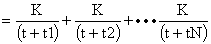
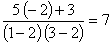
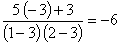
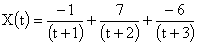
Partial fraction decomposition is used to convert a fraction with multiple factors in the denominator into a sum of terms, with one term for each factor and a constant in the numerator. Doing so simplifies integration and differentiation.


Example:


Note: If poles of X (t) are of multiple order, then include a term for each order; i.e., if (t-1)2 is in the denominator (a pole), then include both (t-1) and (t-2)2 terms.


Webmaster: Kirt Blattenberger, BSEE, UVM 1989