•−• ••−•  −•−• •− ••−• •
RF Cafe in Morse Code: ►Hear It
Search Site Map
RF Cafe Job Board
Engineering Forums
Component Directory
E-Mail RF Cafe
 Engineering Resources  Application Notes | Articles | Books | Calculators|
Calendar | Consulting| Design Data | Education | Engineering Sites | IC
Design | Magazines | Organizations | Papers | Patents | Tech Resources
Tech Services | Software | Sound-Off | Test Notes | White Papers
 Equations - Tables  Chemistry | Electronics | Mathematics | Mechanics | Physics | RF - Microwave
 Industry Standards  Bluetooth | Comm Stds | EMC - ESD - RFI | GPS | GSM | RoHS/WEEE | RFID |
WCDMA | WLAN | WiMAX | ZigBee
 Special Interest  5CCG | Amateur Radio | Astronomy | Crosswords | Humor | Quizzes | Mistakes |
Museums | Nobel Prize | Quotations | Slide Rules | Weather
 RF Cafe  About | Advertise on RF Cafe | Excel Smith Chart | Forums | Monthly Contests|
 Software | T-Shirts & Mugs             - Please add a link to RF Cafe from your website, blog, etc. -
There are more than 3,400 unique pages on RF Cafe for you to explore (see Site Map). Thanks for stopping by!     ©1999-2010

LaPlace Transform Properties

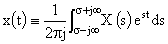
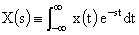
In mathematics, the Laplace transform is one of the best known and most widely used integral transforms. It is commonly used to produce an easily solvable algebraic equation from an ordinary differential equation. It has many important applications in mathematics, physics, optics, electrical engineering, control engineering, signal processing, and probability theory.

In mathematics [and engineering], it is used for solving differential and integral equations. In physics and engineering, it is used for analysis of linear time-invariant systems such as electrical circuits, harmonic oscillators, optical devices, and mechanical systems. In this analysis, the Laplace transform is often interpreted as a transformation from the time-domain, in which inputs and outputs are functions of time, to the frequency-domain, where the same inputs and outputs are functions of complex angular frequency, in radians per unit time. Given a simple mathematical or functional description of an input or output to a system, the Laplace transform provides an alternative functional description that often simplifies the process of analyzing the behavior of the system, or in synthesizing a new system based on a set of specifications. - Wikipedia

See also  LaPlace Transform Pairs

RF Cafe: LaPlace Transform Properties RF Cafe: LaPlace Transform Properties
Signal LaPlace Transform
RF Cafe: LaPlace Transform Properties RF Cafe: LaPlace Transform Properties
RF Cafe: LaPlace Transform Properties (convolution)RF Cafe: LaPlace Transform Properties
RF Cafe: LaPlace Transform Properties RF Cafe: LaPlace Transform Properties


Webmaster: Kirt Blattenberger, BSEE, UVM 1989