Custom Search
Over 9,000 pages indexed!
Your Host
Click here to read about RF CafeKirt
Blattenberger

... single-handedly
redefining what an
engineering website should be.

View the YouTube RF Cafe Intro Video Carpe Diem!
(Seize the Day!)

5CCG (5th MOB):
My USAF radar shop

Hobby & Fun

Airplanes and Rockets:
My personal hobby website

Equine Kingdom:
My daughter Sally's horse riding business website - lots of info

Doggy Dynasty:
My son-in-law's dog training business

•−•  ••−•    −•−•  •−  ••−•  •
RF Cafe Morse Code >Hear It<
Job Board
About RF Cafe©
RF Cafe E-Mail
Product & Service
Directory
Engineering
Jobs
Personally Selected
Manufacturers
Employers Only
(no recruiters)

Differentiation Rules

In calculus, a branch of mathematics, the derivative is a measure of how a function changes as its input changes. Loosely speaking, a derivative can be thought of as how much a quantity is changing at a given point. For example, the derivative of the position (or distance) of a vehicle with respect to time is the instantaneous velocity (respectively, instantaneous speed) at which the vehicle is travelling. Conversely, the integral of the velocity over time is the vehicle's position.

The derivative of a function at a chosen input value describes the best linear approximation of the function near that input value. For a real-valued function of a single real variable, the derivative at a point equals the slope of the tangent line to the graph of the function at that point. In higher dimensions, the derivative of a function at a point is a linear transformation called the linearization. A closely related notion is the differential of a function.

The process of finding a derivative is called differentiation. The fundamental theorem of calculus states that differentiation is the reverse process to integration. - Wikipedia

Product Rule
If f (x) and g (x) are differentiable, then

[ f (x) g (x) ] ' = f (x) g ' (x) + g (x) f ' (x)


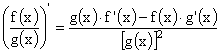
Quotient Rule

If f (x) and g (x) are differentiable and g (x) ¹ 0, then
Power Rule

If f (x) = xn, where n is a positive integer, then
f ' (x) = n xn-1
Chain Rule

If y = f (u) and u = g (x)
and both are differentiable, then


RF Cafe Software

RF Cascade Workbook
RF Cascade Workbook is a very extensive system cascaded component Excel workbook that includes the standard Gain, NF, IP2, IP3, Psat calculations, input & output VSWR, noise BW, min/max tolerance, DC power cauculations, graphing of all RF parameters, and has a graphical block diagram tool. An extensive User's Guide is also included. - Only $35.
RF system analysis including
frequency conversion & filters

Smith Chart™ for Excel
Smith Chart™ for Visio
RF & EE Symbols Word
RF Stencils for Visio

A Disruptive Web Presence

Custom Search
Over 9,000 pages indexed!
Read About RF Cafe
Webmaster: Kirt Blattenberger
KB3UON

Product & Service Directory
Personally Selected Manufacturers

RF Cafe T-Shirts & Mugs
Calculator Workbook
RF Workbench
Please Support My Advertisers