Happy 4th of July - Independence Day!  Please click here to visit RF Cafe.
•−• ••−•  −•−• •− ••−• •
RF Cafe in Morse Code: ►Hear It
SearchSite Map
RF Cafe Job Board
E-Mail RF Cafe
 Engineering Resources  Application Notes | Articles | Books | Calculators| Calendar | Consulting| Design Data | Education | Engineering Sites | IC Design | Magazines | Organizations | Papers | Patents | Tech Resources | Tech Services | Software | Sound-Off | Test Notes | White Papers
 Equations - Tables  Chemistry | Electronics | Mathematics | Mechanics | Physics | RF - Microwave
 Industry Standards  Bluetooth | Comm Stds | EMC - ESD - RFI | GPS | GSM | RoHS/WEEE | RFID | WCDMA | WLAN | WiMAX | ZigBee
 Special Interest  5CCG | Amateur Radio | Astronomy | Crosswords | Humor | Quizzes | Mistakes | Museums | Nobel Prize | Quotations | Slide Rules | Weather
 RF Cafe  About RFC | Excel Smith Chart | Forums | Monthly Contests| Software | T-Shirts & Mugs
       There are more than 3,100 unique pages on RF Cafe for you to explore (see Site Map). Thanks for stopping by!        ©2009

Spurious-Free Dynamic Range


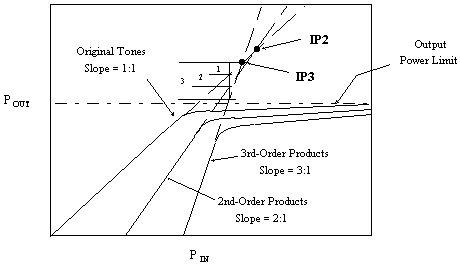
Spurious-free dynamic range (SFDR) is two-thirds the difference between the 2-tone, third-order intercept point (IP3) and the minimum discernible signal (MDS). Referring back to Figure 1, it can be seen that the 3rd-order product line has a 3:1 slope while the fundamental output line has a 1:1 slope. Therefore, the 3rd-order products are always three times as far from the IP3 as the fundamental output. If you use the SFDR as the power of the output tones (dBm) and plug it into the equation for IP3 calculation from the Intercept Points (IP3 & IP2) section of the RF Cafe web site, the power of the 3rd-order products will be right at the MDS power  level.


Spurious-Free Dynamic Range chart plot
Figure 1


Webmaster: Kirt Blattenberger, BSEE, UVM 1989