Properties of Modes in a Rectangular Waveguide |
||||||||||||||||||||||||||||||||||||||||||
|
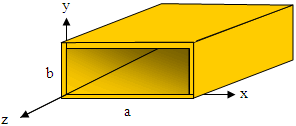
Rectangular waveguides, as opposed to circular and elliptical waveguides, are by far the dominant configuration
for the installed base of waveguides for compact systems like radar and inside equipment shelters. That is
probably due to the generally greater rigidity of rectangular structures because the wall thickness can be easily
made thicker than with circular. It is also easier to route and mount in close quarters, and attaching penetrating
objects like probes and switches is much simpler.
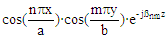
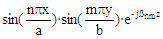
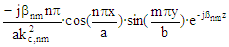
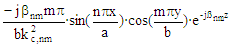
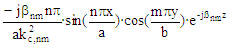
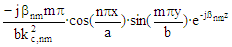
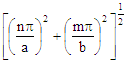
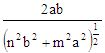
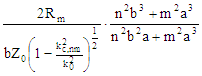
Note: I received the following note from Brian Sequeira, of the Johns Hopkins University Applied Physics Laboratory. "I reviewed tables on rectangular and circular waveguides, and based on my experience of what confuses first-time readers and what does not, I made adjustments to notation & symbols, corrected a couple of sign errors, and put expressions in a form that make their units more apparent." The table for rectangular waveguide can be viewed full-size by clicking on the thumbnail to the right. Brian also provided a table for circular waveguide.
The expression for α
is not valid for degenerate modes. Equations derived from "Foundations for Microwave Engineering, R.E. Collin,
McGraw-Hill
Related Pages on RF Cafe
|
||||||||||||||||||||||||||||||||||||||||||