Component Reliability for Electronic Systems |
|
Click here for the complete list of RF Cafe Quizzes. Note: Some material based on books have quoted passages.
Note: Some of these books are available as prizes in the monthly RF Cafe Giveaway.
1. What is the mathematical technique for determining how often different values of a given characteristic of a device are expected to occur? b) Probability distribution Formulas are members of two general categories - discrete distributions and continuous distributions. (see page 7)
shown to the right? a) Bathtub curve The shape is typical of a cross-section of a bathtub, hence the name. The first region is called "infant mortality" since it refers to early failures during or soon after being manufactured. It is usually a short period of time. The next region is called the "useful operating period," and refers to the period of time that the product functions normally without excessive failures. The third and final region is called the "wear-out period" (aka "end-of-life"), and is the era when the product is expected to begin experiencing a high rate of failure. (see page26) 3. What is the largest contributor to contamination during semiconductor manufacture? b) Equipment. The chart on page 83 shows the distribution 4. Which type of semiconductor type has the lowest tolerance to radiation fields? d) BJT. One news report postulated the possibility that the Toyota accelerator problem might have been caused by cosmic radiation causing a fault. According to the table shown on page 111, BJTs have the lowest tolerance at levels around 1012 to 1012 neurons/cm2. TTL is next at 1014 n/cm2, then CMOS at 1015 n/cm2, and finally isoplanar ECL at 1015 n/cm2, 5. What is/are the most common cause of product failure?
d) All the above. (see page 209) 6. Which of the three lifetime failure curve (see Q2) regions is where an electromigration failure is most likely to occur? a) Wear-out. Electromigration occurs because of the transport of material caused by the gradual movement of the ions in the metal lines, usually due to high current densities. (see page 542) 7. What process is used to apply an electrical stress to components prior to shipping? a) Burn-in. Burn-in puts the components in an operational environment (or one that simulates it) with specified voltages and current applied in order to condition the device for use and screen for instances of infant mortality. (see page 476) 8. Which type of test checks for susceptibility to moisture on a IC die's surface? c) Damp heat test
The damp heat test (aka humidity test) determines how moisture affects the operation and lifespan of an IC. Even hermetically sealed packages need to verified with this test. (see page 535) 9. What is a major advantage of the thick film hybrid process over a thin film process? d) Easy to cross conductor lines Both conductive and insulative pastes are available to permit line crossing. (see page 569)
10. What is a type of failure present in MEMS components not commonly found in standard ICs? b) Surface abrasion Because many MEMS components have surfaces in contact with each other (desired as with a micromotor or undesired due to structure bending), wear-out is commonly encountered. (see page 615) |


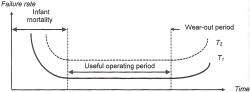 2.
What is the name given to the lifetime failure curve
2.
What is the name given to the lifetime failure curve