Oscillators |
|
Click here for the complete list of RF Cafe Quizzes. Note: Some material based on books have quoted passages. 1. Who from this list is usually credited with being the first to experiment with high frequency oscillator circuits?
a) Benjamin Franklin b) Nikola Tesla c) Edwin Armstrong d) Albert Einstein 2. In the four basic oscillator circuits shown below, what is the primary function of the transistor? a) Frequency control b) Amplitude control c) Compensation for tank circuit losses d) Isolation
a) Colpitts oscillator b) Clapp oscillator c) Hartley oscillator d) Pierce oscillator
a) Colpitts oscillator b) Clapp oscillator c) Hartley oscillator d) Pierce oscillator
a) Colpitts oscillator b) Clapp oscillator c) Hartley oscillator d) Pierce oscillator 6. Which type of oscillator circuit is shown to the right? a) Colpitts oscillator b) Clapp oscillator c) Hartley oscillator d) Pierce oscillator
7. Which factor is most important in maintaining spectral purity in an oscillator circuit? a) Overall circuit Q (quality factor) b) Component sizes c) Q of individual components d) Transistor gain
8. What does the term "frequency pulling" refer to? a) Change in frequency due to power supply variations b) Change in frequency due to load variations c) Change in frequency due to thermal variation d) All the above 9. In a phase-locked loop (PLL) oscillator circuit, what does the phase detector do?
a) Detects phase b) Compares relative phase between the reference input and oscillator output and introduces a shift as necessary to maintain phase coherence c) Injects random phase shifts at the input to stabilize the output frequency d) Phase detectors are not used in PLL circuits 10. Complete the following adage used in the days before computer simulators. "If you want an oscillator, design an amplifier. If you want an amplifier, design a(n) ____." a) Amplifier b) Filter c) Oscillator d) Radio
Need some help? Click here for the answers and explanations. |


 3.
Which type of oscillator circuit is shown to the right?
3.
Which type of oscillator circuit is shown to the right?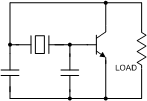 4.
Which type of oscillator circuit is shown to the right?
4.
Which type of oscillator circuit is shown to the right?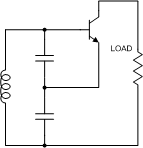 5.
Which type of oscillator circuit is shown to the right?
5.
Which type of oscillator circuit is shown to the right?